Artwork
Martyrdom of the Ten Thousand
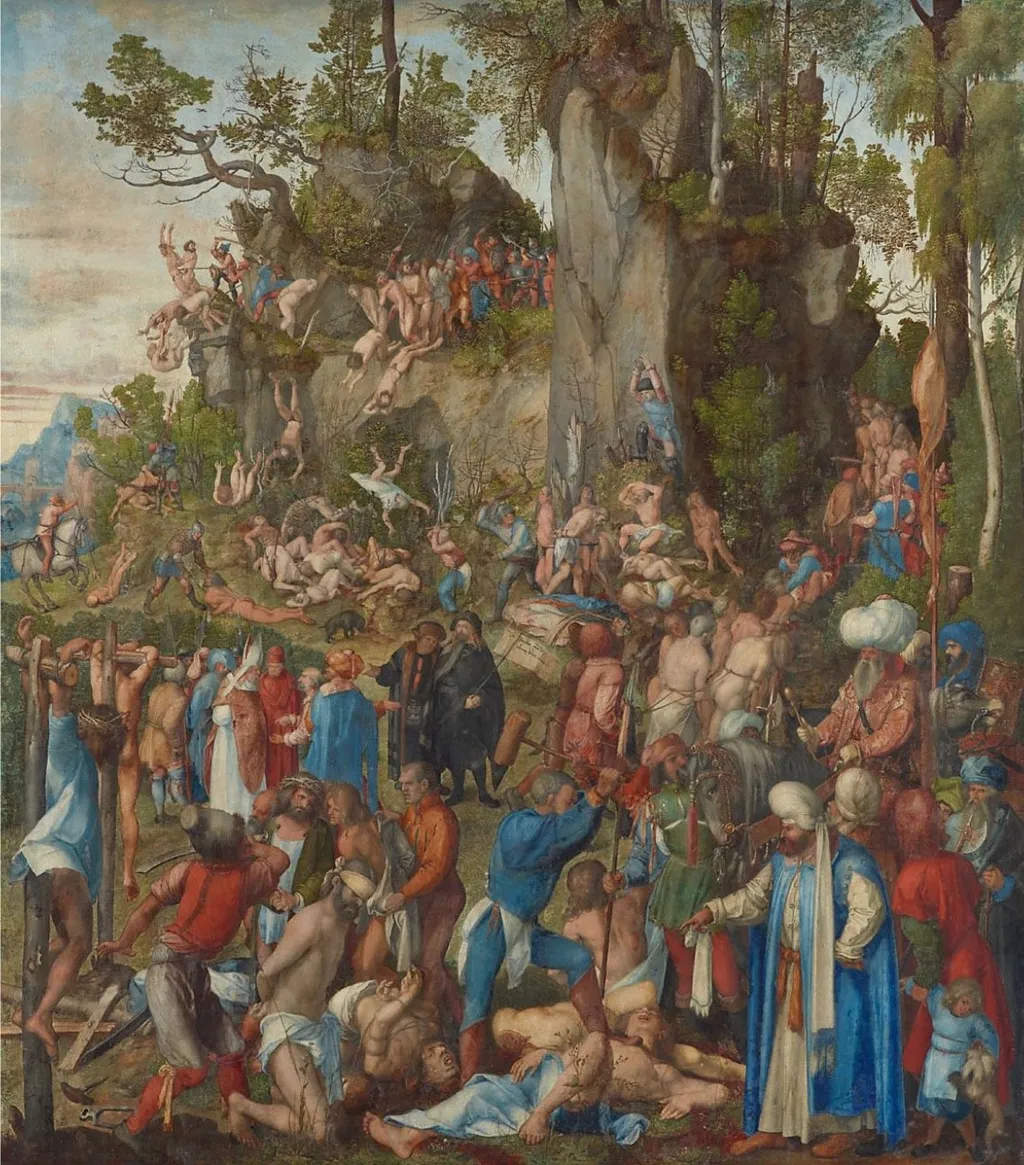
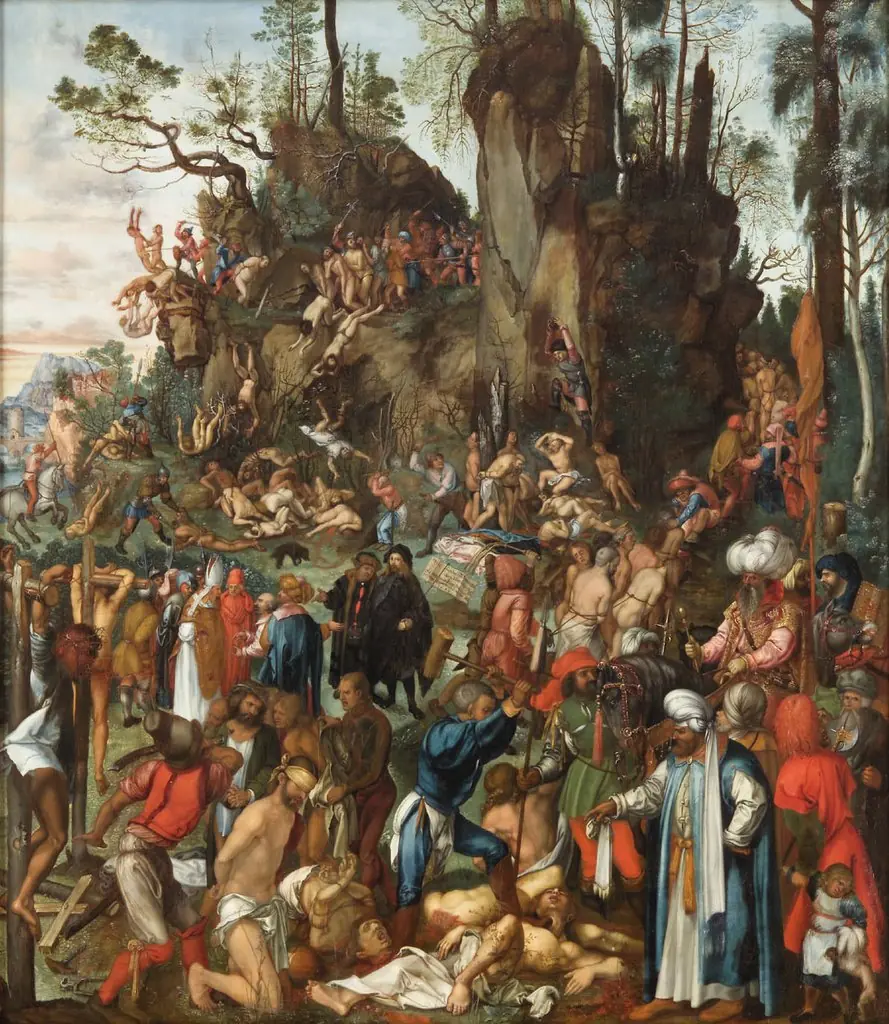
Martyrdom of the Ten Thousand is an oil painting by the Northern Renaissance artist Albrecht Dürer. It dates from 1508 and is held in the collection of the Kunsthistorisches Museum.
About this work
The painting is called Martyrdom of the Ten Thousand by Albrecht Dürer. It was made in 1508. The artist signed the painting on a cartouche, which is a decorative element, and included the year and his name in Latin.
This detail shows the artist's attention to his work. You can learn more about this type of art at the Kunsthistorisches Museum.
Subject & Meaning
Their placid demeanor contrasts sharply with the surrounding torture, framing the scene as a theological dialogue on faith and witness.
The painting illustrates the legendary martyrdom of ten thousand Christian soldiers on Mount Ararat, ordered by the Roman Emperor Hadrian (or alternatively Antoninus Pius or Diocletian) and executed by the Persian King Shapur. Dürer actualizes the historical narrative by portraying the Persian ruler and his executioners in contemporary Ottoman attire, complete with turbans and vibrant garments. The composition functions as a dense 'Wimmelbild,' depicting a chaotic array of violent acts including crucifixions, decapitations, stoning, and victims being cast from cliffs onto thorny bushes.
Amidst this macabre spectacle, two figures dressed in black stand calmly at the center: a self-portrait of Dürer holding a signed cartouche and the humanist Conrad Celtes. Their placid demeanor contrasts sharply with the surrounding torture, framing the scene as a theological dialogue on faith and witness. The inclusion of specific martyrdom methods, such as the chaining of a bishop rather than the eye-drilling shown in Dürer's earlier woodcut, reflects the commission's connection to Frederick the Wise's relic collection in Wittenberg.
Technique & Style
Executed in 1508, this work is an oil painting originally created on a wooden panel. Due to its poor condition by the nineteenth century, the artwork underwent a complex technical procedure to transfer the paint layer from the original wood support to canvas. The composition presents a crowded, intricate scene set within a rocky forest landscape featuring gnarled trees and dense vegetation, a stylistic choice somewhat unusual for the artist but reminiscent of the Danube School.
Dürer populates the canvas with numerous figures engaged in various acts of martyrdom, arranging them with a calibrated precision that lends the macabre subject matter the appearance of an elegant miniature or a choreographed ballet. The vibrant coloration and rich detail mitigate the horror of the depicted tortures, while the central figures, dressed in contemporary black, stand placidly amidst the chaos, creating a distinct separation between the observers and the violent narrative.
History & Provenance
The painting was commissioned by Frederick III, Elector of Saxony, Dürer's patron since 1496, for the newly built All Saints' Church (Castle Church) in Wittenberg, which housed Frederick's relic collection and served from 1502 as the university church of the Leucorea. Frederick personally selected the subject because his collection included relics of the Ten Thousand martyrs. Dürer received 280 florins for the work, a transaction repeatedly mentioned in his correspondence with Jakob Heller of Frankfurt.
The panel is signed and dated on a cartellino held by the artist's self-portrait: "Iste faciebat Ano Domini 1508 Albertus Dürer Aleman."
Later, due to deterioration of the original wooden support, the painting was transferred to canvas in the 19th century. The provenance lists successive owners as Frederick III of Saxony, Antoine Perrenot de Granvelle, and Emperor Rudolf II, before the work entered the Kunsthistorisches Museum in Vienna, where it remains today alongside a 1653 historical copy by Johann Christian Ruprecht. The work measures 99 by 87 centimeters.
Context
Scholarship has emphasized the painting's layered function within the cult of relics and humanist culture at Wittenberg. Anja Grebe interprets the dense composition as a visual compendium that evokes the church's relic collection dedicated to the Ten Thousand Martyrs, while Heike Schlie argues it served as a surrogate presence during Heiltumsweisungen, activating the relics' witness in ritual display.
The work's reception also hinges on Dürer's self-portrait paired with Conrad Celtes, whose identity as the second central figure is supported by Panofsky and Klauner. Their calm detachment amid carnage has been read as a humanist meditation on faith and art's capacity to frame historical violence, aligning with Maximilian I's patronage of a politically resonant German Renaissance.
Overview
Albrecht Dürer's "Martyrdom of the Ten Thousand" is an oil painting completed in 1508. This large-scale work depicts a significant religious narrative, showcasing the artist's detailed approach to complex compositions. The painting currently resides in the collection of the Kunsthistorisches Museum in Vienna, Austria, where it is a notable example of Northern Renaissance art.
Artist & collection
Artist
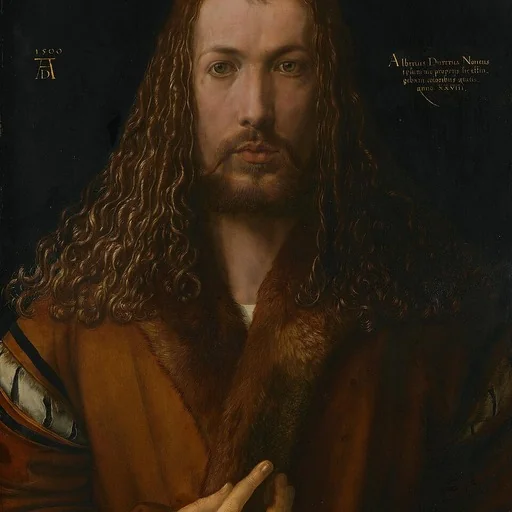
Albrecht Dürer spent his life in Nuremberg, a busy German city where artists traded prints like currency.

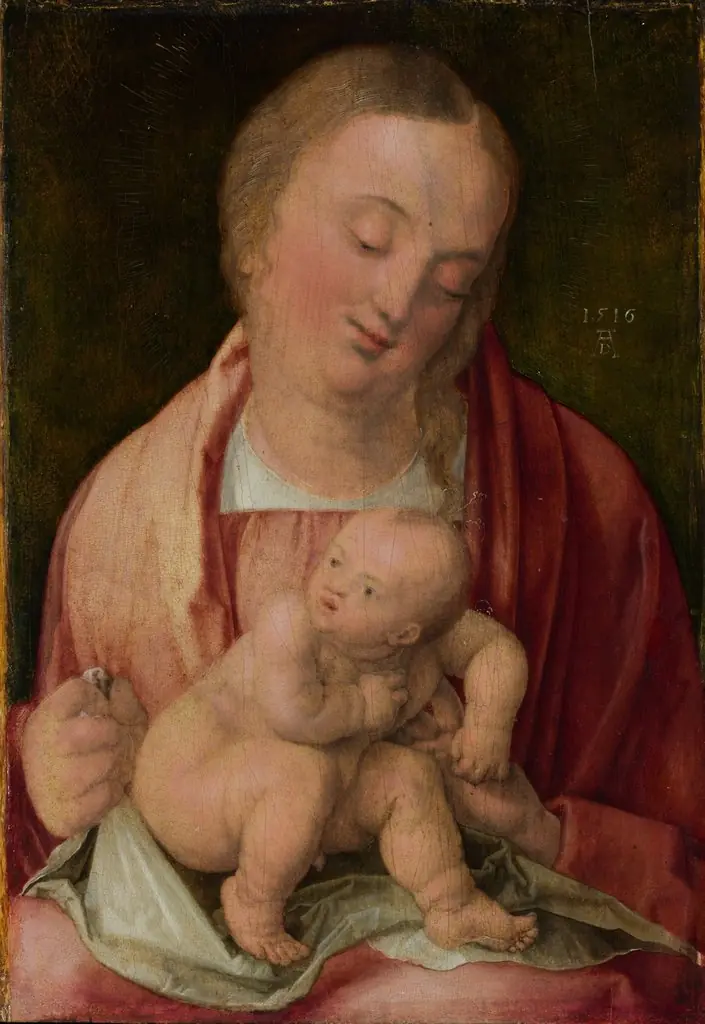
![Madonna and Child [obverse], by Albrecht Dürer](https://artifactworldgallery.com/img/albrecht-durer--madonna-and-child-obverse--d7b8ebf05d22ebe5-w320.webp)
![Lot and His Daughters [reverse], by Albrecht Dürer](https://artifactworldgallery.com/img/albrecht-durer--lot-and-his-daughters-reverse--b4ebf9b282faa17a-w320.webp)