Artwork
Tarquin and Lucretia
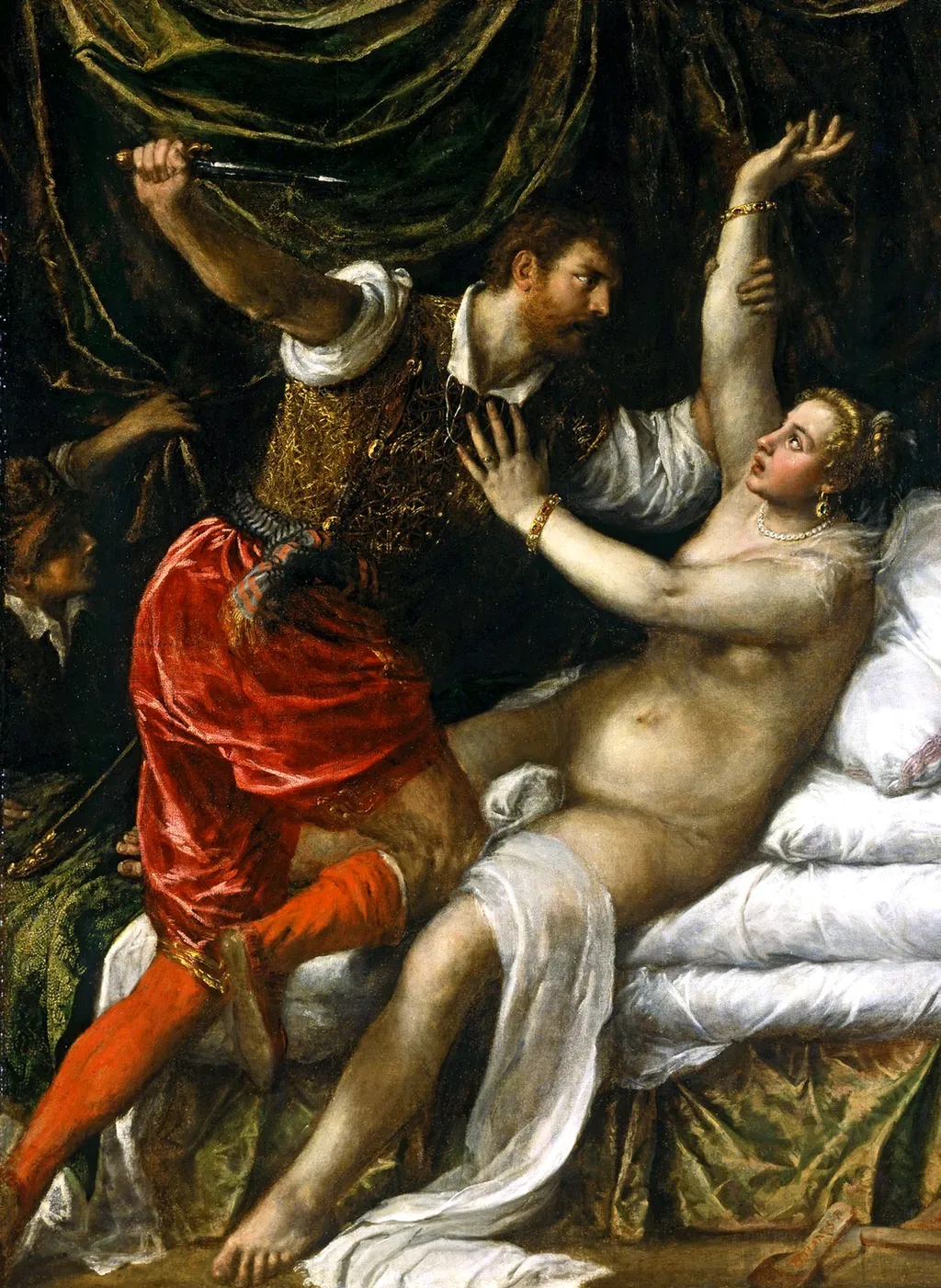
Tarquin and Lucretia is an oil painting by the Venetian School artist Titian. It dates from 1571 and is held in the collection of the Fitzwilliam Museum.
About this work
Technique & Style
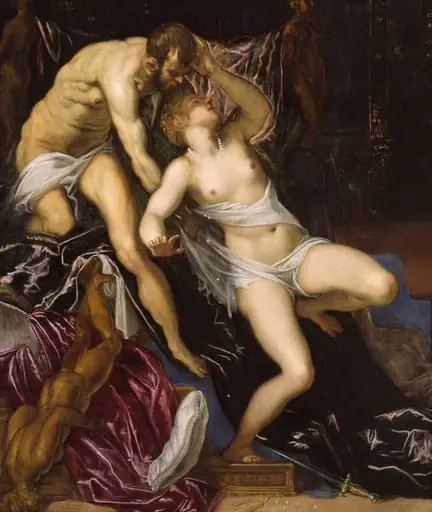
X-radiography reveals substantial revisions during execution, including a lower position of Lucretia’s arm that was later adjusted to the present composition.
Executed in oil on canvas, the painting measures 188.9 cm in height and 145.1 cm in width. X-radiography reveals substantial revisions during execution, including a lower position of Lucretia’s arm that was later adjusted to the present composition. The handling emphasizes dramatic lighting and sharply focused highlights, notably on the dagger tip and the eyes of both figures, which heighten the scene’s tension.
Tarquin’s figure is rendered in rich reds, garment, hose, and even shadow, while Lucretia’s near nudity is partially draped and accented by jewelry, contrasting modern opulence with classical virtue. A small male hand and head at left belong to an enslaved witness, a motif drawn from Ovid’s account and Livy’s narrative.
History & Provenance
Commissioned by Philip II of Spain, Titian's Tarquin and Lucretia was completed in 1571 when the artist was in his eighties. Titian described the work in a 1568 letter as requiring greater labor than any piece he had produced in years, and it remained one of his few fully finished late works. The painting was ready for collection by the Spanish ambassador in Venice by August 1571 and stayed in the Spanish royal collection until 1813.
Following the loss of the Spanish throne, Joseph Bonaparte took the work to France, and it likely accompanied him to America between 1817 and 1832. After Bonaparte's death in 1844, the painting was sold in London in 1845 and passed through several private owners, changing hands six times during the second half of the 19th century. It was finally acquired by the English collector Charles Fairfax Murray, who donated it to the Fitzwilliam Museum in Cambridge in 1918.
Completed in 1571, Tarquin and Lucretia is held by the Fitzwilliam Museum in Cambridge, England. The museum lists the work under accession number 914, having received it as a gift from the artist and historian Charles Fairfax Murray in 1918. Prior to this donation, the painting had a complex history of ownership, having been sold at auction in London in 1845 and changing hands six times during the latter half of the nineteenth century.
The work was originally commissioned for Philip II of Spain and remained in the Spanish royal collection until 1813, when it was removed to France by Joseph Bonaparte. Following Bonaparte's death, the painting likely traveled to the United States before returning to Europe for sale. The provided sources do not record any specific exhibitions where the work has been displayed.
Context
Completed in 1571 when Titian was in his eighties, Tarquin and Lucretia stands as a fully finished masterpiece from the artist's final years, distinguishing itself from other late works often left incomplete. Commissioned by Philip II of Spain, the painting serves as critical evidence in scholarly debates regarding whether Titian's late paintings were ever truly concluded by his own hand. The work is notable for its direct, violent composition, a hallmark of Titian's late style which favored mythological and religious subjects drawn largely from Ovid.
Unlike many contemporary depictions that isolated the moment of suicide, Titian captured the active assault, incorporating a slave figure to heighten the drama according to Livy's account. This specific narrative choice and the painting's refined poses influenced subsequent prints, such as the 1571 engraving by Cornelius Cort. The work's significance is further underscored by its status as one of the few documented late historical subjects, contrasting with the artist's typical mythological themes of the period.
Legacy
The painting Tarquin and Lucretia exerted significant influence through its immediate reproductive prints and subsequent reinterpretations. An authorized engraving by Cornelius Cort (1571) reversed Titian's composition, which was then pirated and re-reversed, demonstrating its rapid dissemination. The composition drew from classical precedents, notably the female figure in the Farnese Bull sculpture, and underwent compositional changes revealed by x-rays, including an earlier placement of the dagger-hand.
Workshop copies, such as the one in Bordeaux, preserved alternative compositions where the threatening hand was positioned lower. Later artists, including Luca Giordano, Rubens, and Tiepolo, produced their own versions of the subject, ensuring its continued presence in the artistic canon. The work's dramatic use of light on the dagger tip and eyes, its portrayal of Lucretia's nudity adorned with jewellery, and its complex narrative, capturing the moment of threatened rape rather than suicide, became influential in depictions of the story.
Its status as one of Titian's few fully finished late works, coupled with its provenance from Philip II's commission to its eventual donation to the Fitzwilliam Museum, cemented its legacy as a pivotal interpretation of the Lucretia legend.
Overview
Titian’s oil painting Tarquin and Lucretia, completed in 1571 when the artist was in his eighties, was created for Philip II of Spain. The work bears the master’s signature and is regarded as wholly finished by Titian himself, unlike several other late pieces that remained unfinished. Today the canvas belongs to the Fitzwilliam Museum in Cambridge, England.
Subject & Meaning
The composition depicts the moment Sextus Tarquinius forces himself on Lucretia, a scene drawn from early Roman legend. Lucretia, shown half‑clothed on a bed with a raised arm, has just been violated; the narrative continues with her exposing the crime and committing suicide, an act that sparked the overthrow of the Tarquin monarchy and the founding of the Roman Republic in 509 BC.
Own this work as a print
Artist & collection
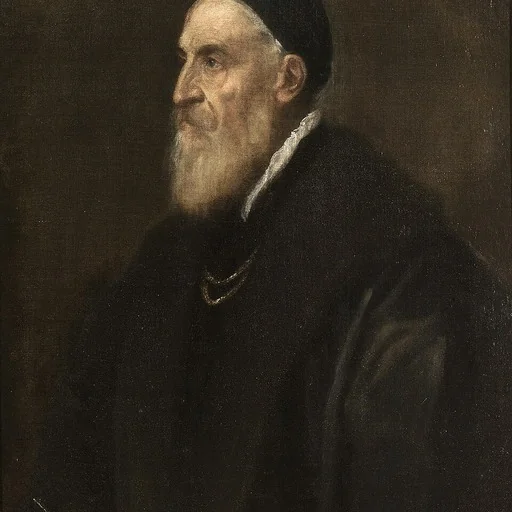
Artist
Tiziano Vecellio (Italian:; c. 1488/1490 – 27 August 1576), Latinized as Titianus, hence known in English as Titian ( TISH-ən), was an Italian Renaissance painter. The most important artist of Renaissance Venetian…