Artwork
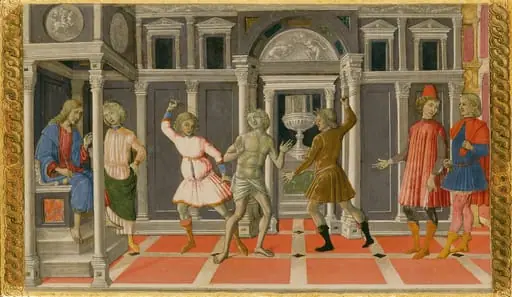
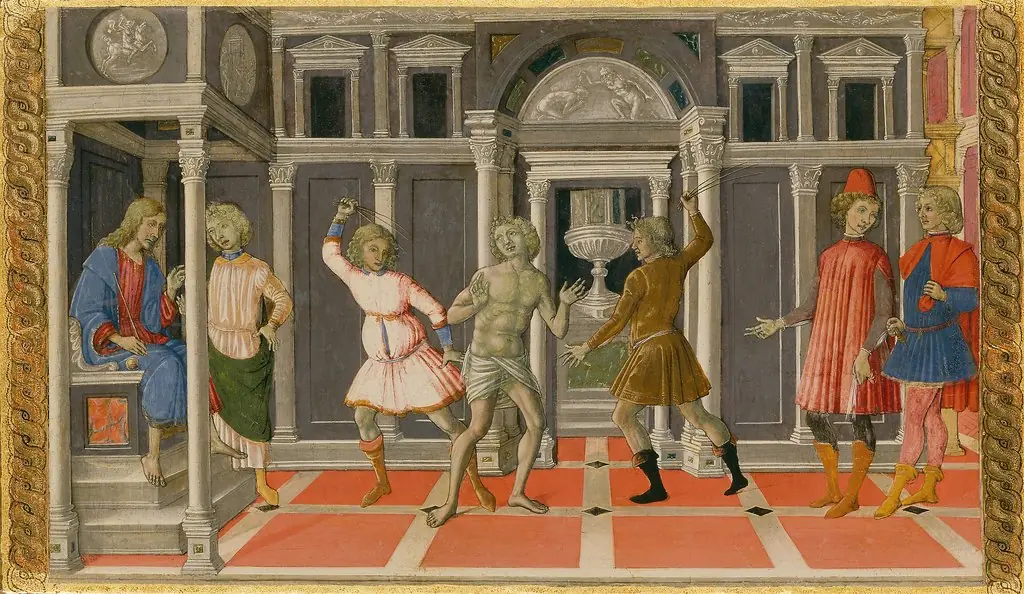
The Flagellation of Christ
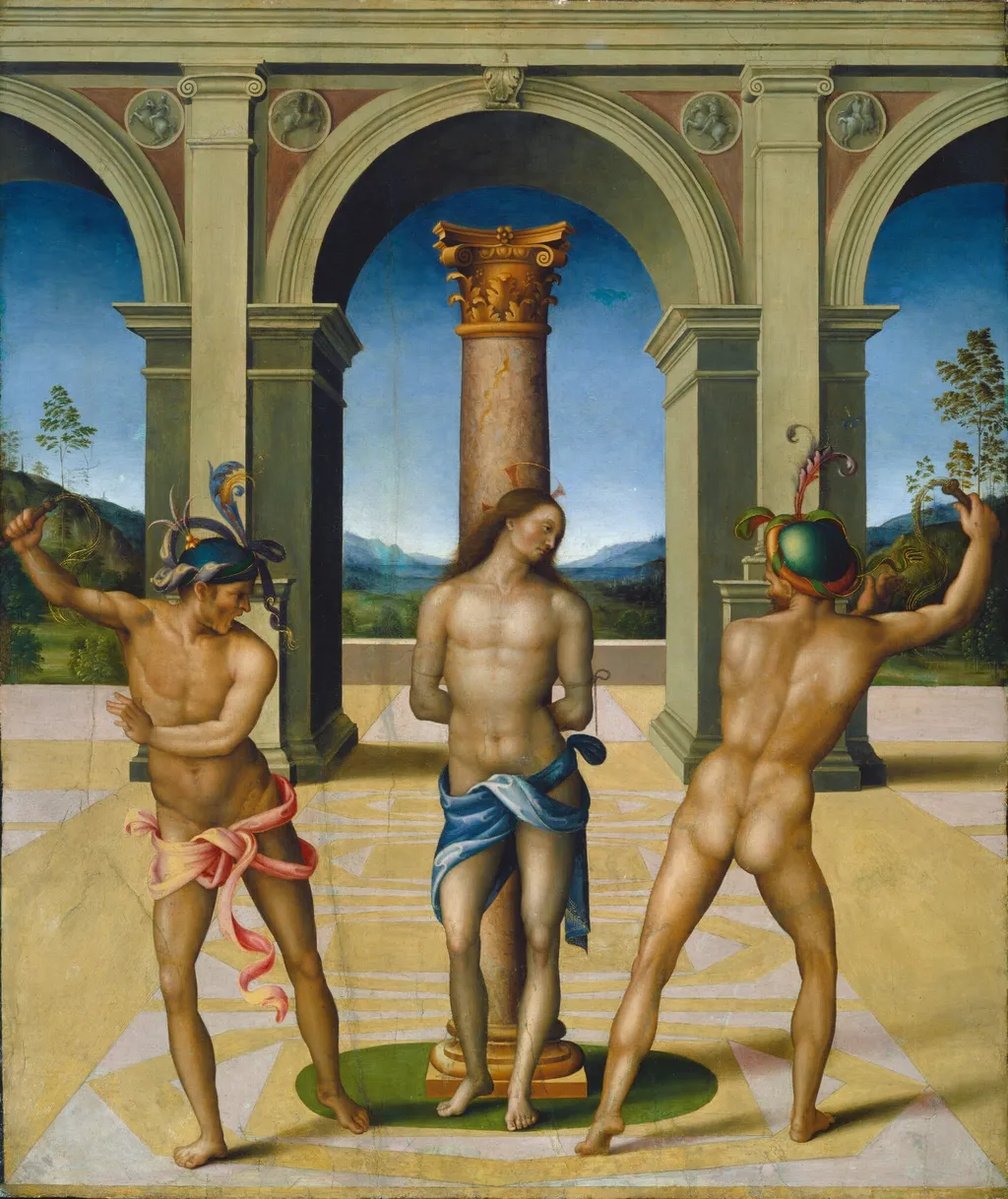
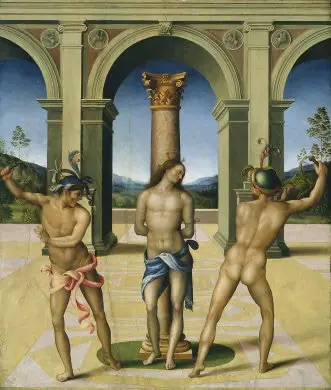
The Flagellation of Christ is an oil painting by the Early Renaissance artist Francesco Bacchiacca. It dates from 1514 and is held in the collection of the National Gallery of Art.
About this work
Subject & Meaning
The Flagellation of Christ depicts the biblical episode in which Christ is scourged at the pillar before his crucifixion, a subject widely represented in Italian Renaissance art to evoke themes of suffering, sacrifice, and divine redemption. In Bachiacca's rendering, the composition centers on the bound Christ, his body turned away from the viewer, while Roman soldiers administer blows, emphasizing physical torment and impending sacrifice. The architectural setting, a classical interior with columns, contrasts with the violence, underscoring the contrast between earthly brutality and spiritual significance.
The work's iconography aligns with traditional depictions of this moment, reinforcing its devotional purpose to elicit contemplation on Christ's passion and the promise of salvation.
Technique & Style
The painting's provenance records a series of sales and transfers, indicating multiple ownership changes before its purchase by the Samuel H.
The Flagellation of Christ is executed in oil on a wooden panel, a technique typical of early 16th-century Italian panels, and measures 55.9 cm by 48.1 cm. The work was painted in 1514 by Francesco Ubertini, called Bachiacca. Its support is a panel, and the composition depicts the flagellation of Christ, rendered with a focus on narrative clarity characteristic of Renaissance religious painting. The painting's provenance records a series of sales and transfers, indicating multiple ownership changes before its purchase by the Samuel H. Kress Foundation in 1948. Documentation does not specify the current physical condition of the panel.
History & Provenance
The Flagellation of Christ was painted by Bachiacca in 1514 in oil on panel. Its early ownership is undocumented; the panel is first recorded in an anonymous Milanese collection before passing to the London dealer George Morland, then through A. Hope, and by 1839 to Sir John Rushout, 6th Baronet (2nd Baron Northwick), who held it at Northwick Park and Thirlestane House. It appeared in the 1859 Thirlestane House (Phillips) sale, attributed to Raphael, then passed to John Watkins Brett and was acquired by Sir John Charles Robinson, who sold it in 1868 to Sir Francis Cook, 1st Baronet, for Doughty House in Richmond, Surrey.
It descended through the Cook baronets until July 1947, when it was sold to Count Alessandro Contini Bonacossi through Gualtiero Volterra. In July 1948 the panel was acquired by the Samuel H. Kress Foundation, which donated it in 1952 to the National Gallery of Art in Washington, D.C., where it forms part of the Samuel H. Kress Collection.
Overview
Bachiacca's The Flagellation of Christ, executed around 1514, is a religious panel painting rendered in oil. This work portrays a pivotal moment from the Passion of Christ, specifically the scene where Jesus is subjected to scourging. The composition captures the dramatic intensity of this event, a common theme in Christian art, reflecting the artist's engagement with devotional narratives of the early 16th century.
Own this work as a print
Artist & collection
Artist
Francesco d'Ubertino Verdi, called Bachiacca (say "bah ki ah cka"). He is also known as Francesco Ubertini, il Bacchiacca (1494–1557). He was an Italian painter of the Renaissance whose work is characteristic of the…