Artwork
Education of Pan
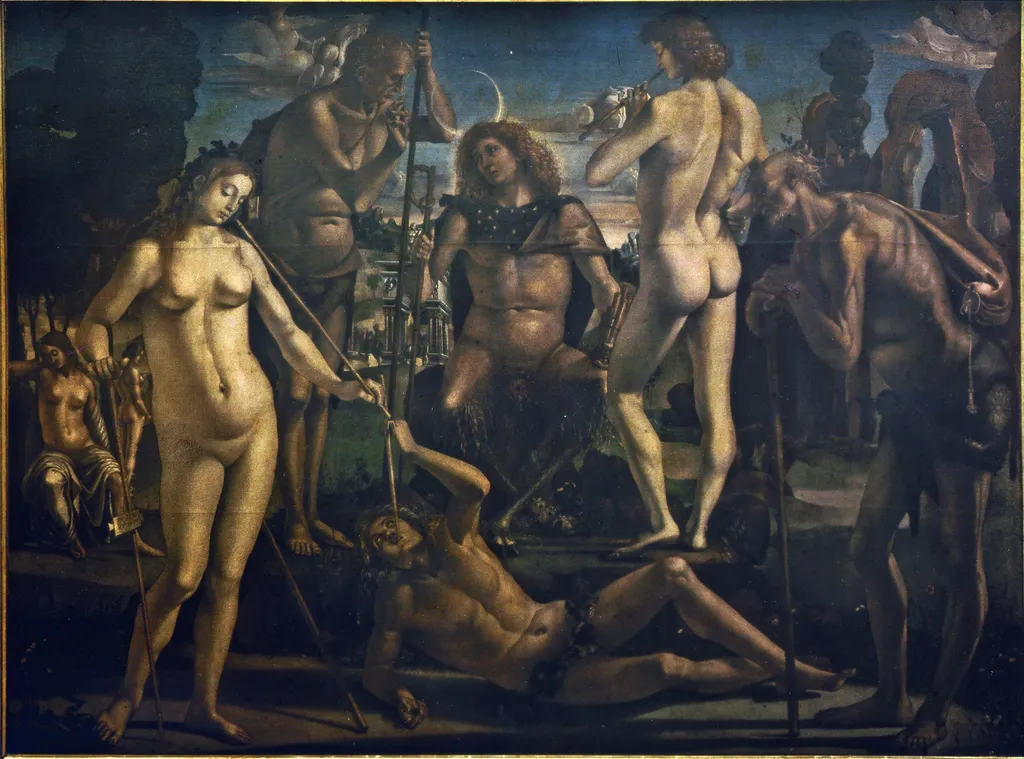
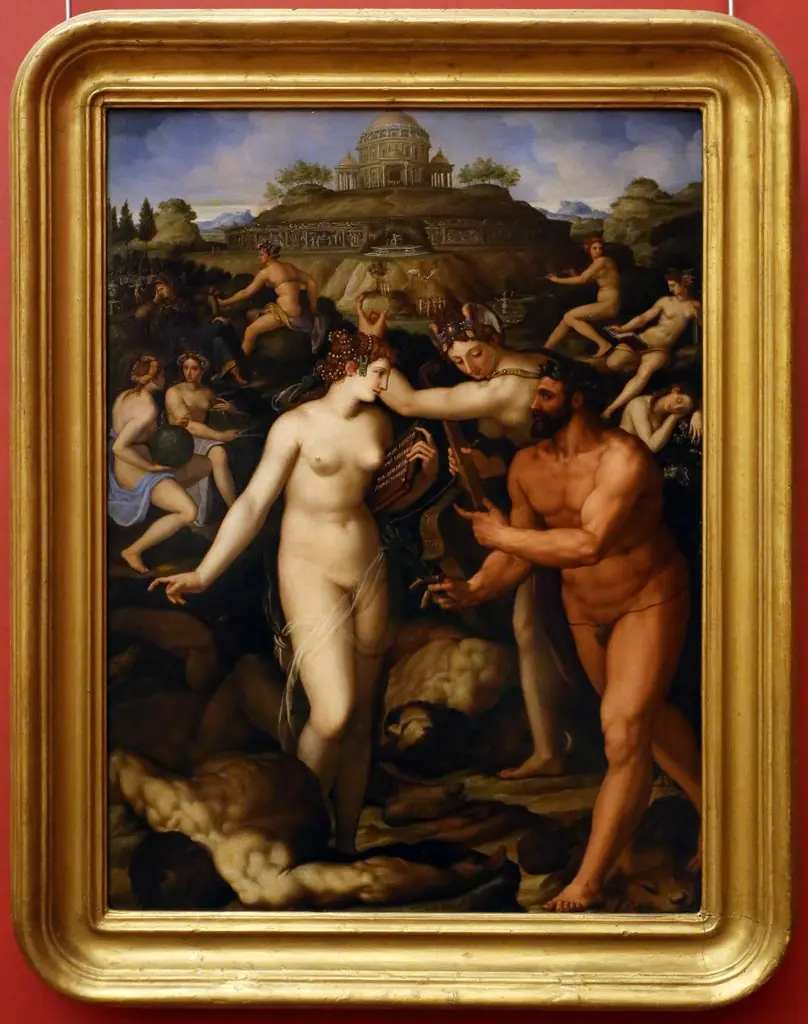
Education of Pan is an oil painting by the Early Renaissance artist Luca Signorelli. It dates from 1496 and is held in the collection of the Bode Museum.
About this work
The Education of Pan is a painting by Luca Signorelli. It was created in 1490.
The painting was originally held in the Kaiser-Friedrich-Museum in Berlin. It was moved to the Flakturm Friedrichshain during the Second World War, where it was destroyed in a fire in May 1945.
You can learn more about the artist who created this lost work, Luca Signorelli.
Overview
Today the painting survives only in black-and-white photographs, a small colorized photograph, and a copy once held in a private collection in Montpellier.
The Education of Pan is a lost mythological painting by the Italian Renaissance artist Luca Signorelli, created circa 1490. Executed in tempera on canvas and measuring 194 by 257 centimeters, it was commissioned by Lorenzo de' Medici and is considered the most significant commission Signorelli received from the Florentine ruler. The work depicted the god Pan enthroned at center, surrounded by nude and partially clothed figures in a pastoral landscape. After centuries of private ownership in Florence, it entered the collection of the Kaiser Friedrich Museum in Berlin in 1873, only to be destroyed by fire in May 1945 at the Flakturm Friedrichshain shortly after the end of World War II. Today the painting survives only in black-and-white photographs, a small colorized photograph, and a copy once held in a private collection in Montpellier. Its loss represents one of the most devastating casualties of wartime destruction of art.
Subject & Meaning
The painting's subject derives from classical mythology concerning the god Pan, a deity associated with music, nature, and the pastoral realm. In Signorelli's composition, Pan sits enthroned at the center, his goat legs crossed, wearing a star-spotted cape on his upper body while his lower body remains uncovered. He holds his characteristic syrinx, or panpipes. Surrounding him are multiple figures of varying ages and sexes, including elderly men with staffs and bags, a reclining male nude with a vine leaf covering his genitals, a standing female nude holding a long staff or pipe, and a youth playing a wind instrument with his back turned to the viewer. The scene has been interpreted in several ways: as Pan's education or initiation into the pastoral arts, as his triumph or kingdom, and as a Neoplatonic allegory of cosmic harmony. The French Wikipedia source notes that the four ages of man and three ages of woman are represented in relation to the cycle of seasons invoked by Pan. Scholarly debate persists about the precise meaning of the attendant figures. Some interpretations connect the scene to the Neoplatonic circle around Lorenzo de' Medici, reading Pan as a cosmic deity of Nature who regulates life's cycle through music. The composition borrows the structural format of the sacred conversation, typically reserved for Christian subjects, and applies it to a pagan theme. A cartellino attached to the female figure's staff at left bore the painter's signature: LUCA / CO / RTONEM.
Technique & Style
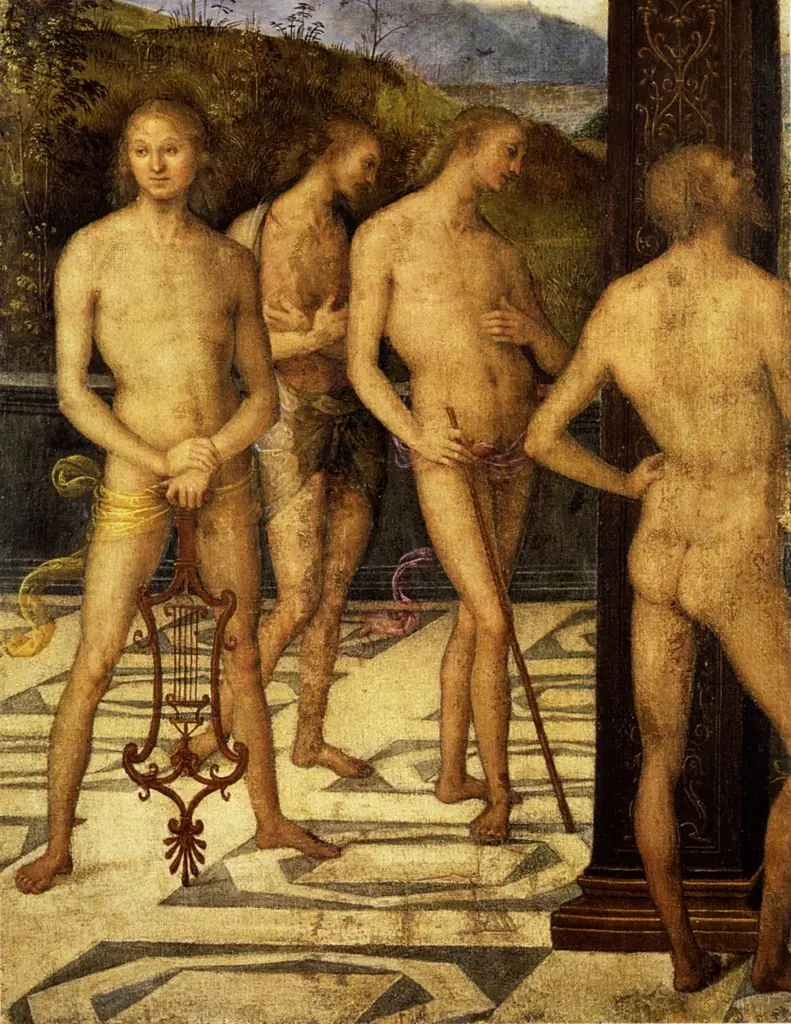
The painting was executed in tempera on canvas, a support that has occasioned scholarly comment given Vasari's apparent misidentification of it as a panel. The large horizontal format, 194 by 257 centimeters, allowed for an expansive, frieze-like arrangement of figures across the picture plane. The visual evidence from surviving photographs indicates smooth, blended brushwork with careful modeling of musculature and soft transitions between light and shadow. The palette was dominated by deep browns, muted greens, and cool blues, with flesh tones rendered in warm, shadowed hues. Light falls selectively across the bodies, creating strong contrasts between illuminated skin and surrounding darkness. The composition lacks a single focal point, instead weaving figures together in a complex, interlocked arrangement typical of Signorelli's mature style. The background features dark foliage, architectural structures including what appears to be a triumphal arch with horsemen, and a twilight sky with a visible crescent moon. The overall effect demonstrates Signorelli's mastery of anatomical realism and dynamic posing, with muscular, idealized nudes that show the influence of classical antiquity. The handling of the figures, particularly the elderly man with a staff and the reclining youth, has been connected to Piero della Francesca's Adamiti in the lunette of the Death of Adam at Arezzo.
History & Provenance
The painting was commissioned by Lorenzo de' Medici, probably between 1489 and 1490, shortly after Signorelli completed the Bichi Altarp Signorelli's most significant commission from the Florentine ruler. Giorgio Vasari recorded the work in the first edition of his Lives, describing it as a painting of "nude gods" made for Lorenzo, though he mistakenly referred to it as on panel rather than canvas. After Lorenzo's death in 1492, the painting disappeared from inventories for nearly two centuries. It resurfaced in 1687 at the Palazzo Pitti, where the nude figures had been covered with painted breeches. In 1865 it passed to the Corsi-Salviati collection at Palazzo Tornabuoni near San Gaetano. The painter-restorer Angelo Tricca rediscovered it in an attic in 1869, removed the overpainting, and recognized it as the work described by Vasari. Cardinal Cosimo Corsi, scandalized by the nudity, ordered Tricca to dispose of it. The English collector Janet Ross acquired it cheaply, intending to resell at profit. It was offered to the National Gallery in London in 1869 but rejected due to the nudity. In 1873 Wilhelm von Bode, then deputy director of the Berlin Gemäldegalerie, purchased it for three times what Ross had paid, bringing it into public collection. During World War II it was moved with other large paintings to the Flakturm Friedrichshain for safekeeping, where an incendiary bomb caused a fire in May 1945 that destroyed it.
Context
The Education of Pan emerged from the cultural milieu of Lorenzo de' Medici's Florence, where Neoplatonic philosophy and the revival of classical mythology flourished. The painting has been described by Pietro Scarpellini as "the most important figur of the Neoplatonic entourage," referring to the refined circle that gathered at the villa of Careggi. In this intellectual environment, ancient myths were reinterpreted through philosophical and even Christian lenses. The choice of Pan held particular resonance: the god's name, meaning "all" in Greek, could be linked to Cosimo de' Medici through wordplay on "cosmos." The subject also connected to contemporary literary interests, with possible links to Longus's Daphnis and Chloe and to the pastoral poetry of Theocritus and Virgil as mediated by Marsilio Ficino's translations. The painting exemplifies the broader Renaissance project of reconciling pagan antiquity with contemporary Christian culture. Bernhard Berenson, the pioneering art historian, famously described it as "one of the few most fascinating works of art in our heritage." The work's destruction in 1945, along with countless other masterpieces from the Kaiser Friedrich Museum, represents a pivotal moment in the history of wartime cultural losses.
Legacy
The destruction of The Education of Pan in May 1945 has made it an emblematic case among lost artworks of the twentieth century. Its fate was sealed when an incendiary bomb struck the Flakturm Friedrichshain, where Berlin's museums had concentrated their most precious large-format paintings for protection. The fire that consumed the tower took with it not only Signorelli's masterpiece but also works by Caravaggio, Raphael, and numerous other masters. Today the painting's afterlife depends entirely on photographic documentation and scholarly reconstruction. The surviving black-and-white photographs, a small colorized version, and a copy once in a private Montpellier collection constitute the only visual records. The painting continues to generate scholarly interest precisely because of its loss: debates about its subject, meaning, and place in Signorelli's oeuvre remain active, with recent scholarship connecting it to Servius's commentary on Virgil and to the theme of Pan's defeat by Love. Its rejection by the National Gallery on grounds of nudity in 1869 also stands as a significant episode in Victorian museum history. For Signorelli's reputation, the painting represented a high point of his engagement with mythological subject matter and the Medici court, a phase that would be curtailed by Lorenzo's death and the political upheavals that followed.
Own this work as a print
Artist & collection
Artist
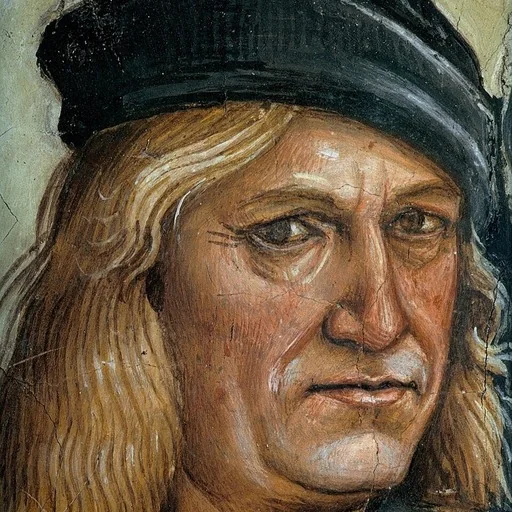
Luca Signorelli (c. 1441/1445 – 16 October 1523) was an Italian Renaissance painter from Cortona, in Tuscany, who was noted in particular for his ability as a draftsman and his use of foreshortening. His massive frescos…