Artwork
The butchered pig
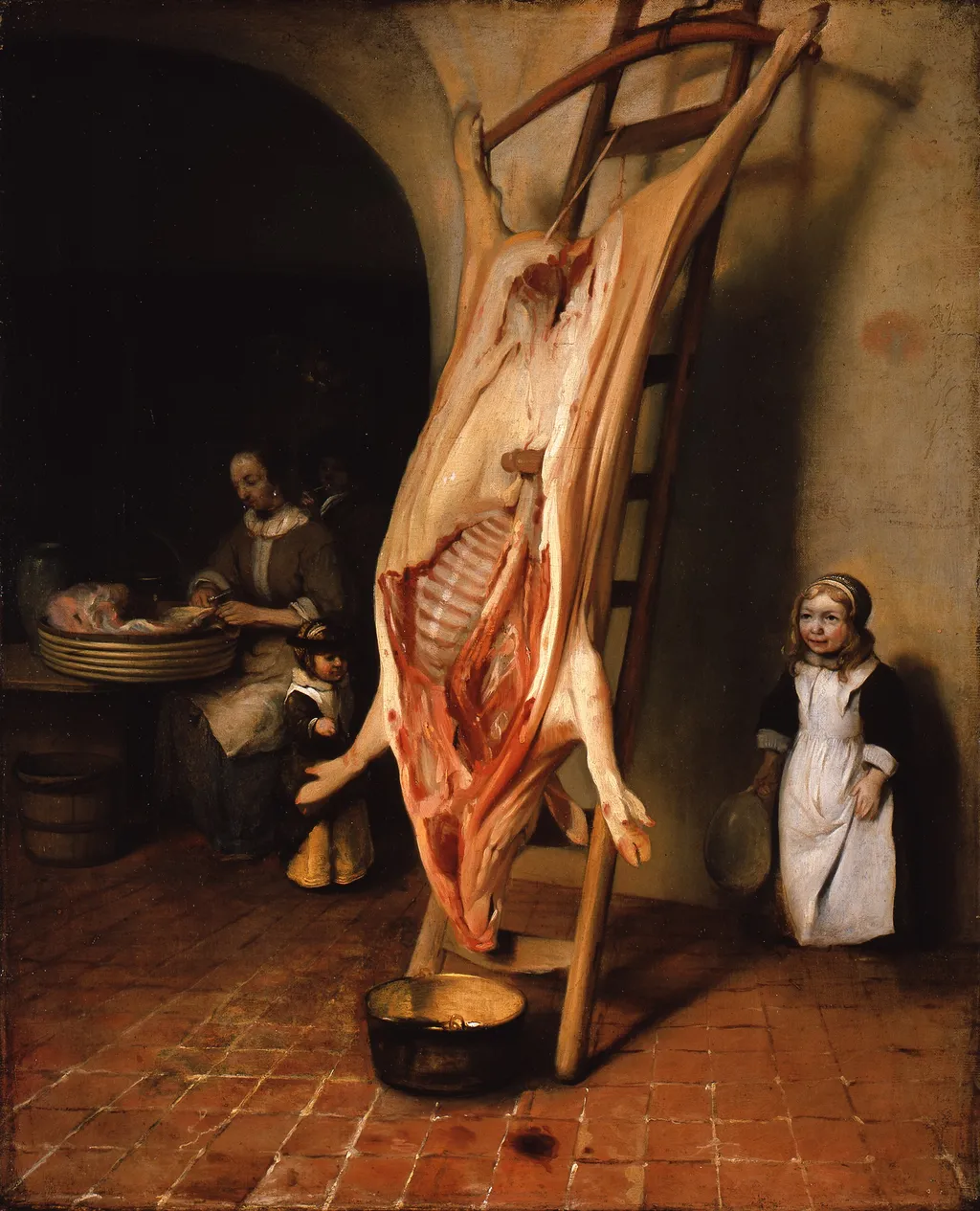
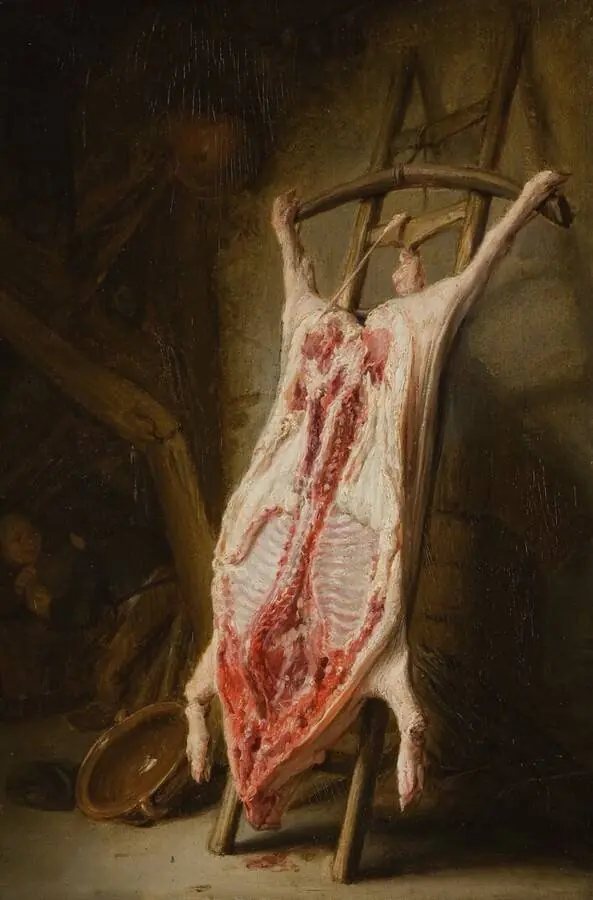
The butchered pig is a paint painting by the Dutch Golden Age artist Barent Fabritius. It dates from 1656 and is held in the collection of the Gemäldegalerie Berlin.
About this work
Subject & Meaning
Its iconography, ladder, slaughter tools, and fleeting domestic activity, symbolizes the inevitability of death and the transience of material existence.
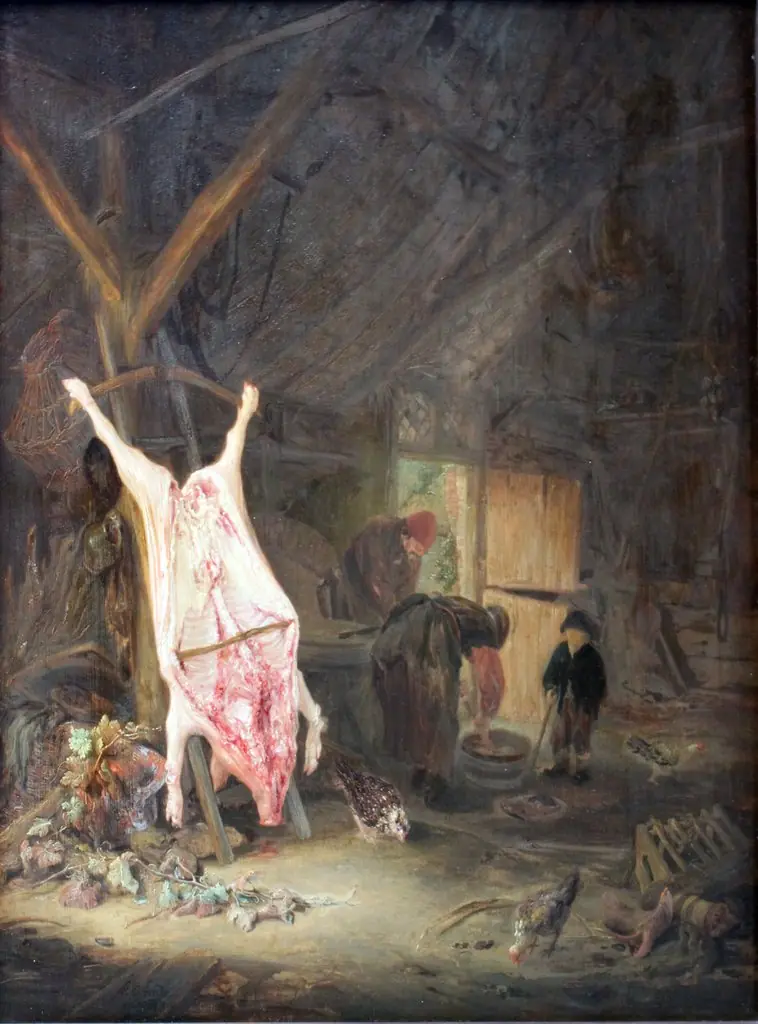
The butchered pig is shown suspended on a ladder, its belly opened and blood collecting in a copper pot, while a child holds an inflated bladder and a woman works at a table of meat. The composition brings together a child, a woman, a man smoking a pipe, and various household objects such as a kettle and a basin, creating a domestic interior that functions as a vanitas allegory. The work, painted by Barent Fabritius in 1656, belongs to the genre of genre scene and is classified as a painting.
Its iconography, ladder, slaughter tools, and fleeting domestic activity, symbolizes the inevitability of death and the transience of material existence.
Technique & Style
The Berlin and Rotterdam versions of The butchered pig are oil paintings on canvas, a medium indicated by the description ‘Öl auf Leinwand’ and the material listing of paint and canvas. Fabritius employed a careful oil technique to render the slaughtered pig, the glistening blood, the copper pot, the tiled floor and the varied fabrics of the figures, using fine brushwork to capture texture and subtle variations in tone. The Berlin canvas shows a heavily rubbed signature and date on the right‑hand wall, indicating surface wear to the paint layer.
Stylistically, the work presents a genre scene illuminated by strong chiaroscuro: the centrally hung pig is brightly lit while deep shadows model the ladder, wall and background niche, creating a dramatic, almost theatrical effect that underscores the vanitas theme of earthly transience.
History & Provenance
The Berlin version of The Butchered Pig was painted by Barent Fabritius in 1656, as indicated by the signature and date on the wall: “B Fabritius 1656.”
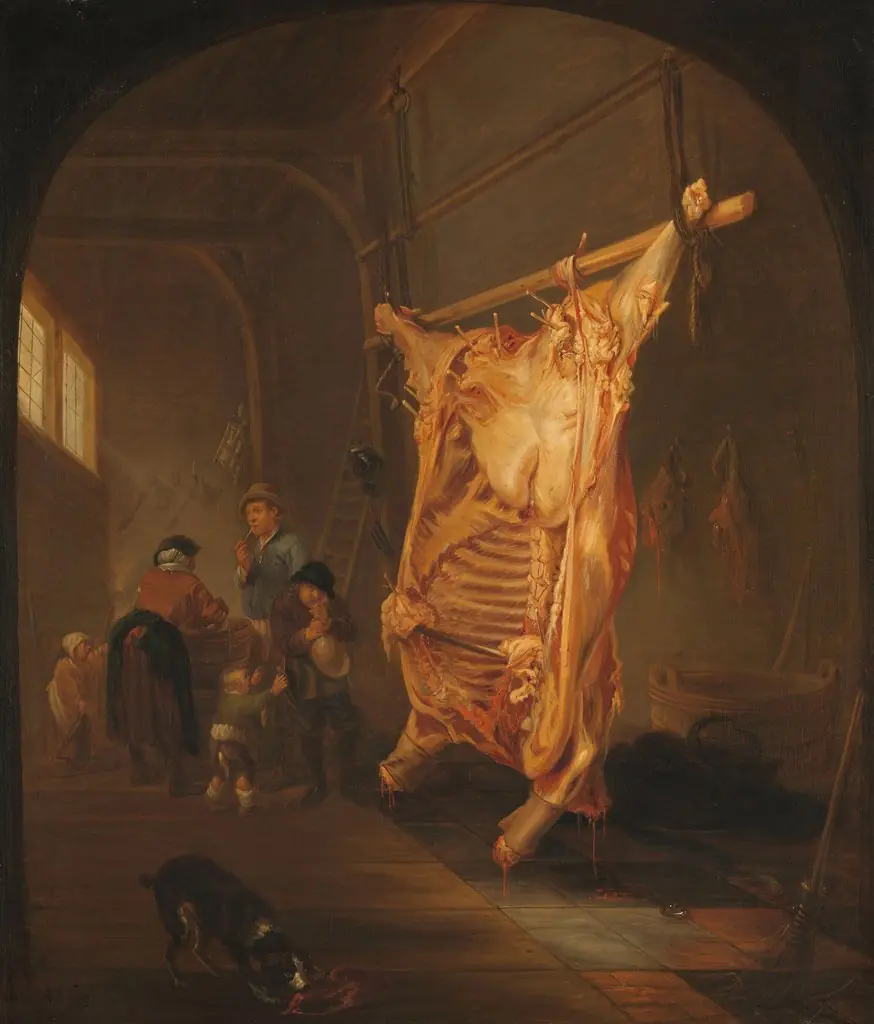
The Rotterdam version, held by Museum Boijmans Van Beuningen, carries the monogram “B. Fabritius 165” on the lower rung of its ladder, which was long read as 1652 but is now dated by the museum to 1665. Both works depict genre interiors centered on a slaughtered pig suspended from a ladder, aligning their subject with vanitas motifs.
The Berlin painting entered the collection of the Gemäldegalerie Berlin by 1900 and remains in its holdings, while the Rotterdam picture is listed as part of the Museum Boijmans Van Beuningen collection.
The 1656 version of The Butchered Pig is held in the Gemäldegalerie Berlin, where it forms part of the museum's painting collection. It is executed in oil on canvas and measures 97 × 64 cm. The canvas bears the signature and date "B Fabritius 1656" on the right-hand wall, an inscription that is described as heavily abraded.
A second version of the composition, long dated to 1652 on the basis of an incomplete inscription "B. Fabritius 165" on the lowest rung of the ladder, is now given by Museum Boijmans Van Beuningen in Rotterdam a creation date of c. 1665. That Rotterdam variant measures 100 × 80 cm and is likewise painted in oil on canvas.
Neither source provides a specific accession/inventory number for the Berlin picture, nor any documented exhibition history beyond its presence in the Gemäldegalerie's collection.
Context
Scholarship identifies Barent Fabritius's depictions of slaughtered pigs as vanitas motifs, emphasizing the transience of earthly life. The artist produced two known variations of this subject: an earlier 1656 version held in Berlin and a later iteration from approximately 1665 located in Rotterdam. While both works feature the central image of a dressed pig hanging from a ladder, they offer distinct interpretive possibilities through their specific compositions.
The Berlin painting highlights dramatic lighting and shadow to enhance the scene's gravity, whereas the Rotterdam version incorporates additional domestic elements like a cat and figures engaged in sausage preparation. These works situate Fabritius within the Dutch genre tradition, utilizing common household scenes to convey deeper moral messages about mortality.
Overview
Barent Fabritius's painting, "The Butchered Pig," created in 1656, offers a glimpse into domestic life during the Dutch Golden Age. This oil on canvas work depicts a scene of a pig being prepared for consumption within a dimly lit interior. Fabritius, a Dutch artist active in the mid-17th century, is known for his diverse subject matter, including genre scenes like this one, which captures an everyday activity with a focus on light and shadow.
Own this work as a print
Artist & collection
Artist
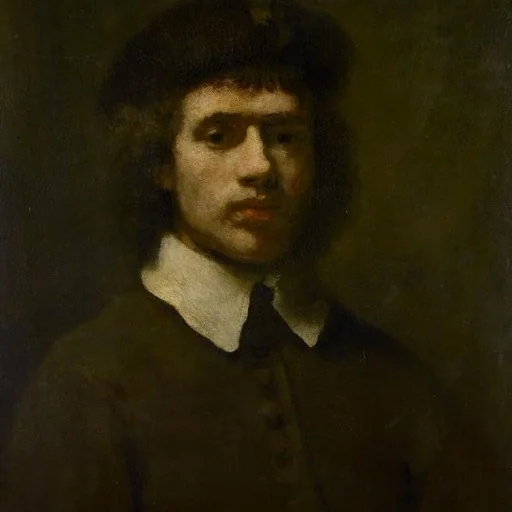
Barent or Bernard Pietersz Fabritius (or Fabricius) (bapt. 16 November 1624 – bur. 20 October 1673), was a Dutch painter. Fabritius was born at Middenbeemster, North Holland, the son of Pieter Carelsz. Fabritius. He…