Artwork
明 卞文瑜 谿山秋靄圖 卷|Streams and Mountains in Autumn Mist
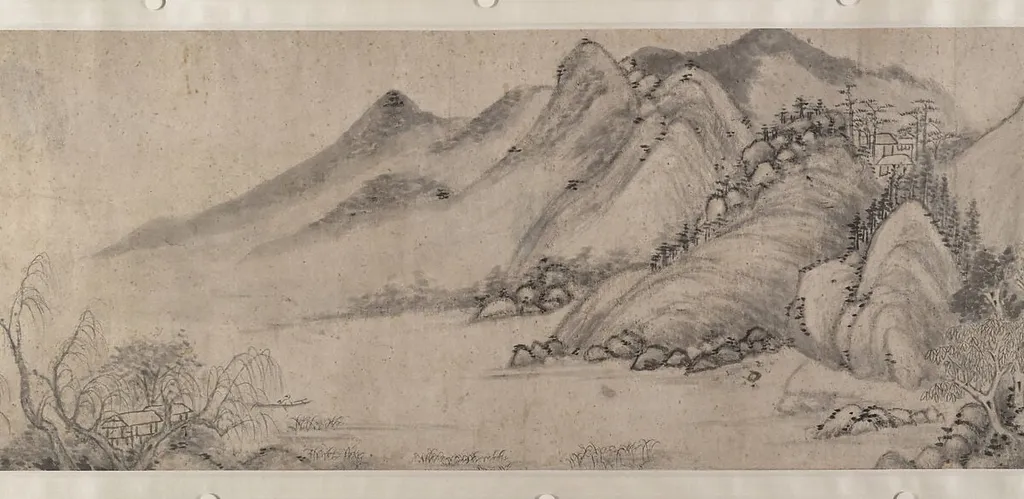
明 卞文瑜 谿山秋靄圖 卷|Streams and Mountains in Autumn Mist is an ink painting by the Baroque artist Bian Wenyu. It dates from 1634 and is held in the collection of the Metropolitan Museum of Art.
About this work
Subject & Meaning
As a genre painting, it represents the scholar-artists' engagement with nature, depicting an idealized environment rather than a specific geographic location.
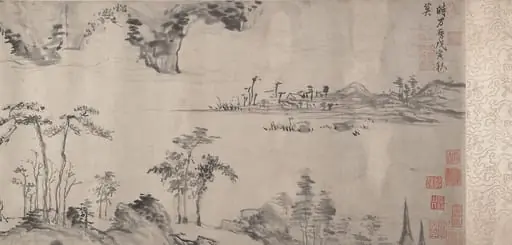
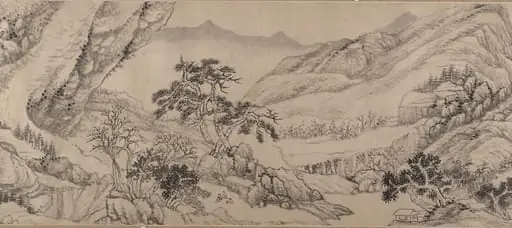
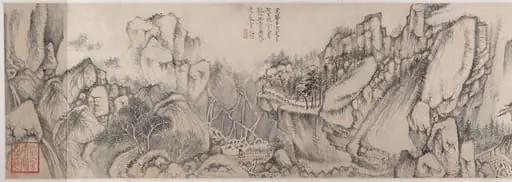
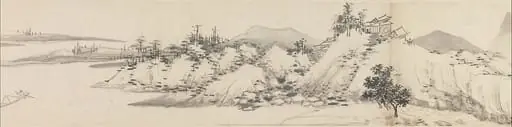
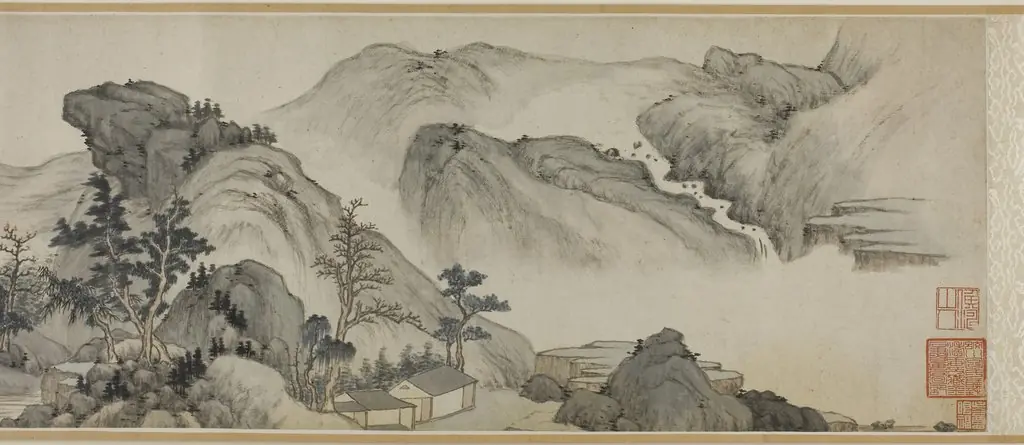
Created in 1634 by Bian Wenyu, this handscroll presents a landscape composition dominated by mountains and misty valleys. The work's title, Streams and Mountains in Autumn Mist, explicitly identifies the seasonal setting as autumn, a period often associated with transition and melancholy in Chinese artistic tradition. Visually, the piece focuses on the interplay between solid geological forms and atmospheric voids, utilizing ink on paper to render the rugged terrain alongside flowing waterways.
As a genre painting, it represents the scholar-artists' engagement with nature, depicting an idealized environment rather than a specific geographic location. The iconography centers on the enduring presence of the mountains contrasted with the ephemeral quality of the autumnal mist, reflecting traditional philosophical contemplations on permanence and change within the natural world.
Technique & Style
Bian Wenyu’s handscroll Streams and Mountains in Autumn Mist (1634) is executed in ink on paper, a format typical of Ming‑era Chinese landscape painting. Measuring approximately 26 cm in height and 108 cm in width, the work unfolds as a continuous visual narrative that guides the viewer’s eye through layered mountain forms veiled in mist. The artist employs delicate brushstrokes and subtle tonal gradations to suggest depth and atmospheric perspective, while the composition emphasizes the vertical rhythm of peaks against a mist‑filled sky.
As part of the Metropolitan Museum of Art’s collection, the piece exemplifies the literati tradition of combining poetic observation with restrained formalism.
History & Provenance
Created in 1634 by the Ming dynasty artist Bian Wenyu, this handscroll titled 'Streams and Mountains in Autumn Mist' was executed in ink on paper within China. The work measures 26 centimeters in height and 108 centimeters in width. While specific details regarding its original commission or early ownership chain are not provided in the available records, the piece is currently held in the collection of the Metropolitan Museum of Art.
The artwork is classified as a landscape painting, depicting mountainous scenery enveloped in autumn mist, consistent with the artist's known genre focus during this period.
The handscroll titled Streams and Mountains in Autumn Mist, painted by Bian Wenyu in 1634, is housed in the Metropolitan Museum of Art. The museum’s collection records identify it as part of their Asian art holdings, but they do not publish an accession or inventory number for the work. The painting is documented as a landscape handscroll, ink on paper, measuring 26 cm in height and 108 cm in width.
No exhibition history or loan listings appear in the sources examined, indicating that the piece has not been featured in public exhibitions or catalogues based on the available documentation.
Overview
Streams and Mountains in Autumn Mist is a handscroll painted in 1634 by the Chinese artist Bian Wenyu. Executed in ink on paper, the work exemplifies the literati landscape tradition of the late Ming dynasty. The composition unfolds horizontally, guiding the viewer through a misty autumnal terrain where jagged mountain peaks emerge from swirling clouds.
Bian employs a monochromatic palette, utilizing varying ink densities to create atmospheric depth; sharp, dark strokes define the rocky textures and cliff faces, while lighter, wash-like applications suggest the encroaching fog and distant horizons. Delicate trees cling precariously to the precipices, and a small temple is subtly integrated into the rock formations, emphasizing the scale of nature against human presence. Created during a period when Bian Wenyu was an active member of the Songjiang school, this piece reflects his study of earlier masters like Dong Yuan and Juran, reinterpreted through a distinctively personal brushwork style that balances structural rigor with lyrical fluidity.
The scroll serves as a meditation on the transient beauty of the season, capturing the quiet stillness of an autumn landscape through the dynamic interplay of ink tones and negative space.
Artist & collection

 清 傳弘仁 寺橋山色圖 卷|River Scene in Winter
 River and Mountains on a Clear Autumn Day
 清 松年 山水 手卷|Landscape
 明 王紱 江山漁樂圖 卷|Joys of the Fisherman
 清 戴熙 山水圖 冊|Landscapes
 清 柳堉 幽谷深林圖 卷|Remote Valleys and Deep Forests
 Recluse Dwellings in the Autumn Mountains
 清 惲壽平 倣宋元山水圖 冊|Landscapes in the manner of Song and Yuan masters