Artwork
Floats and Participants
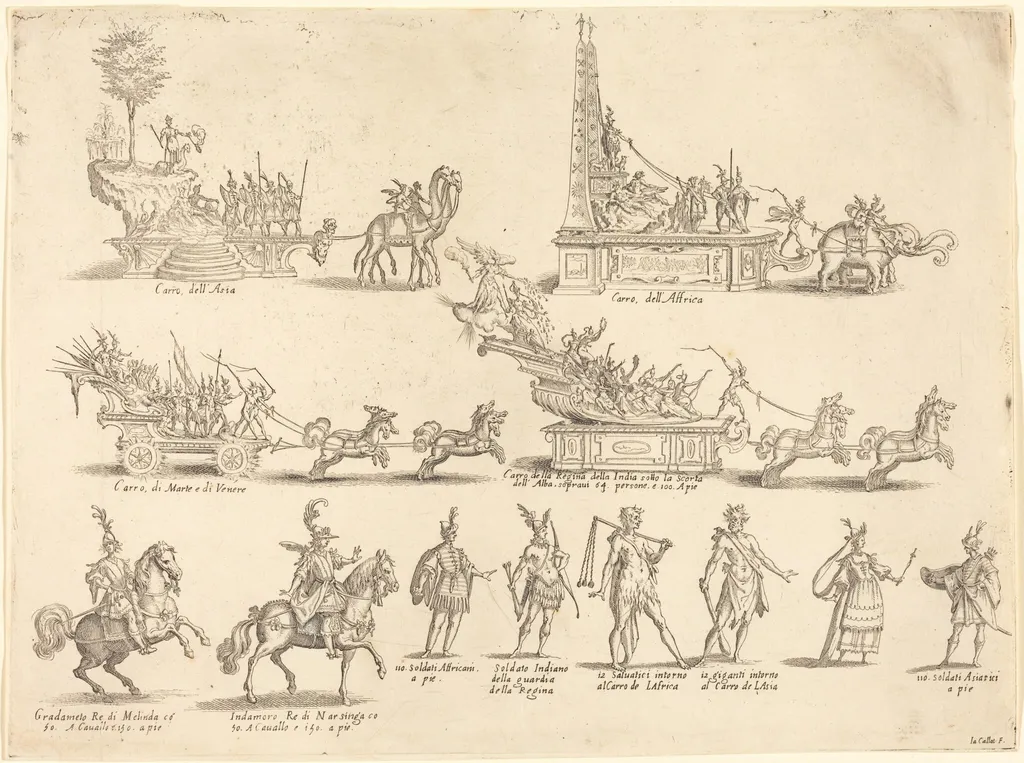
Floats and Participants is an ink print by the Baroque artist Jacques Callot. It dates from 1616 and is held in the collection of the National Gallery of Art.
- Inscription
- Inscribed:lower right in plate: Ia Callot. F.; in Italian under each float,left to right, top to bottom: Float of Asia / Float of Africa / Float of Mars and Venus / Float of
About this work
Overview
The scene is densely populated with soldiers, musicians, and exotic characters, all rendered in the fine line work characteristic of Callot’s printmaking.
Jacques Callot’s 1616 etching titled Floats and Participants depicts a bustling procession on laid paper. The composition presents four elaborate parade floats accompanied by a line of costumed figures, each float drawn by a mixture of horses, camels and fantastical winged creatures. The scene is densely populated with soldiers, musicians, and exotic characters, all rendered in the fine line work characteristic of Callot’s printmaking.
Subject & Meaning
The work records a ceremonial spectacle, likely a public celebration or military display, featuring a tower‑like float with combatants atop, a ship‑shaped float bearing armed men, and a camel bearing a female figure. Labels such as “Carro dell’Africa” and “Soldato Indiano” identify the floats and participants, suggesting a narrative that blends local pageantry with references to distant lands and colonial forces.
Technique & Style
Executed in etching, the image showcases Callot’s precise incising on laid paper, allowing for intricate detailing of armor, feathered hats, tiny shields, and even the curled tail of a camel. The fine lines create a sense of depth and movement, while the densely packed figures demonstrate Callot’s skill in managing complex compositions within the limited space of a print.
History & Provenance
Floats and Participants belongs to Callot’s prolific output of more than 1,400 etchings, produced during his career as a leading Baroque printmaker from the Duchy of Lorraine. The print reflects his ongoing interest in documenting the social and military life of early‑17th‑century Europe, a theme that recurs throughout his oeuvre.
Context
Created at a time when public festivals and military parades served both entertainment and propaganda, the etching captures the elaborate costumes, armaments, and exotic motifs popular in early Baroque court culture. Callot’s inclusion of foreign elements, such as the “Indian soldier,” mirrors contemporary fascination with overseas territories and expanding European influence.
Own this work as a print
Artist & collection
Artist
Jacques Callot (French: ; c. 1592 – 1635) was a baroque printmaker and draftsman from the Duchy of Lorraine. He is an important person in the development of the old master print. He made more than 1,400 etchings that…

 Holy Family at supper
 Restoration of the Aqueduct at Pisa
 Restoration of the Aqueduct at Pisa
 Square in Paris with Many Figures
 Square in Paris with Many Figures
 Horsemen Attacked by Robbers
 HOW WILL A COVERED PART BE CORRECTED?HOW WIKA A COVERED HEART DEED CORRECTED?
![Christ Walking on the Water [second plate], by Jacques Callot](https://artifactworldgallery.com/img/jacques-callot--christ-walking-on-the-water-second-plate--2069f3bfe4cb2126-w320.webp) Christ Walking on the Water [second plate]
Christ Walking on the Water [second plate]
 H Beard Print Collection
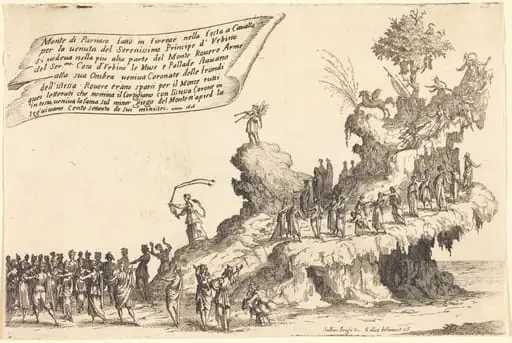 The Float of Mount Parnassus
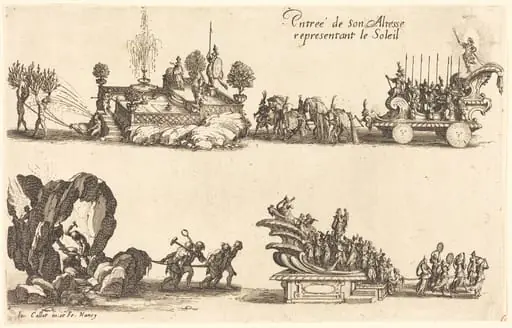 Entry of His Highness, Representing the Sun
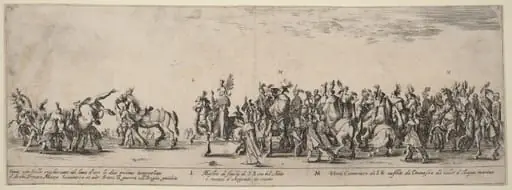 Master of His Excellency's Stables and Twenty Servants
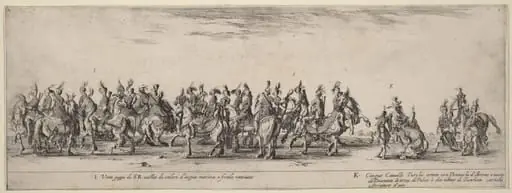 Twenty Pages and Five Turkish Horses
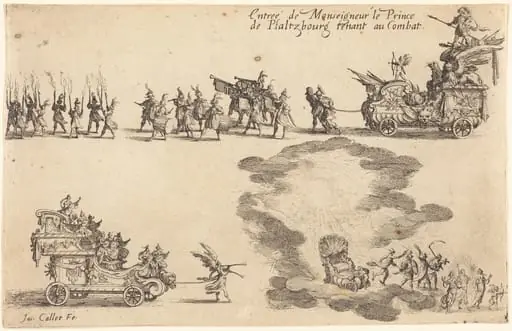 Entry of the Prince of Pfaltzbourg
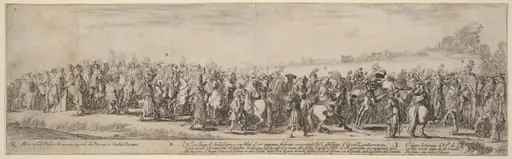 Polish Nobles, His Excellency the Ambassador, and His Carriage
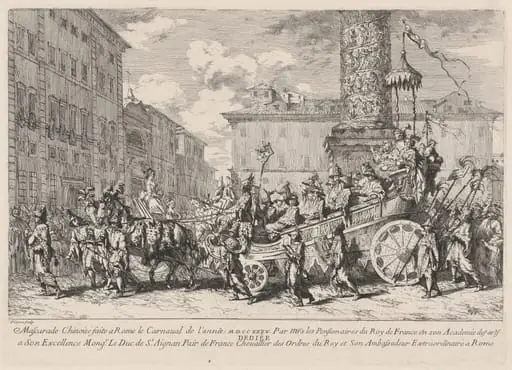 Mascarade Chinoise faite a Rome (Chinese Masquerade)
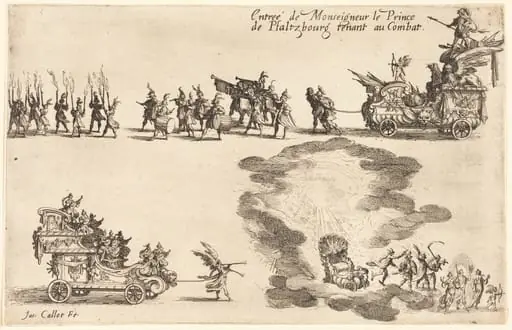 Entry of the Prince of Pfaltzbourg