Artwork
The Flight into Egypt
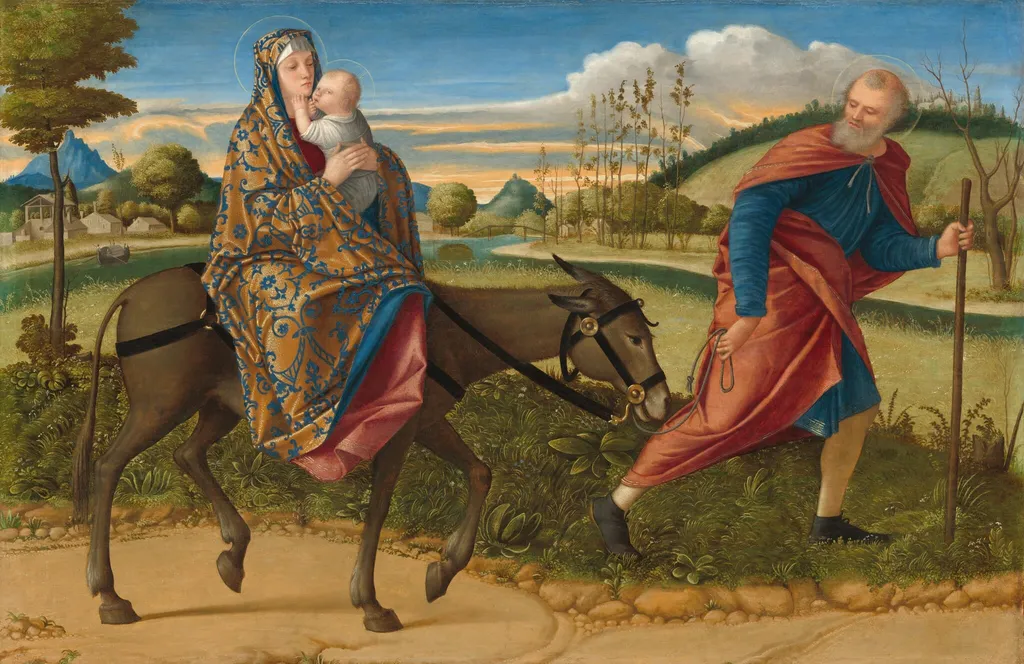
The Flight into Egypt is an oil painting by the Renaissance artist Vittore Carpaccio. It dates from 1515 and is held in the collection of the National Gallery of Art.
About this work
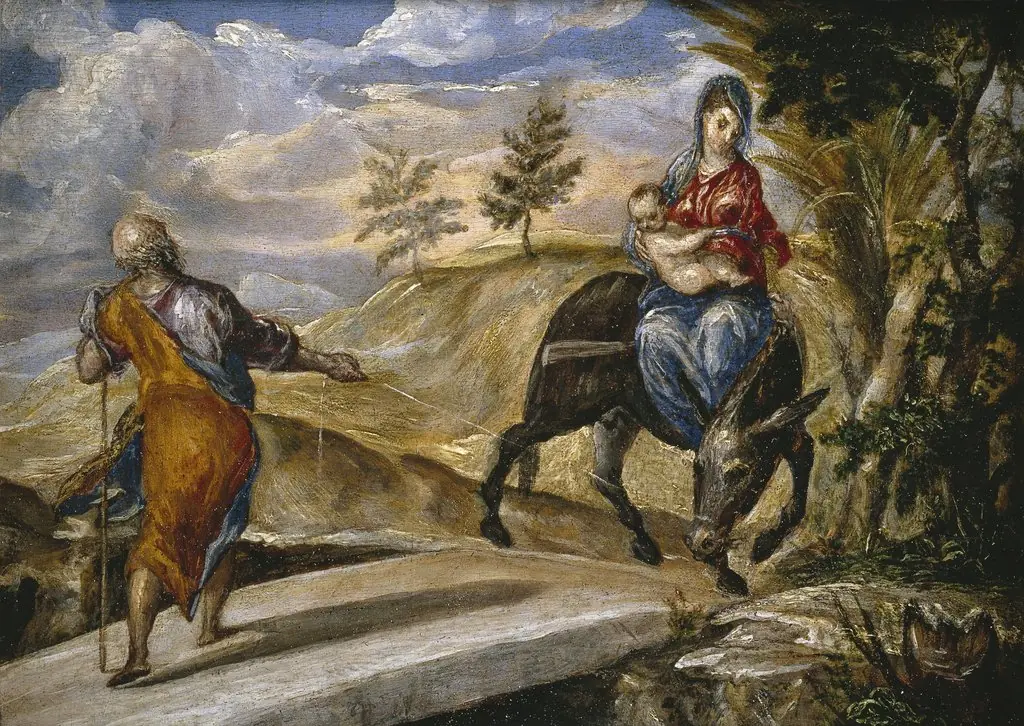
Joseph leads a plodding donkey along a riverbank at dawn, glancing back toward Mary and the Christ Child in this panel from around 1515. Vittore Carpaccio plays down the danger of Herod's massacre, moving the Holy Family unhurried through a lush Venetian landscape of rolling hills, jagged peaks, and a bridge over calm water.
Subject & Meaning
The family is shown escaping the Massacre of the Innocents ordered by King Herod, seeking refuge in Egypt, where established Jewish communities offered safety.
The painting depicts the Flight into Egypt, a biblical episode from the Gospel of Matthew, with additional details drawn from apocryphal gospels. Mary, wearing an ornate gold-and-blue damask mantle, holds the Christ Child while riding a donkey led by Saint Joseph. The family is shown escaping the Massacre of the Innocents ordered by King Herod, seeking refuge in Egypt, where established Jewish communities offered safety.
The idyllic landscape, with atmospheric light and color, integrates the figures harmoniously, emphasizing the journey’s narrative and protective nature. This subject was uncommon as an independent painting; its scale suggests it may have been created for a Venetian confraternity, serving a devotional purpose focused on the Holy Family’s peril and divine guidance. The iconography highlights themes of refuge, maternal care, and divine protection.
Technique & Style
Executed in oil on panel and measuring 73 × 111 cm, Carpaccio's composition combines a detailed foreground with an expansive landscape. Stylistically, the work displays atmospheric handling of light and color reminiscent of Giovanni Bellini, yet Carpaccio retains a crisper outline and less sfumato, lending the figures a slightly archaic quality. The sky achieves a tonal softness that suggests direct observation from nature.
Mary's damask mantle, rendered in gold and blue, exemplifies the painter's attention to decorative surface. Conservation examination completed in 1995 confirmed that the original paint layer is well preserved.
History & Provenance
The circumstances of the commission and original location of Carpaccio’s Flight into Egypt are unknown. The painting is generally dated to the early 16th century, with scholars placing it around 1500 or within the range 1500–1510. Its provenance begins with Edward Solly in Berlin; in 1821 it was purchased for the Königliche Museen and from 1904 was displayed at the Kaiser-Friedrich-Museum.
It was sold in 1924 to Charles Albert de Burlet, passing through the collections of Luigi Grassi and Arthur J. Sulley & Co. before being acquired by Otto H. Kahn in 1927. After a period with Duveen Brothers, it was purchased on 26 April 1937 by the A.W. Mellon Educational and Charitable Trust and donated that same year to the National Gallery of Art, where it remains.
The painting is held at the National Gallery of Art, Washington, D.C., as part of the Andrew W. Mellon collection. It was exhibited at the Kaiser-Friedrich-Museum in Berlin from 1904 to 1924. The work was gifted to the National Gallery of Art in 1937 by The A.W. Mellon Educational and Charitable Trust. No specific accession number is provided in the available sources.
Context
Scholarship on Carpaccio's Flight into Egypt has long debated both its attribution and dating. In 1980, Ellis Waterhouse asserted that the painting was 'widely believed to have been painted almost entirely by Luigi Grassi,' a restorer; however, conservation examination by the National Gallery of Art in 1995 confirmed the original paint layer is well preserved, reaffirming Carpaccio's authorship. The work's date remains uncertain, placed between 1500 and 1510.
Stylistically, the painting employs atmospheric light and color reminiscent of Giovanni Bellini, yet Carpaccio retains a more linear, archaic treatment of figures, situating him within Venetian Renaissance traditions. The subject is rare as an independent panel rather than a predella scene, which has led scholars to speculate it may have been commissioned by a Venetian confraternity.
Overview
Vittore Carpaccio's oil on panel painting, The Flight into Egypt, created around 1515, depicts the Holy Family's journey to escape King Herod. Rather than focusing on the danger of their flight, the artist portrays a tranquil, measured procession through a vast landscape. Joseph leads the donkey, carrying Mary and the infant Jesus, as dawn breaks over rolling hills and distant peaks.
This work is a significant example of Carpaccio's mature style, now housed at the National Gallery of Art.
Own this work as a print
Artist & collection

Artist
Vittore Carpaccio (UK: kar-PATCH-ee-oh, US: -PAHTCH-, Italian: ; c. 1460/65 – c. 1525) was an Italian painter of the Venetian school who studied under Gentile Bellini. Carpaccio was largely influenced by the style of…