Artwork
A Caribbe Village in Dutch Guiana
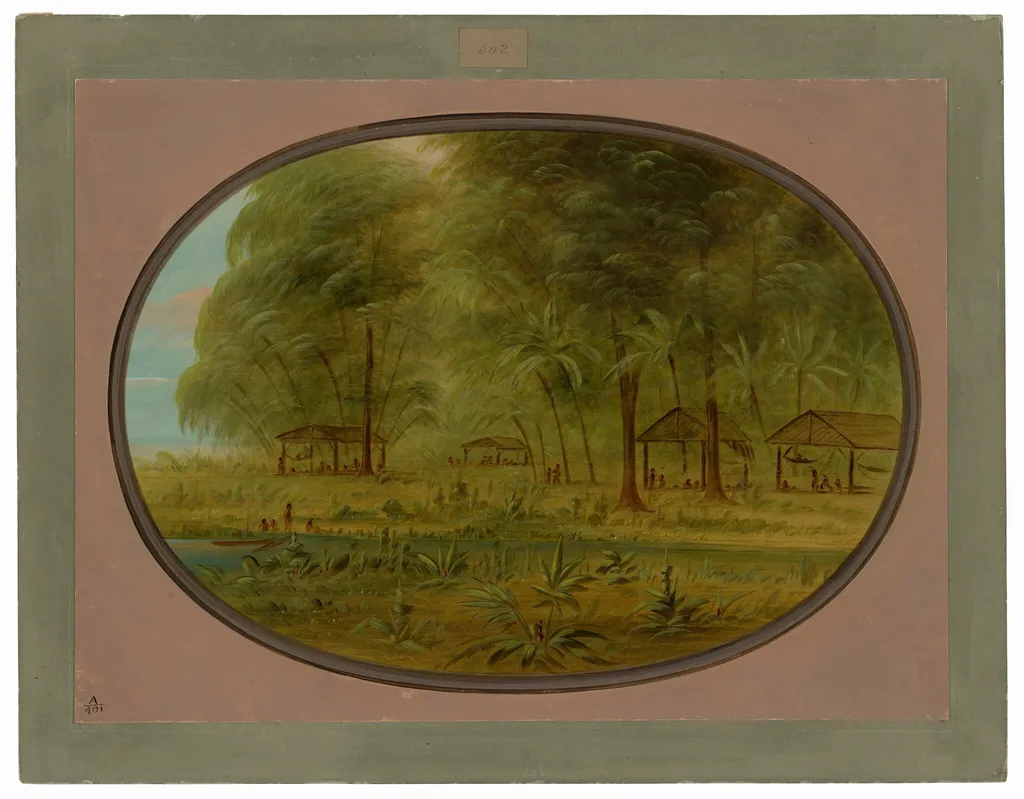
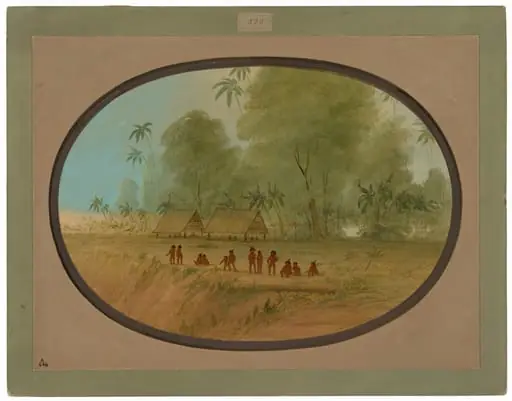
A Caribbe Village in Dutch Guiana is an oil painting by the Impressionist artist George Catlin. It dates from 1862 and is held in the collection of the National Gallery of Art.
About this work
He traveled to South America to sketch what he saw, then turned those sketches into paintings like this one.
This painting shows a Caribbean village with palm trees and wooden houses along a dirt road. A few people walk under the shade of the trees. The colors are bright but not too sharp.
George Catlin painted it in 1854, but he came back to touch it up in 1869. He traveled to South America to sketch what he saw, then turned those sketches into paintings like this one.
If you like this, look up Catlin, George.
Technique & Style
George Catlin painted A Caribbe Village in Dutch Guiana in 1861 using oil on card that was later mounted on paperboard, a support typical of his portable field works. The painting measures 45.8 cm by 62.4 cm and depicts a solitary tree within a tropical setting, rendered with loose brushwork that emphasizes atmospheric light and the dense foliage characteristic of Catlin's landscape style. The canvas bears signs of careful handling, including a protective backing and a later mounting onto a rigid board to preserve its fragile support.
Its condition remains stable, with only minor craquelure along the edges that has not compromised the integrity of the image. The work is housed in the National Gallery of Art in Washington, D.C., where it is displayed as part of the institution's American art collection.
History & Provenance
The painting was created in 1861 by George Catlin as an oil on card mounted on paperboard landscape. It descended through the artist's daughters Clara Gregory Catlin, Louise Catlin Kinney, and Elizabeth Wing Catlin before being purchased in 1912 from Elizabeth Wing Catlin by the American Museum of Natural History. The work was later sold in 1959 through Kennedy Galleries, New York, to Paul Mellon of Upperville, Virginia, and was gifted to the National Gallery of Art in 1965.
A Caribbe Village in Dutch Guiana is currently held by the National Gallery of Art in Washington, D.C. The work entered the museum's collection in 1965 as a gift from Paul Mellon. Its provenance traces back to the artist George Catlin and his daughters before being acquired by the American Museum of Natural History in 1912. The painting was subsequently sold through Kennedy Galleries in New York to Paul Mellon in 1959.
The provided sources do not list a specific inventory or accession number, nor do they document any exhibition history for the work.
The National Gallery of Art serves as the permanent location for this 1861 oil painting.
Context
Painted in 1861, A Caribbe Village in Dutch Guiana exemplifies George Catlin's interest in Caribbean landscapes and indigenous life, reflecting his broader engagement with colonial territories during the mid-19th century. The work's depiction of a tree aligns with his observational focus on natural elements within ethnographic contexts. It entered the National Gallery of Art's collection in 1965 through the bequest of Paul Mellon, following its acquisition from Kennedy Galleries in 1959 and prior descent through the Catlin family. The painting remains part of the National Gallery of Art's holdings in Washington, D.C.
Overview
George Catlin’s A Caribbe Village in Dutch Guiana presents a tropical settlement rendered in oil on card that has been mounted on paperboard. The composition centers on a cluster of palm‑fringed wooden dwellings lining a narrow, unpaved road, with a few figures moving beneath the trees. The palette is vivid yet restrained, conveying the humid atmosphere without resorting to harsh contrasts.
Subject & Meaning
The painting captures a moment in a Caribbean village of Dutch Guiana, emphasizing everyday life rather than grand historical events. Palm trees provide shade for the modest wooden homes, while pedestrians traverse the dusty thoroughfare, suggesting a community engaged in routine activity. The work reflects Catlin’s interest in documenting the lives of peoples on the margins of the Western world.
Own this work as a print
Artist & collection

Artist
George Catlin ( KAT-lin; July 26, 1796 – December 23, 1872) was an American lawyer, painter, author, and traveler, who specialized in portraits of Native Americans in the American frontier.

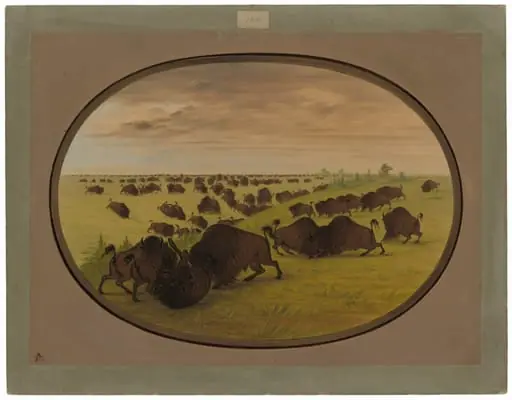 Bulls Fighting
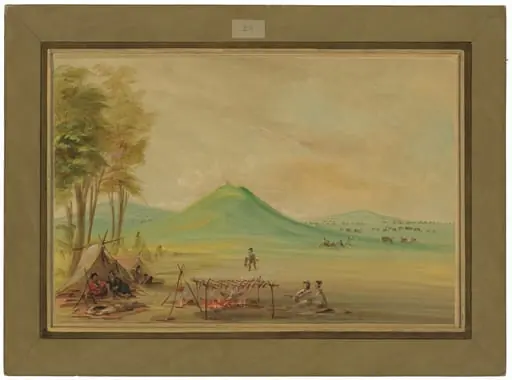 Expedition Encamped on a Texas Prairie. April 1686
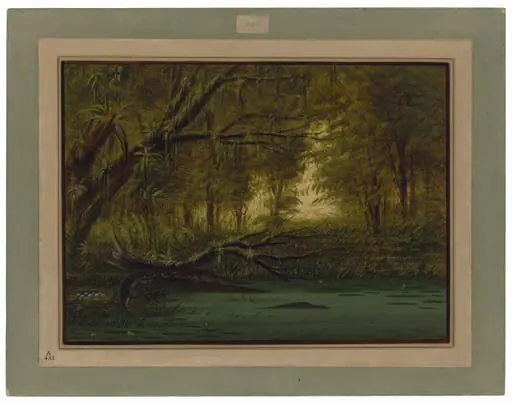 An Alligator's Nest
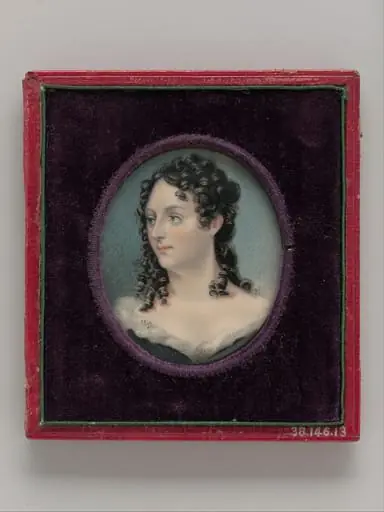 Mrs. George Catlin (Clara Bartlet Gregory)
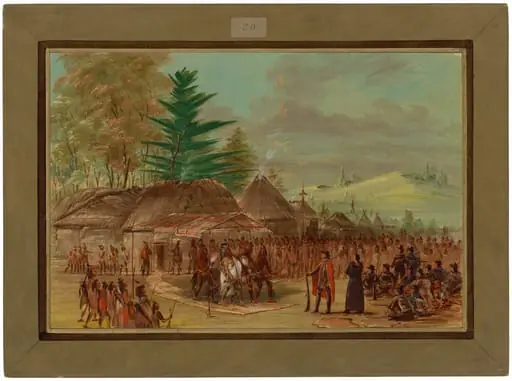 Chief of the Taensa Indians Receiving La Salle. March 20, 1682
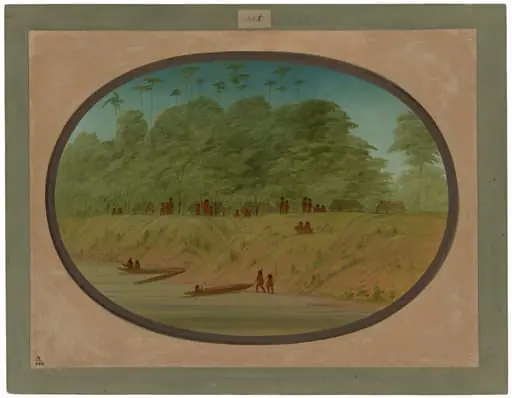 A Small Village - Payaguas Indians
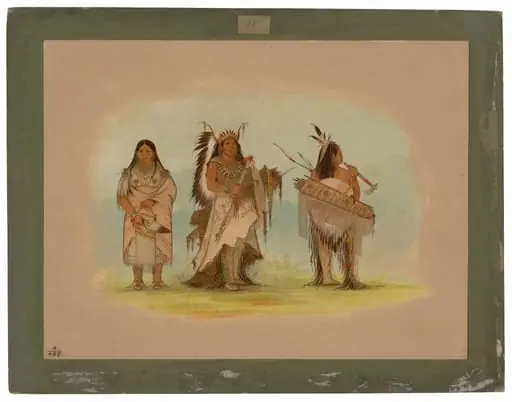 Omaha Chief, His Wife, and a Warrior
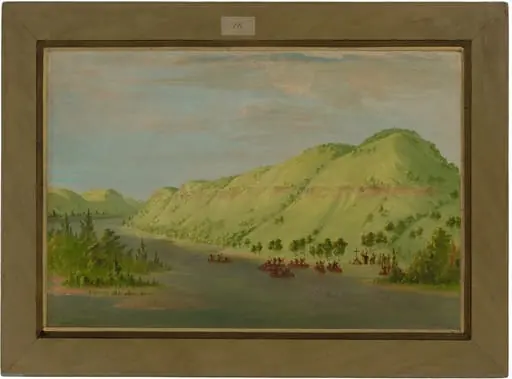 Father Hennepin Leaving the Mississippi to Join La Salle. May 8, 1680