Artwork
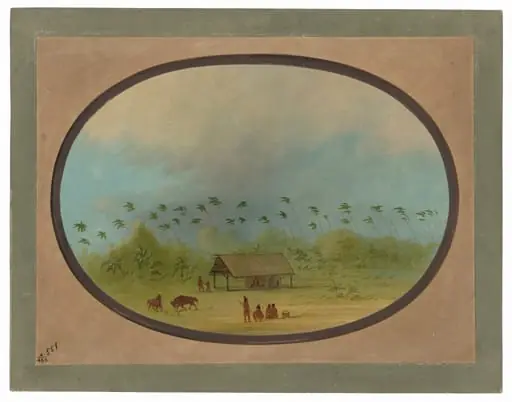
A Connibo Village
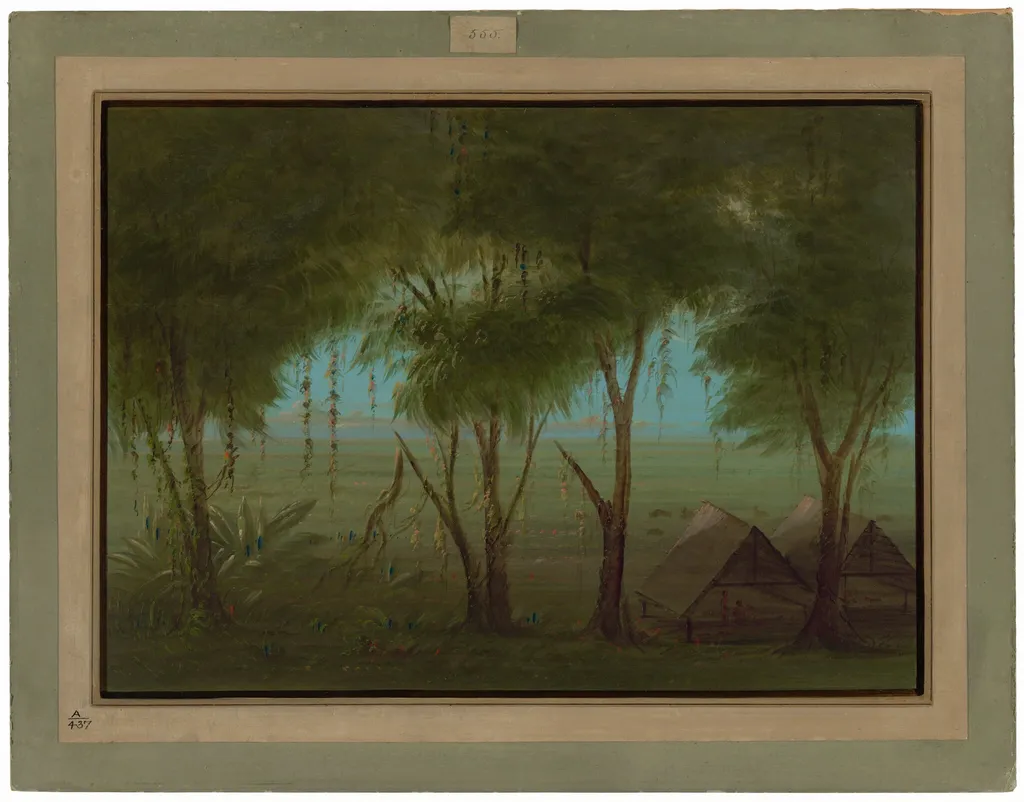
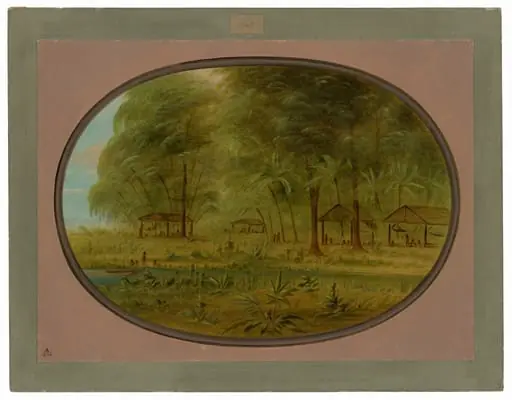
A Connibo Village is an oil painting by the Impressionist artist George Catlin. It dates from 1862 and is held in the collection of the National Gallery of Art.
About this work
Subject & Meaning
The work reflects Catlin’s broader project of documenting Native American cultures during his travels along the Amazon and Orinoco rivers in 1856–1857.
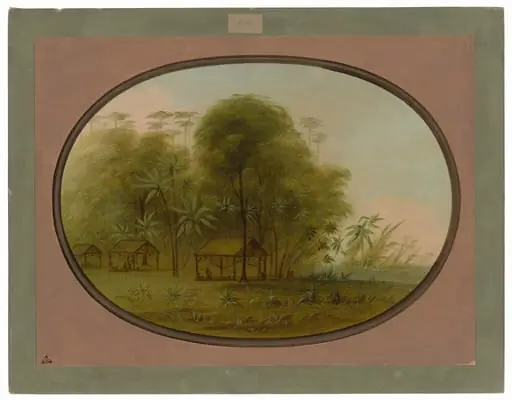
The painting depicts a scene of an Indigenous village associated with the Conibo people, an ethnic group of the western Amazon basin. Catlin’s composition centers on a cluster of thatched communal houses arranged around a large tree, emphasizing the integration of built structures with the surrounding forest. The tree functions as both a natural landmark and a communal space, suggesting themes of shelter, kinship, and environmental harmony that Catlin associated with Indigenous lifeways.
The work reflects Catlin’s broader project of documenting Native American cultures during his travels along the Amazon and Orinoco rivers in 1856–1857. By framing the village as a harmonious settlement within nature, the painting advances an idealized vision of Indigenous society that Catlin promoted in his visual and written records.
Technique & Style
Executed in 1861, this work is an oil painting applied on card that has been mounted onto a paperboard support. The composition features a tree as a primary depicted element within the village scene. The physical dimensions of the piece are recorded as 46 cm in height and 59.8 cm in width.
As a painting by George Catlin, the work utilizes traditional oil media to render its subject matter on a rigid, composite backing rather than a conventional canvas or wooden panel.
History & Provenance
Painted by George Catlin in 1861, this oil on card work remained in the artist's possession until his death in 1872. Ownership subsequently passed by descent to his daughters: Clara Gregory Catlin, Louise Catlin Kinney, and Elizabeth Wing Catlin. In 1912, the American Museum of Natural History purchased the piece directly from Elizabeth Wing Catlin.
The museum retained the work until 1959, when it was sold through Kennedy Galleries of New York to Paul Mellon of Upperville, Virginia. Mellon later donated the painting to the National Gallery of Art in Washington, D.C., in 1965.
A Connibo Village is held by the National Gallery of Art in Washington, D.C., where it entered the collection in 1965 as a gift from Paul Mellon of Upperville, Virginia. Mellon had acquired the painting in 1959 through Kennedy Galleries in New York. Before that, the work had been purchased in 1912 by the American Museum of Natural History from Elizabeth Wing Catlin, one of George Catlin's three daughters, through whom it had descended from the artist.
The painting was created in 1861 in oil on card mounted on paperboard, and measures 46 by 59.8 centimeters.
Context
Painted in 1861, the work entered the National Gallery of Art collection in 1965 after passing through the artist's descendants and a 1959 sale at Kennedy Galleries to Paul Mellon. George Catlin, known for his documentation of North American Indigenous cultures, created this piece during a period when his expeditions and paintings were gaining institutional attention. The painting remains part of the National Gallery of Art's permanent holdings in Washington, D.C.
Scholarly discussion of the work situates it within Catlin's broader effort to record disappearing cultural practices, though specific critical reception details are not provided in the available sources.
Legacy
The painting A Connibo Village (1861) by George Catlin entered the National Gallery of Art collection in 1965, ensuring its preservation and scholarly visibility. Its inclusion in major Catlin retrospectives during the 1970s renewed interest in his ethnographic approach to Native American subjects, influencing later anthropological art documentation practices. The work's provenance through prominent collectors such as Paul Mellon contributed to its market recognition, with subsequent exhibitions at institutions like the Smithsonian American Art Museum highlighting its significance in 19th-century American art.
Overview
Created in 1862, A Connibo Village is an oil painting executed on a card support that has been mounted on paperboard. The composition centers on a solitary, tall tree rising above a group of round, thatched huts, with sunlight illuminating the roofs and casting shadows at the base. A few figures in modest attire move among the dwellings, conveying a moment of everyday life.
Own this work as a print
Artist & collection

Artist
George Catlin ( KAT-lin; July 26, 1796 – December 23, 1872) was an American lawyer, painter, author, and traveler, who specialized in portraits of Native Americans in the American frontier.

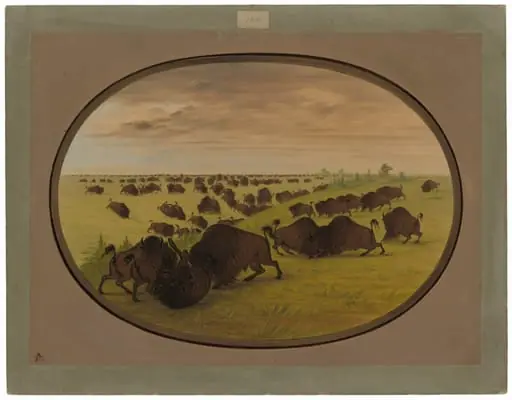 Bulls Fighting
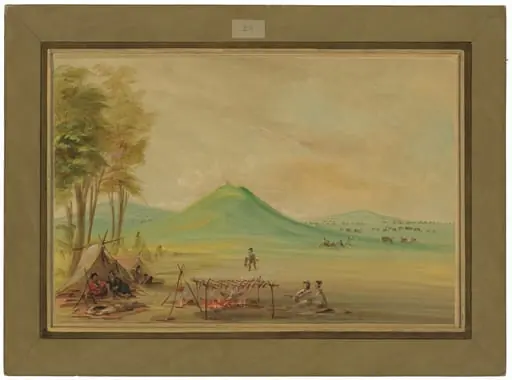 Expedition Encamped on a Texas Prairie. April 1686
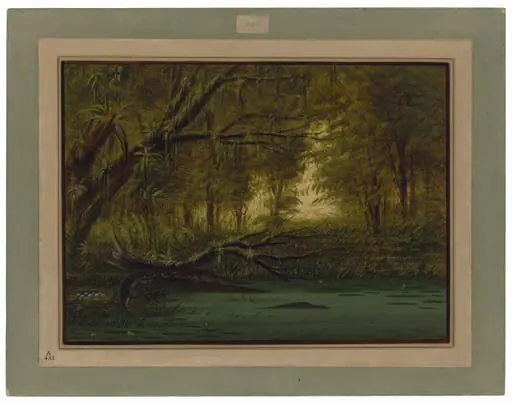 An Alligator's Nest
 Mrs. George Catlin (Clara Bartlet Gregory)
 Chief of the Taensa Indians Receiving La Salle. March 20, 1682
 A Small Village - Payaguas Indians
 Omaha Chief, His Wife, and a Warrior
 Father Hennepin Leaving the Mississippi to Join La Salle. May 8, 1680