Artwork
An Amazon Forest - Looking Ashore
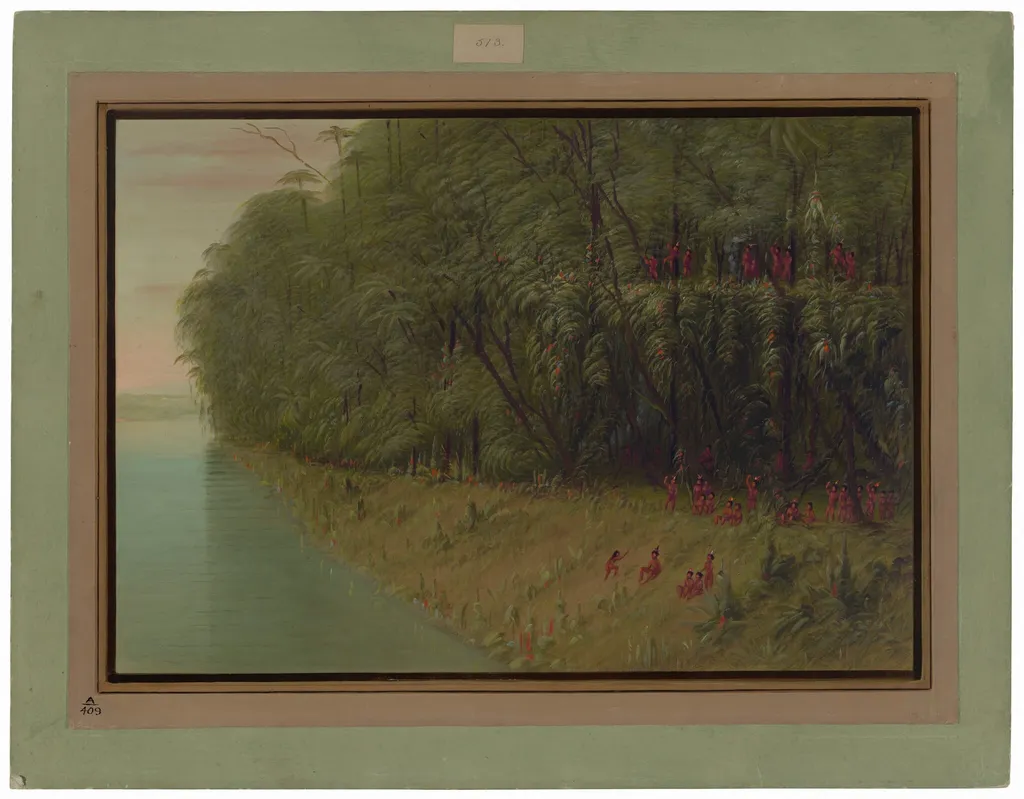
An Amazon Forest - Looking Ashore is an oil painting by the Impressionist artist George Catlin. It dates from 1862 and is held in the collection of the National Gallery of Art.
About this work
Overview
An Amazon Forest - Looking Ashore is an oil painting on card mounted on paperboard created by American artist George Catlin in 1861.
An Amazon Forest - Looking Ashore is an oil painting on card mounted on paperboard created by American artist George Catlin in 1861. Measuring 46.2 by 62.7 centimeters, the work is held in the collection of the National Gallery of Art in Washington, D.C., where it entered in 1965 as part of a major gift from Paul Mellon. The painting belongs to Catlin's so-called Cartoon Collection, a second body of work numbering more than 600 paintings that he produced during the 1850s and 1860s, largely from memory and earlier notes, after financial difficulties forced him to sell his original Indian Gallery in 1852. While Catlin is best known for his portraits of Native Americans of the Great Plains, this work represents his engagement with South American subjects during his later travels, demonstrating the breadth of his documentary ambitions across the Americas.
Subject & Meaning
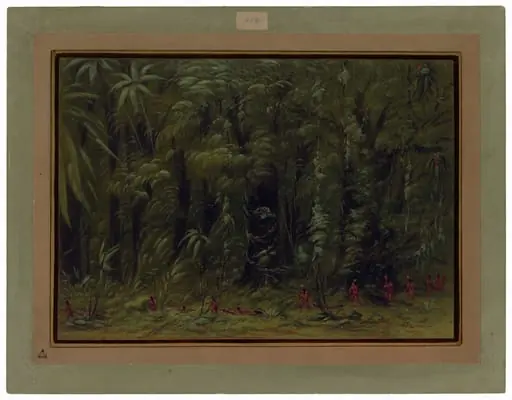
The painting depicts a dense tropical forest rising along a calm riverbank, viewed from the water as if from a vessel. The composition is horizontally divided between a broad expanse of greenish water on the left and a thickly wooded shore on the right. Numerous small human figures, many wearing red, are scattered throughout the scene, some standing in groups among the trees, others sitting or reclining on the grassy bank, and several appearing partially submerged at the water's edge. Catlin's own 1871 catalog entry for the work, when he exhibited the Cartoon Collection in New York, describes it as An Amazon Forest, looking ashore from the steamer, indicating the perspective of a traveler observing riverside life from a passing boat. The scene captures a moment of everyday activity in the Amazon basin, with the figures engaged in what appears to be casual riverside existence rather than the more formal ceremonial subjects Catlin often depicted. The red garments of the figures provide visual accents against the dominant greens of the forest and water, drawing attention to human presence within the vast tropical landscape. The work thus serves as both a topographical record and an ethnographic observation, consistent with Catlin's lifelong project of documenting Indigenous peoples and their environments across the Americas.
Technique & Style
The medium is oil on card mounted on paperboard, a support Catlin frequently used for the Cartoon Collection works. The brushwork varies from smooth in the water to more stippled and layered in the vegetation, creating textural differentiation between the liquid surface and the dense foliage. The forest is rendered with layered, textured foliage in deep greens with darker trunks and undergrowth, while the sky at the upper left shows pale pinkish and gray tones. Light appears diffused throughout, with no strong shadows, suggesting an overcast or humid atmosphere characteristic of tropical river environments. This handling of light and atmosphere differs somewhat from the more dramatic illumination often found in Catlin's earlier western landscapes. The painting is mounted in a wide mat with a small numbered label at top center, a presentation format consistent with the Cartoon Collection's exhibition history. The relatively modest scale, typical of the Cartoon works, belies the ambition of the panoramic view, as Catlin compresses extensive riverside terrain into a compact format through layered spatial recession.
History & Provenance
The painting was created in 1861, during the period when Catlin was actively producing works for his second collection. After Catlin's death in 1872, the work descended to his daughters, Clara Gregory Catlin, Louise Catlin Kinney, and Elizabeth Wing Catlin. In 1912, the American Museum of Natural History purchased the painting from Elizabeth Wing Catlin, acquiring a substantial portion of the surviving Cartoon Collection. The museum deaccessioned the work in 1959, selling it through Kennedy Galleries in New York to Paul Mellon of Upperville, Virginia. Mellon, a major collector and philanthropist, purchased more than 300 paintings from the Cartoon Collection during this deaccession. In 1965, he gave 351 works from this collection to the National Gallery of Art, including this painting, which received accession number 1965.16.272. The work has been exhibited in several notable contexts: it was lent for extended display at the U.S. Embassy residence in Luxembourg from 1986 to 1990, and it appeared in Picturing Paradise: The Rain Forest at Risk at the Fernbank Museum of Natural History in Atlanta from 1992 to 1993. It was also included in the National Gallery's lending program exhibitions of South American Indian Paintings by George Catlin at the Museums at Hartwick College in Oneonta, New York, in 1992, and at the Lowe Art Museum at the University of Miami in Coral Gables, Florida, from 1994 to 1995. The work has been reproduced in the National Gallery's American Paintings catalogues in 1970, 1980, and 1992.
Context
George Catlin (1796-1872) was a self-trained artist who became among the first painters to travel west specifically to record American Indian subjects and environments. Beginning in 1830, he undertook five expeditions between 1830 and 1836, visiting fifty tribes and producing more than 500 paintings that formed his original Indian Gallery. Financial difficulties forced him to sell this collection in 1852, after which he spent the remaining two decades of his life recreating and reimagining his earlier work. The Cartoon Collection, produced during the 1850s and 1860s, included more than 600 works based on his earlier sketches, notes, and memories. During this later period, Catlin also traveled through South and Central America from 1852 to 1857, and the Amazon subjects reflect this expanded geographical scope. While his earlier work focused primarily on the Plains Indians of North America, the later paintings incorporated his broader travels. The Cartoon Collection works, including An Amazon Forest - Looking Ashore, were long accepted as exact copies of his earlier subjects but are now understood as images shaped by European artistic conventions and the artist's own evolving memory. Catlin's practice of working from memory and repetition has generated scholarly discussion about the documentary status of his later works, with critics noting that his pictures of native peoples are veneered with European sensibilities even as they claim ethnographic accuracy.
Legacy
An Amazon Forest - Looking Ashore occupies a significant place within the larger body of Catlin's Cartoon Collection and in the institutional history of American art. As one of 351 works from this collection donated by Paul Mellon to the National Gallery of Art in 1965, it helped establish one of the most comprehensive holdings of Catlin's later work in any museum. The painting's inclusion in exhibitions such as Picturing Paradise: The Rain Forest at Risk in 1992-1993 demonstrates its continued relevance to discussions of environmental representation and the visual documentation of tropical landscapes. The work also figures in the broader reassessment of Catlin's career, in which scholars have moved away from viewing his paintings as straightforward ethnographic records toward understanding them as complex constructions mediated by European artistic traditions, personal memory, and the demands of popular exhibition. The survival of Catlin's catalog entry for this work, with its specific notation of the steamer vantage point, provides valuable primary documentation for understanding his working methods and the narrative framing he intended for his audiences. As with much of Catlin's output, the painting continues to serve as a focal point for debates about the representation of Indigenous peoples and environments by Euro-American artists, the reliability of visual documents produced from memory, and the institutional histories that have shaped the preservation and display of American art.
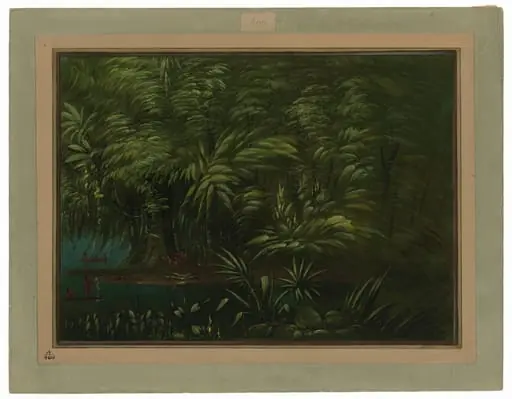
Own this work as a print
Artist & collection

Artist
George Catlin ( KAT-lin; July 26, 1796 – December 23, 1872) was an American lawyer, painter, author, and traveler, who specialized in portraits of Native Americans in the American frontier.

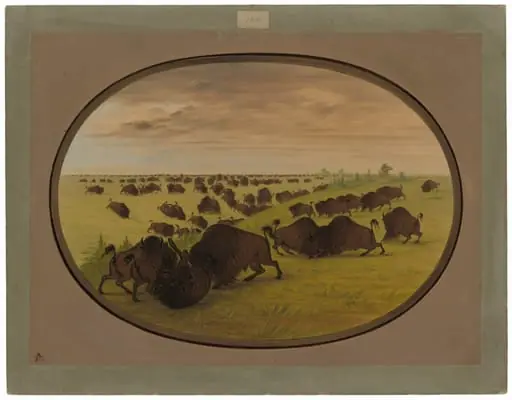 Bulls Fighting
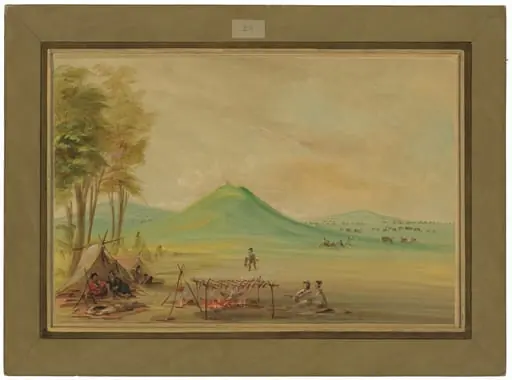 Expedition Encamped on a Texas Prairie. April 1686
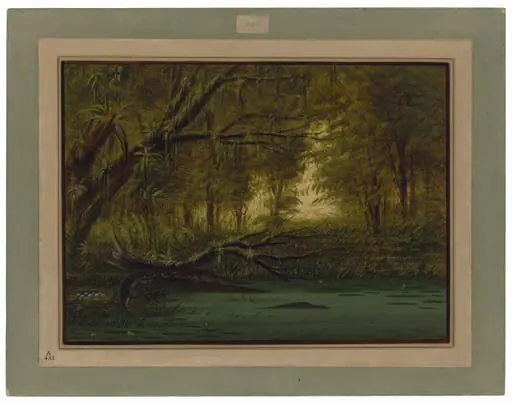 An Alligator's Nest
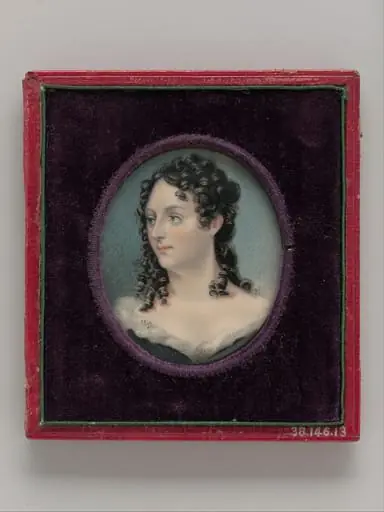 Mrs. George Catlin (Clara Bartlet Gregory)
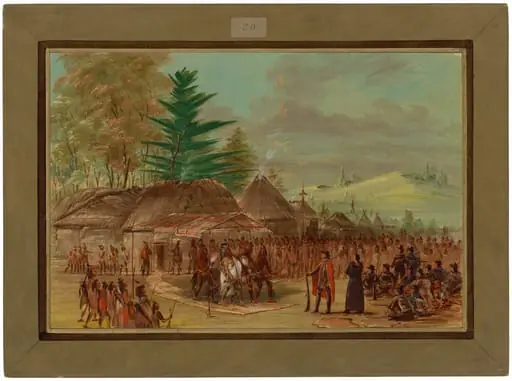 Chief of the Taensa Indians Receiving La Salle. March 20, 1682
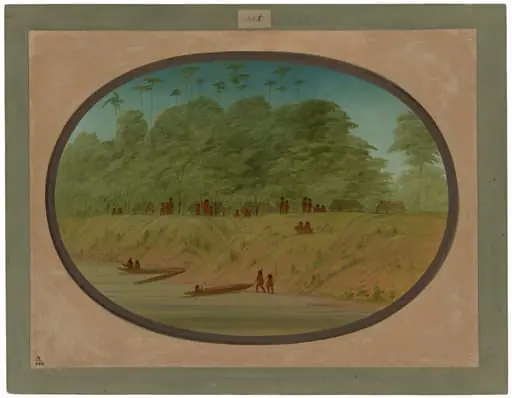 A Small Village - Payaguas Indians
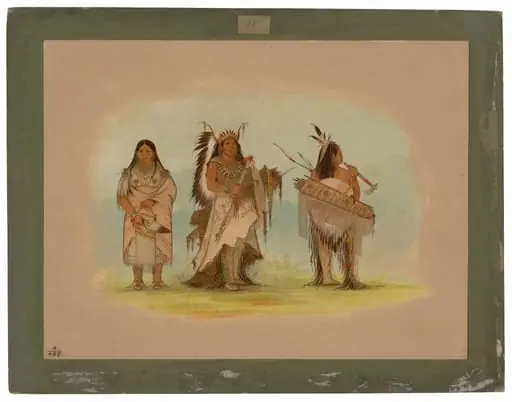 Omaha Chief, His Wife, and a Warrior
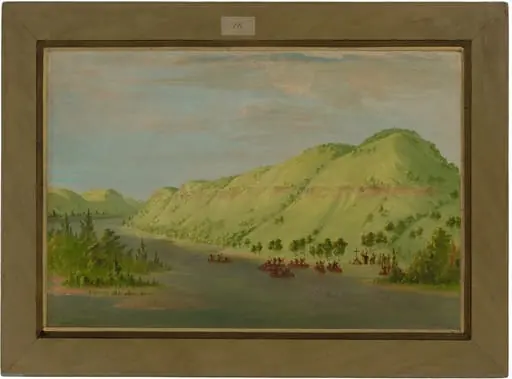 Father Hennepin Leaving the Mississippi to Join La Salle. May 8, 1680