Artwork
Buffalo Chase in the Snow Drifts - Ojibbeway
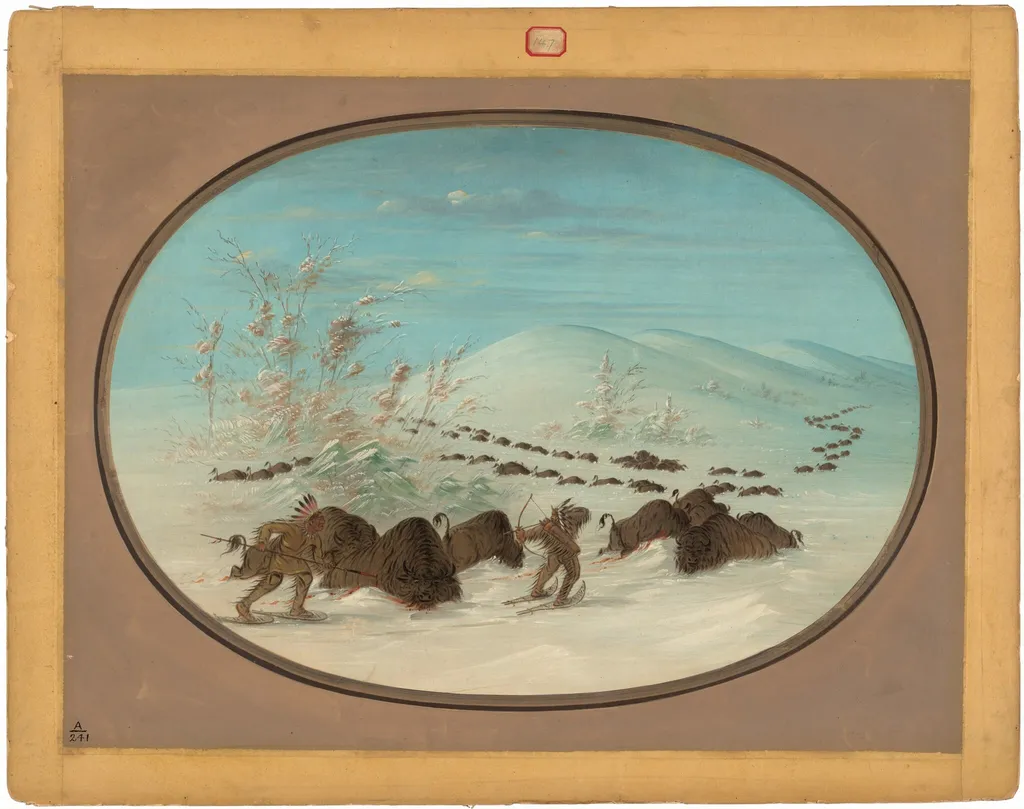
Buffalo Chase in the Snow Drifts - Ojibbeway is an oil painting by the Impressionist artist George Catlin. It dates from 1865 and is held in the collection of the National Gallery of Art.
About this work
George Catlin shows a stampede of bison crashing through deep snow. Their dark shapes stand out against the white ground. A lone rider on a horse races beside them, barely visible.
This wasn’t painted from life. Catlin saw it in 1832 but made the work years later, in 1861. He wanted to keep a record of disappearing Native ways.
Look up Catlin, George next.
Technique & Style
Classified as a landscape painting, the composition incorporates trees within its depiction of the winter scene.
George Catlin's Buffalo Chase in the Snow Drifts - Ojibbeway is executed in oil paint applied directly to a card support, which is subsequently mounted onto a paperboard backing. The work measures 47.5 cm in height and 63.3 cm in width. Classified as a landscape painting, the composition incorporates trees within its depiction of the winter scene.
The medium and mounting technique reflect the specific material choices Catlin employed for this 1861 artwork, distinguishing it from his larger-scale canvas works.
History & Provenance
George Catlin executed "Buffalo Chase in the Snow Drifts - Ojibbeway" in 1861 as an oil painting on card mounted to paperboard. Following the artist's death in 1872, the work passed by descent to his daughters: Clara Gregory Catlin, Louise Catlin Kinney, and Elizabeth Wing Catlin. In 1912, the American Museum of Natural History purchased the piece directly from Elizabeth Wing Catlin.
The museum subsequently sold the painting in 1959 through Kennedy Galleries of New York to Paul Mellon of Upperville, Virginia. Mellon retained the work until 1965, at which point he gifted it to the National Gallery of Art in Washington, D.C., where it remains in the collection.
The painting Buffalo Chase in the Snow Drifts - Ojibbeway is held by the National Gallery of Art in Washington, D.C. It was acquired by the museum in 1965 as a gift from Mr. Paul Mellon. The work entered the collection through a series of transactions beginning with its creation by George Catlin in 1861, followed by descent through his daughters, a 1912 purchase by the American Museum of Natural History, a 1959 sale via Kennedy Galleries to Paul Mellon, and finally its 1965 donation to the National Gallery of Art.
Context
George Catlin painted Buffalo Chase in the Snow Drifts - Ojibbeway in 1861, an oil on card work now held by the National Gallery of Art in Washington, D.C.. The landscape depicts a tree and belongs to Catlin's broader series documenting Ojibwe life and Arctic and American frontier scenes. Its provenance traces from the artist's daughters to the American Museum of Natural History, then through Kennedy Galleries to Paul Mellon before its 1965 donation to the National Gallery of Art.
Overview
George Catlin’s oil painting on card, mounted on paperboard, portrays a winter buffalo stampede on the Ojibwe trail. Dark silhouettes of bison surge across a deep snowfield, while a solitary rider on horseback follows the herd, almost swallowed by the white expanse. The work dates to the mid‑1860s and reflects Catlin’s long‑term project of recording Indigenous life.
Subject & Meaning
The scene captures a moment of Ojibwe hunting practice, emphasizing the relationship between the tribe, the horse, and the bison in a harsh winter environment. By depicting the chase in snow, Catlin highlights both the vitality of the hunt and the challenges posed by the northern climate.
Own this work as a print
Artist & collection

Artist
George Catlin ( KAT-lin; July 26, 1796 – December 23, 1872) was an American lawyer, painter, author, and traveler, who specialized in portraits of Native Americans in the American frontier.

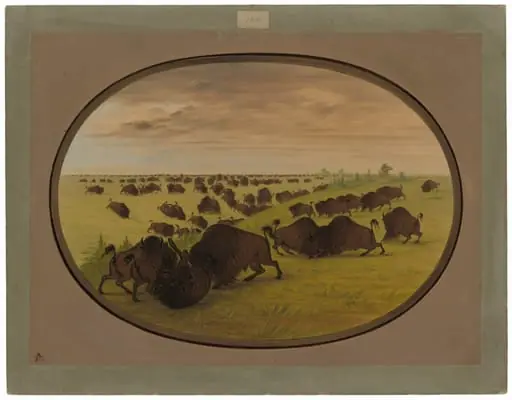 Bulls Fighting
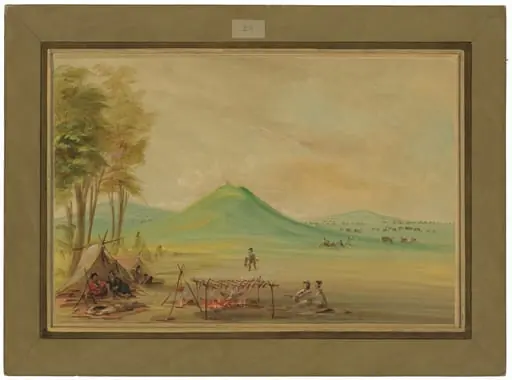 Expedition Encamped on a Texas Prairie. April 1686
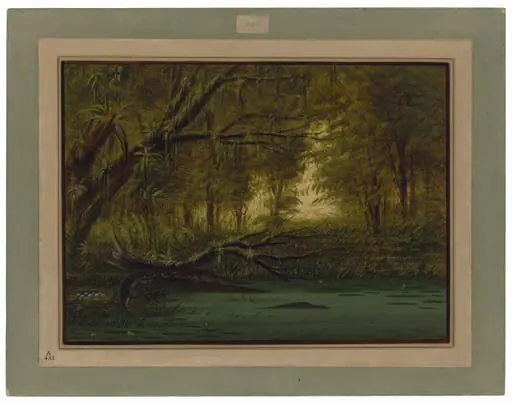 An Alligator's Nest
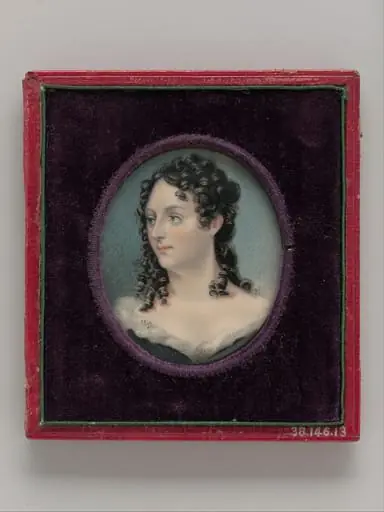 Mrs. George Catlin (Clara Bartlet Gregory)
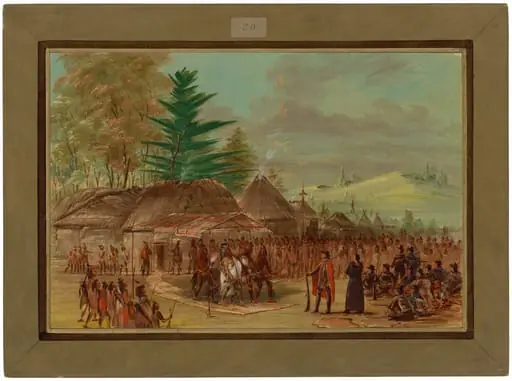 Chief of the Taensa Indians Receiving La Salle. March 20, 1682
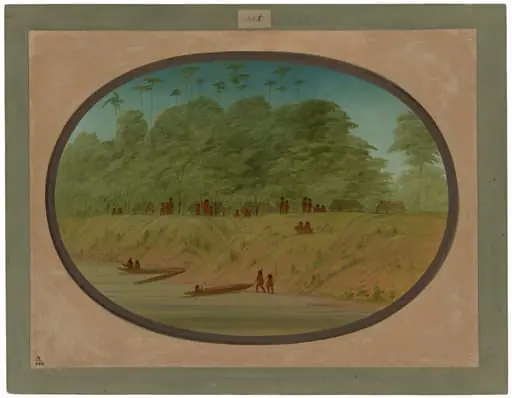 A Small Village - Payaguas Indians
 Omaha Chief, His Wife, and a Warrior
 Father Hennepin Leaving the Mississippi to Join La Salle. May 8, 1680