Artwork
Nine Ojibbeway Indians in London
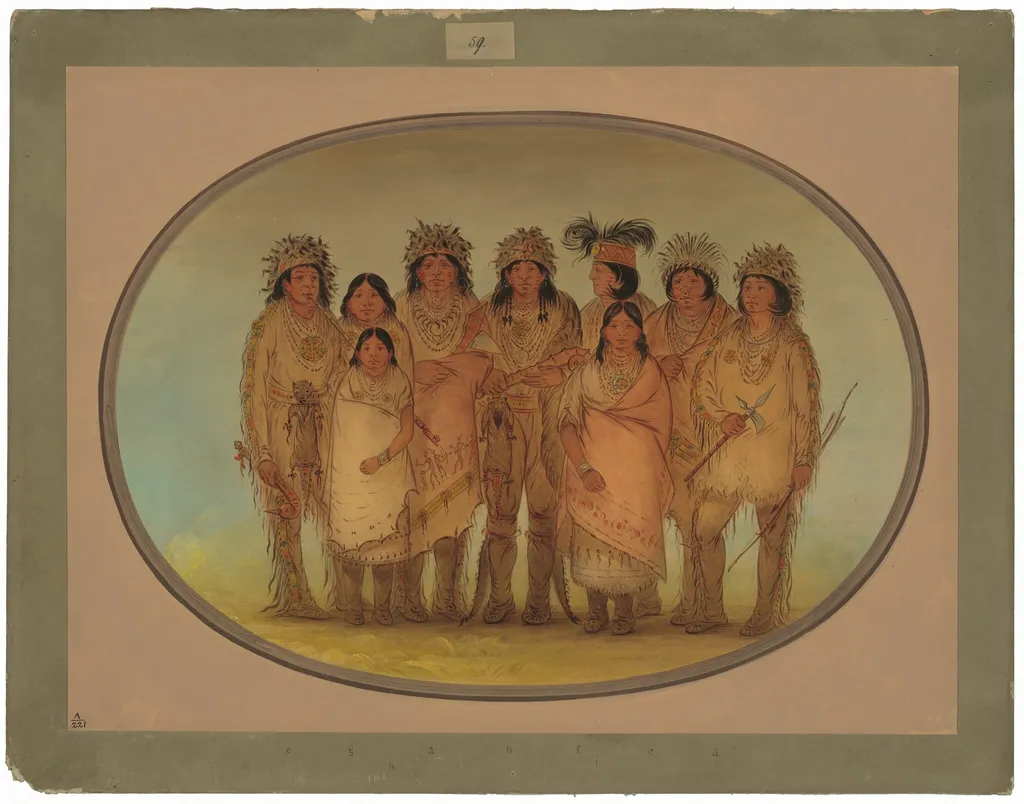
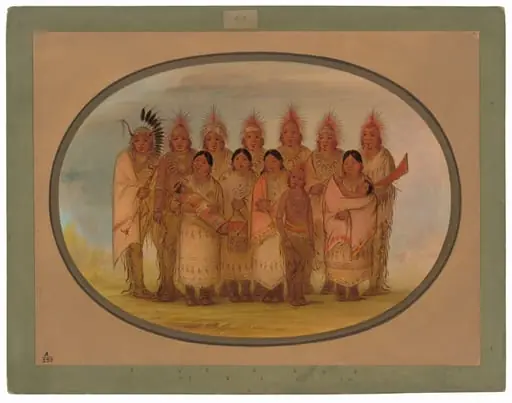
Nine Ojibbeway Indians in London is an oil painting by the American Folk Art artist George Catlin. It dates from 1865 and is held in the collection of the National Gallery of Art.
About this work
Subject & Meaning
By presenting the figures together, Catlin underscores themes of cultural exchange and the perceived vulnerability of Native communities facing colonization.
The painting depicts nine Ojibwe individuals gathered in an urban setting, a subject that Catlin framed as a documentation of Indigenous peoples encountering the modern world. The work functions as a visual ethnography, emphasizing the subjects’ traditional dress and posture to convey cultural identity while situating them within a contemporary European capital. By presenting the figures together, Catlin underscores themes of cultural exchange and the perceived vulnerability of Native communities facing colonization.
The composition serves both as a record of appearance and as a symbolic commentary on the intersection of Indigenous representation and Western modernity.
The portrait’s iconography relies on accurate ceremonial attire and accessories, which Catlin rendered with attention to detail to signal specific tribal affiliations and social roles. Symbolic elements such as feathered headdresses and beaded garments communicate status and spiritual significance, while the setting of London functions as a visual metaphor for displacement and adaptation. Together, these components construct a narrative of resilience and visibility, framing the subjects as active participants in a global encounter rather than passive curiosities.
Technique & Style
The work is an oil painting executed on card that is mounted on paperboard, classifying it as a portrait in the portrait genre. George Catlin rendered the scene with a focus on individual likenesses, capturing the distinct dress and postures of each Ojibwe figure while employing a relatively flat compositional space and restrained color palette characteristic of mid‑nineteenth‑century American portraiture. The canvas measures 46.6 cm in height by 62.4 cm in width, reflecting Catlin’s practice of working on modestly scaled supports that could be easily transported and displayed.
The painting’s condition appears stable, with the oil medium retaining its original sheen and the mounted support showing minimal warping despite centuries of handling and exhibition. These formal qualities underscore the work’s role as both a documentary record and a stylistic example of Catlin’s effort to document Indigenous peoples with a blend of ethnographic detail and artistic convention.
History & Provenance
The painting Nine Ojibbeway Indians in London was created by George Catlin in 1861. It is an oil work on card mounted on paperboard. The artist retained ownership until his death in 1872, after which the work passed by descent to his daughters: Clara Gregory Catlin, Louise Catlin Kinney, and Elizabeth Wing Catlin.
In 1912, the American Museum of Natural History purchased the piece from Elizabeth Wing Catlin. The museum sold it in 1959 through Kennedy Galleries in New York to collector Paul Mellon of Upperville, Virginia. Mellon subsequently gifted the painting to the National Gallery of Art in 1965, where it remains part of the collection.
The painting is held by the National Gallery of Art, Washington, D.C., where it is inventoried as accession 1965.1.104. It entered the collection in 1965 as a gift from Paul Mellon.
Its exhibition history is not documented in the cited sources.
Legacy
The painting's presence in the National Gallery of Art in Washington, D.C., where it has been part of the collection since 1965, ensures its continued visibility within a major American art institution. Its provenance, including acquisition by Paul Mellon and donation to the NGA, underscores its significance in 20th-century American art circles. The work remains cataloged in major art databases, such as the National Gallery of Art's collection, preserving its historical record.
Overview
Created in 1865, Nine Ojibbeway Indians in London is an oil painting executed on card that has been mounted on paperboard. The work presents a group portrait of nine Ojibwe individuals positioned side by side, each dressed in vivid garments and feathered headdresses, some holding sticks or pipes, against a pale, almost sky‑like background.
Context
The painting belongs to a broader body of work in which Catlin sought to preserve what he considered vanishing cultures. While many of his earlier pieces were drawn from direct observation on the frontier, this work illustrates the transatlantic interest in Native American peoples during the mid‑nineteenth century.
Own this work as a print
Artist & collection

Artist
George Catlin ( KAT-lin; July 26, 1796 – December 23, 1872) was an American lawyer, painter, author, and traveler, who specialized in portraits of Native Americans in the American frontier.

 Bulls Fighting
 Expedition Encamped on a Texas Prairie. April 1686
 An Alligator's Nest
 Mrs. George Catlin (Clara Bartlet Gregory)
 Chief of the Taensa Indians Receiving La Salle. March 20, 1682
 A Small Village - Payaguas Indians
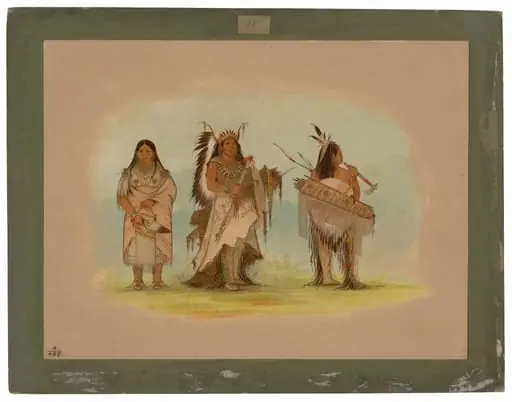 Omaha Chief, His Wife, and a Warrior
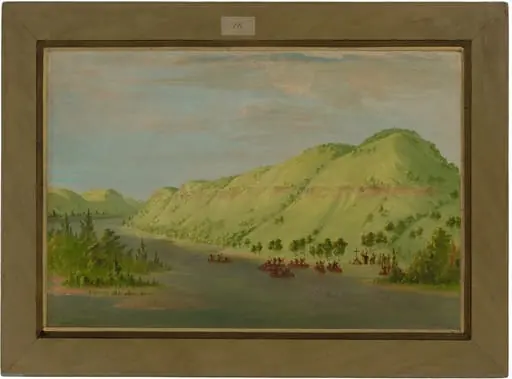 Father Hennepin Leaving the Mississippi to Join La Salle. May 8, 1680