Artwork
Two Saukie Chiefs and a Woman
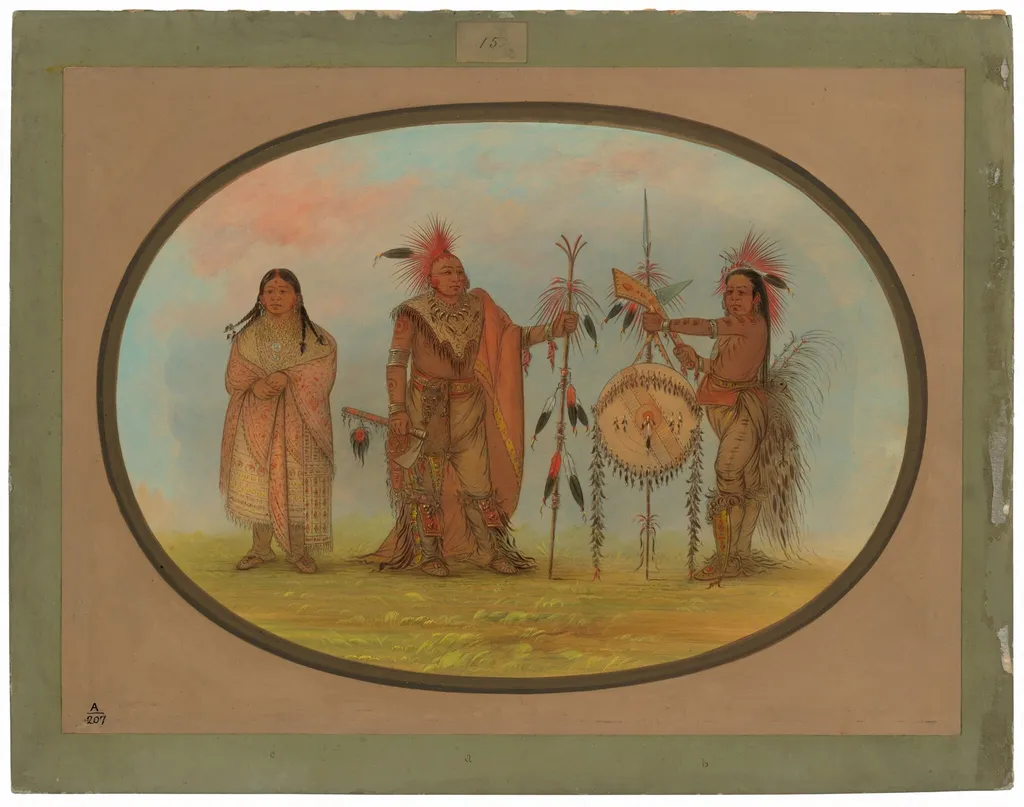
Two Saukie Chiefs and a Woman is an oil painting by the Impressionist artist George Catlin. It dates from 1865 and is held in the collection of the National Gallery of Art.
About this work
In this 1861 painting, George Catlin shows two Sauk chiefs sitting side by side with a woman standing between them.
In this 1861 painting, George Catlin shows two Sauk chiefs sitting side by side with a woman standing between them. The chiefs wear traditional feathers and beads while the woman holds a fan of feathers. Their faces look calm but serious.
Catlin traveled west in the 1830s to paint Native tribes. He met the Sauk in 1861 and sketched this scene years later. His work helps us see how people dressed and posed in daily life long ago.
Check out another Catlin, George painting to compare styles.
Technique & Style
Two Saukie Chiefs and a Woman is executed in oil on card mounted on paperboard, a support combination consistent with George Catlin's later practice of working on portable, lightweight grounds suited to his travels and to the rapid, on-the-spot portraiture he favored when documenting Indigenous leaders.
The painting is a small-scale, horizontally oriented composition measuring 46.8 cm in height by 63.1 cm in width, arranged to accommodate three figures across the picture plane. The handling reflects Catlin's characteristic directness: oil applied over the card-and-paperboard support yields a relatively matte, somewhat absorbent surface, on which he registered the figures' features, dress, and accoutrements with linear clarity rather than dense, polished finish.
Stylistically, the work belongs to Catlin's sustained ethnographic portrait series of Native American subjects, presenting the Saukie (Sac) chiefs and accompanying woman in a frontal, documentary mode designed to record likenesses, regalia, and bearing rather than to construct a narrative scene.
History & Provenance
Two Saukie Chiefs and a Woman is an 1865 oil on card mounted on paperboard by George Catlin. Following Catlin's death in 1872, the painting descended to his daughters Clara Gregory Catlin, Louise Catlin Kinney, and Elizabeth Wing Catlin. The American Museum of Natural History acquired it in 1912, purchasing it from Elizabeth Wing Catlin.
The work left the museum in 1959, sold through Kennedy Galleries in New York to Paul Mellon of Upperville, Virginia. Mellon gave the painting to the National Gallery of Art in 1965, where it remains.
Inventory or accession details are not specified in the available sources beyond its presence in the National Gallery of Art's holdings, and no further exhibition records are cited.
Legacy
The painting's legacy is defined by its presence in the National Gallery of Art's collection, where it has been publicly accessible since its donation in 1965. Its provenance, tracing from George Catlin's descendants through major collectors and institutions, reflects its standing as an example of nineteenth-century ethnographic portraiture and its continued relevance to scholarship on Native American portraiture and American art of the period.
Overview
George Catlin’s oil on card, mounted on paperboard, titled Two Saukie Chiefs and a Woman, was completed in 1865. The work presents a small group portrait: two Sauk chiefs seated side by side with a standing woman positioned between them. The figures are rendered with a calm, solemn expression, and their attire includes traditional feathered headdresses, beadwork, and a feather fan held by the woman.
Subject & Meaning
The painting records a moment of tribal representation, focusing on leadership and gender roles within the Sauk community. The chiefs’ feathered ornaments signal status, while the woman’s feather fan suggests a ceremonial or domestic function. The composed stillness of the trio conveys dignity and a sense of cultural continuity amid the broader changes affecting Native peoples in the mid‑nineteenth century.
Context
The painting belongs to Catlin’s larger project of recording Native American cultures after years of travel across the western frontier in the 1830s and 1840s. By the 1860s, his focus had shifted from landscape to portraiture, aiming to preserve visual records of tribal leaders and customs as U.S. expansion increasingly threatened their traditional ways of life.
Own this work as a print
Artist & collection

Artist
George Catlin ( KAT-lin; July 26, 1796 – December 23, 1872) was an American lawyer, painter, author, and traveler, who specialized in portraits of Native Americans in the American frontier.

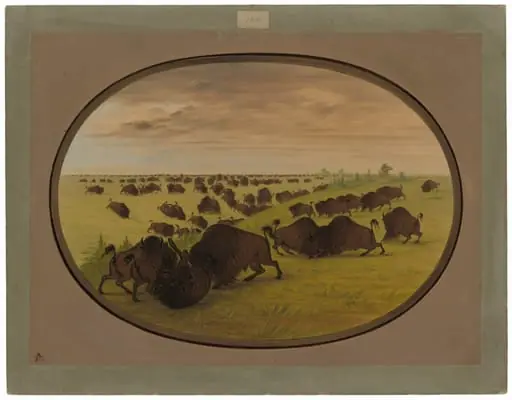 Bulls Fighting
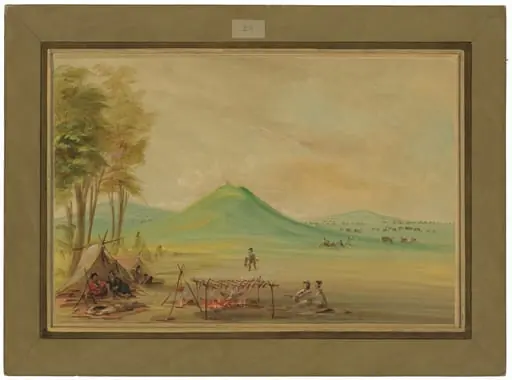 Expedition Encamped on a Texas Prairie. April 1686
 An Alligator's Nest
 Mrs. George Catlin (Clara Bartlet Gregory)
 Chief of the Taensa Indians Receiving La Salle. March 20, 1682
 A Small Village - Payaguas Indians
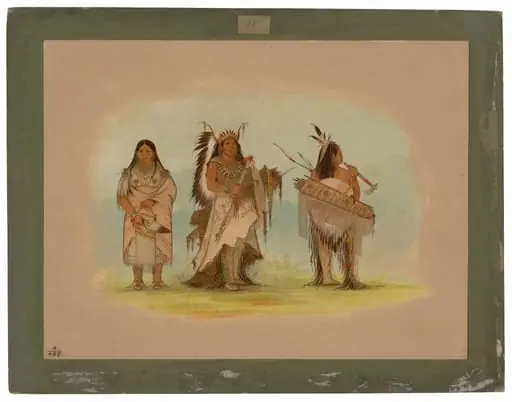 Omaha Chief, His Wife, and a Warrior
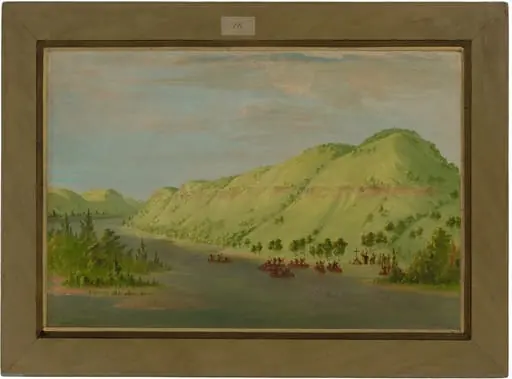 Father Hennepin Leaving the Mississippi to Join La Salle. May 8, 1680
- Saukie Warrior, His Wife, and a Boy
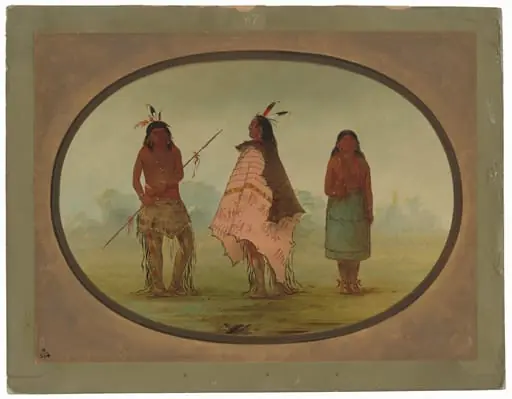 Two Apachee Warriors and a Woman
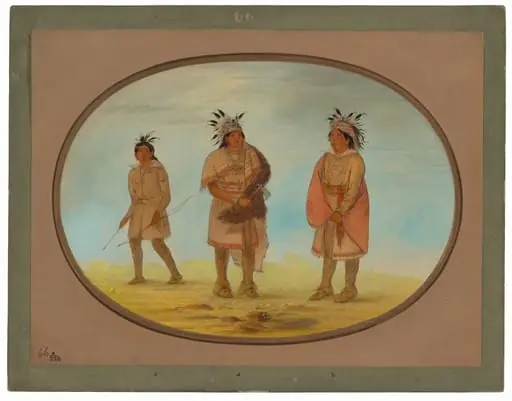 Two Weeah Warriors and a Woman
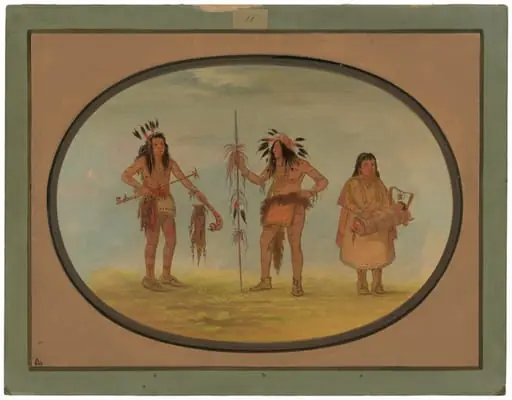 Two Ojibbeway Warriors and a Woman
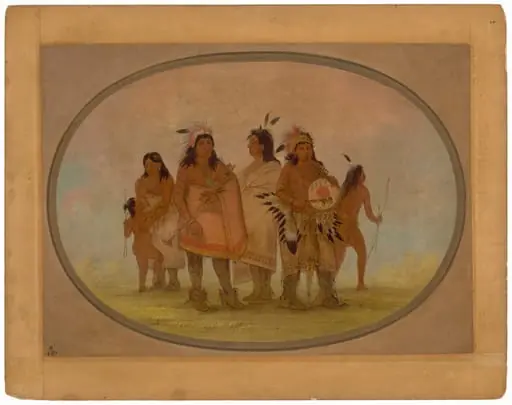 Two Sioux Chiefs, a Medicine Man, and a Woman with a Child
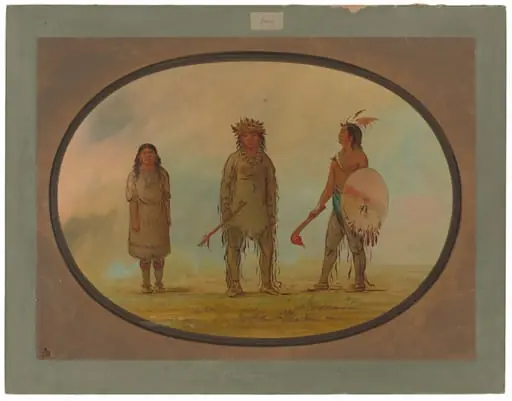 Athapasca Chief, His Wife, and a Warrior
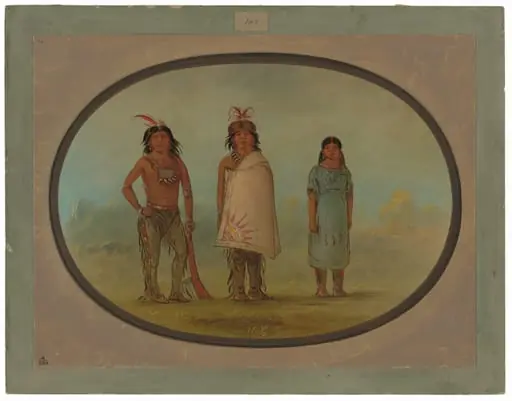 Two Chippewyan Warriors and a Woman
 Mandan Civil Chief, His Wife, and Child
 Cochimtee Chief, His Wife, and a Warrior