Artwork
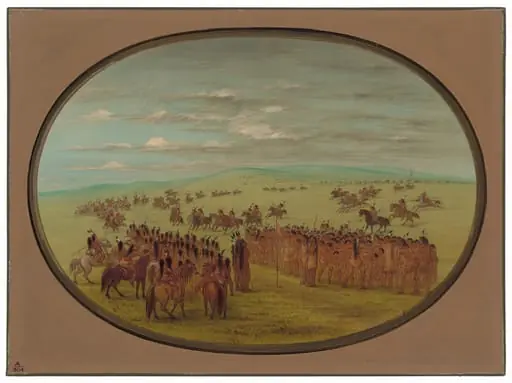
War Dance of the Saukies
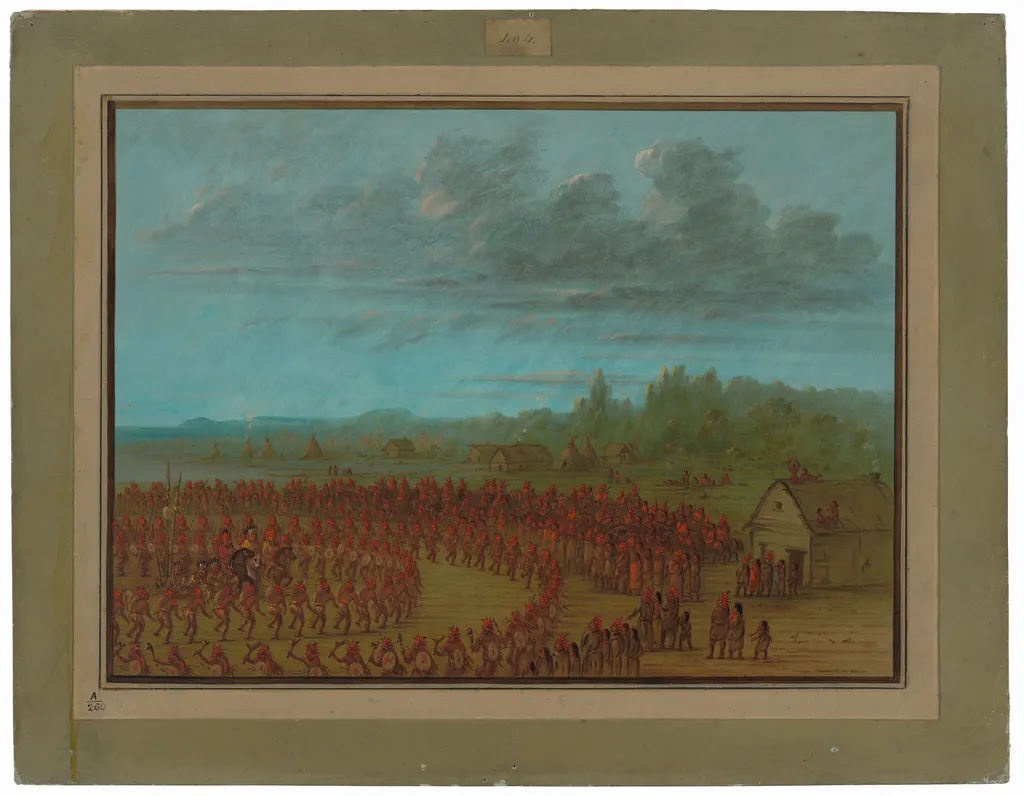
War Dance of the Saukies is an oil painting by the Impressionist artist George Catlin. It dates from 1865 and is held in the collection of the National Gallery of Art.
About this work
Overview
War Dance of the Saukies is an oil painting by American artist George Catlin, dated 1861, depicting a ceremonial gathering of Sauk (Sac) people.
War Dance of the Saukies is an oil painting by American artist George Catlin, dated 1861, depicting a ceremonial gathering of Sauk (Sac) people. The work measures 46 by 60.9 centimeters (18 1/8 by 24 inches) and is executed in oil on card mounted on paperboard. It is held in the collection of the National Gallery of Art in Washington, D.C., under accession number 1965.16.143, having entered the museum as part of a major gift from Paul Mellon in 1965. The painting belongs to Catlin's second major body of work, the "Cartoon Collection," which he produced during the 1850s and 1860s as a reworking and expansion of themes first explored in his earlier "Indian Gallery" of the 1830s.
Subject & Meaning
The painting portrays a war dance performed by the Saukies (Sauk) at the close of the Black Hawk War, as ordered by Chief Keokuk at his village on the Des Moines River. According to Catlin's own 1871 catalog entry for the work, both the artist and General Street, the Indian agent, were present at the 1831 event. The composition presents a wide horizontal landscape format in which a vast sky occupies roughly the upper two-thirds, while a large gathering of figures fills the foreground and middle ground. Numerous individuals wear red head ornaments and move rhythmically in rows and circles, some carrying shields or weapons. To the right, a wooden structure with a pitched roof appears, with figures positioned on and around it. In the distance, conical tents and small buildings cluster near a tree line, with low hills beyond. The emphasis falls not on any single figure but on the collective movement of the assembled group, suggesting the communal and ceremonial significance of the dance as both a social and political ritual marking the end of hostilities.
Technique & Style
Catlin executed War Dance of the Saukies in oil on card mounted on paperboard, a support characteristic of the Cartoon Collection works. The palette is dominated by turquoise and blue in the sky, with darker clouds massing centrally, while the ground is rendered in ochre and olive tones. The red of the head ornaments provides a striking accent across the crowd. The brushwork appears relatively smooth and descriptive, with careful attention to the grouping of figures and atmospheric perspective in the background. Light falls evenly across the scene, suggesting an overcast or late afternoon condition. The wide horizontal format accommodates the panoramic scope of the gathering, while the compositional structure, with its low horizon line and expansive sky, creates a sense of openness appropriate to the Plains setting. The painting is mounted within a wide, pale green border with a small numbered plaque reading "104" at top center.
History & Provenance
The painting remained in Catlin's possession until his death in 1872, then descended to his daughters: Clara Gregory Catlin, Louise Catlin Kinney, and Elizabeth Wing Catlin. In 1912, the American Museum of Natural History purchased the work from Elizabeth Wing Catlin. Following deaccession, it was sold in 1959 through Kennedy Galleries in New York to Paul Mellon of Upperville, Virginia, who subsequently gave it to the National Gallery of Art in 1965. The work has been exhibited on several notable occasions: it was lent to the Phoenix Art Museum for display with the permanent collection from 1968 to 1969; shown at the Allentown Art Museum, Pennsylvania, in the 1970 Exhibition of George Catlin Paintings; placed on extended loan to Secretary Roger C. B. Morton at the U.S. Department of Interior from 1971 to 1975; and loaned to The White House from 1975 to 1991. It later appeared in Art and the Oval Office: Presidential Selections from the Nation's Museums, 1960-2000 at the Arkansas Arts Center, Little Rock, from 2004 to 2005.
Context
War Dance of the Saukies occupies a significant position within Catlin's two major collections of Native American imagery. The first, his "Indian Gallery" of more than 500 works from the 1830s, was based on direct observation during his western travels; most surviving examples are now at the Smithsonian American Art Museum. The second, the "Cartoon Collection" of more than 600 works from the 1850s and 1860s, represented Catlin's effort to recreate and systematize his earlier experiences, often working from memory, sketches, and earlier compositions. The present work belongs to this later collection and was exhibited when Catlin showed the Cartoon Collection in New York in 1871, at which time he published the catalog that provides the documentary basis for the painting's subject. The work has been reproduced in successive National Gallery of Art catalogues in 1970, 1980, and 1992, indicating its established place within the museum's holdings of American painting.
Legacy
The painting's extended loan to The White House from 1975 to 1991, followed by its inclusion in an exhibition examining presidential art selections, attests to its perceived symbolic resonance in representing Native American history and American western expansion. As part of the 351-work Mellon gift to the National Gallery of Art, it contributed to one of the most significant transfers of Catlin material into public collections. The work exemplifies the complex afterlife of Catlin's project: begun as documentary observation, reframed through memory and repetition in the Cartoon Collection, and ultimately institutionalized as part of the canon of 19th-century American art. Its subject, the conclusion of the Black Hawk War, positions it at a pivotal moment in Sauk history and in United States-Native relations more broadly, giving the painting continuing relevance for scholars of American art, ethnohistory, and the politics of representation.
Own this work as a print
Artist & collection

Artist
George Catlin ( KAT-lin; July 26, 1796 – December 23, 1872) was an American lawyer, painter, author, and traveler, who specialized in portraits of Native Americans in the American frontier.

 Bulls Fighting
 Expedition Encamped on a Texas Prairie. April 1686
 An Alligator's Nest
 Mrs. George Catlin (Clara Bartlet Gregory)
 Chief of the Taensa Indians Receiving La Salle. March 20, 1682
 A Small Village - Payaguas Indians
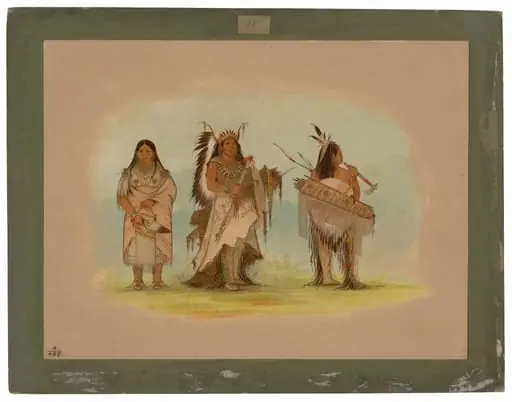 Omaha Chief, His Wife, and a Warrior
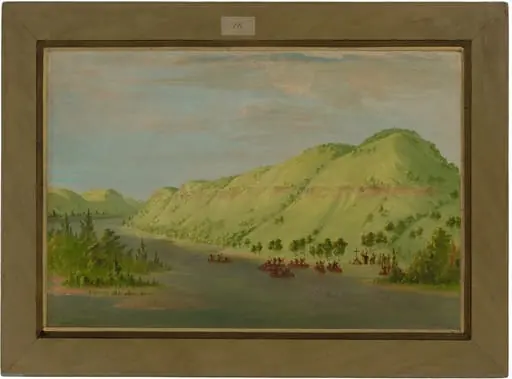 Father Hennepin Leaving the Mississippi to Join La Salle. May 8, 1680