Artwork
The Scullery Maid
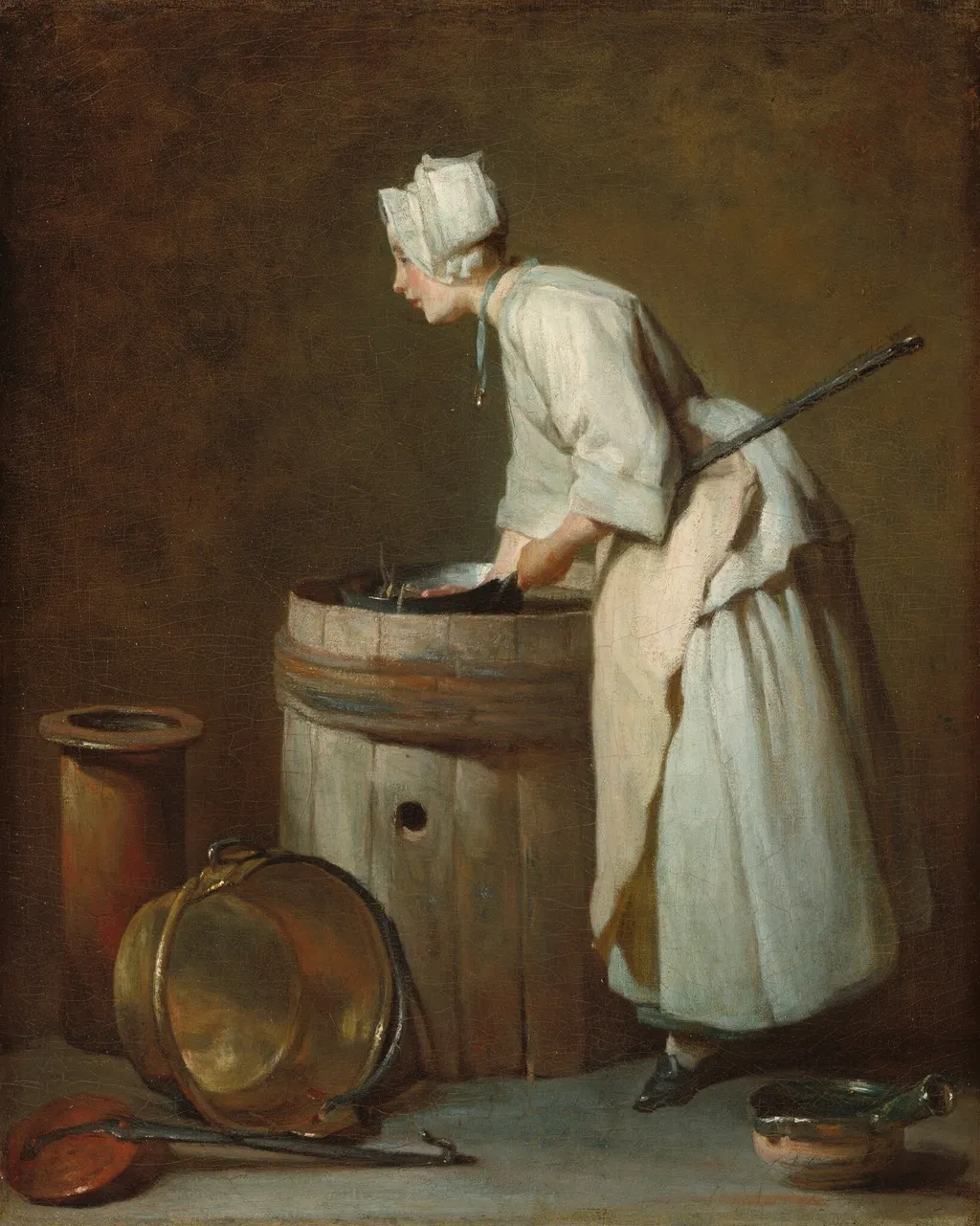
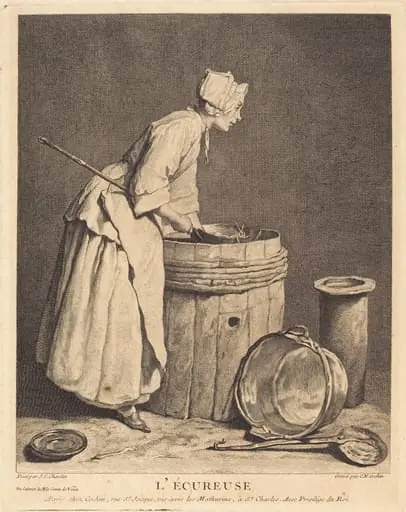
The Scullery Maid is an oil painting by the Baroque artist Jean-Baptiste-Siméon Chardin. It dates from 1738 and is held in the collection of the National Gallery of Art.
- Inscription
- Inscribed:center left between face and top of barrel: Ch[ardin] / 17[38] (recorded in 1948 as: Chardin / 1738)
About this work
Subject & Meaning
Chardin presents her as a solitary figure absorbed in her work, embodying the dignity of everyday life rather than offering social commentary or idealization.
The painting depicts a scullery maid, a domestic servant responsible for the lowest kitchen tasks, shown in a moment of quiet labor. Chardin presents her as a solitary figure absorbed in her work, embodying the dignity of everyday life rather than offering social commentary or idealization. The subject belongs to the tradition of genre painting, where ordinary people and their daily activities become worthy of artistic attention.
Through careful observation and restrained composition, Chardin elevates the humble scullery maid to a figure of contemplative presence, reflecting the artist's broader interest in the inner lives of common people.
Technique & Style
The work is an oil painting on canvas, measuring 47 cm in height by 38.1 cm in width, created in 1738. It belongs to the genre‑scene category. The painting is executed in oil paint, a medium the artist used to achieve fine detail and subtle tonal modulation. Its support is a canvas, and the composition reflects careful handling.
History & Provenance
The Scullery Maid was painted by Jean-Siméon Chardin in 1738 in oil on canvas. Its early ownership is uncertain, with the earliest recorded holder possibly being Jacques Augustin de Silvestre in Paris; his estate sale, conducted by F.L. Regnault-Delalande between 28 February and 25 March 1811, listed the work as lot 13, paired with Return from the Market. The painting subsequently passed through Laneuville and then to Godfrey von Preyer in Vienna, before being acquired by the American collector William Andrews Clark of New York.
Clark bequeathed the canvas in 1926 to the Corcoran Gallery of Art in Washington, and it was acquired by the National Gallery of Art in 2014, where it remains held.
The Scullery Maid is held by the National Gallery of Art, Washington, D.C. It entered the collection in 2014, following its acquisition from the Corcoran Gallery of Art, to which William Andrews Clark had bequeathed the painting in 1926. Earlier provenance includes possible ownership by Jacques Augustin de Silvestre in Paris, and later by Godfrey von Preyer in Vienna. The painting was exhibited at the Galeries nationales du Grand Palais, Paris; Kunstmuseum et Kunsthalle, Düsseldorf; Royal Academy of Arts, London; and The Metropolitan Museum of Art, New York, in 1999.
Overview
Jean Siméon Chardin's painting, The Scullery Maid, rendered in oil on canvas around 1738, captures a moment of quiet domesticity. This genre scene depicts a young woman engaged in her daily tasks within a modest interior, surrounded by the tools of her trade. The artwork exemplifies Chardin's characteristic focus on the unadorned realities of common life, offering a window into the routines of 18th-century households.
Context
During an era when much of European painting celebrated grand historical events, mythological tales, or aristocratic portraits, Chardin distinguished himself by focusing on the humble and the domestic. The Scullery Maid exemplifies this artistic choice, presenting an unpretentious view of a working-class individual's life. This quiet observation of the everyday offered a novel perspective, inviting viewers to find beauty and significance in the ordinary rather than the extraordinary.
Own this work as a print
Artist & collection

Artist
Jean Siméon Chardin (French:; November 2, 1699 – December 6, 1779) was an 18th-century French painter.