Artwork
Soap Bubbles
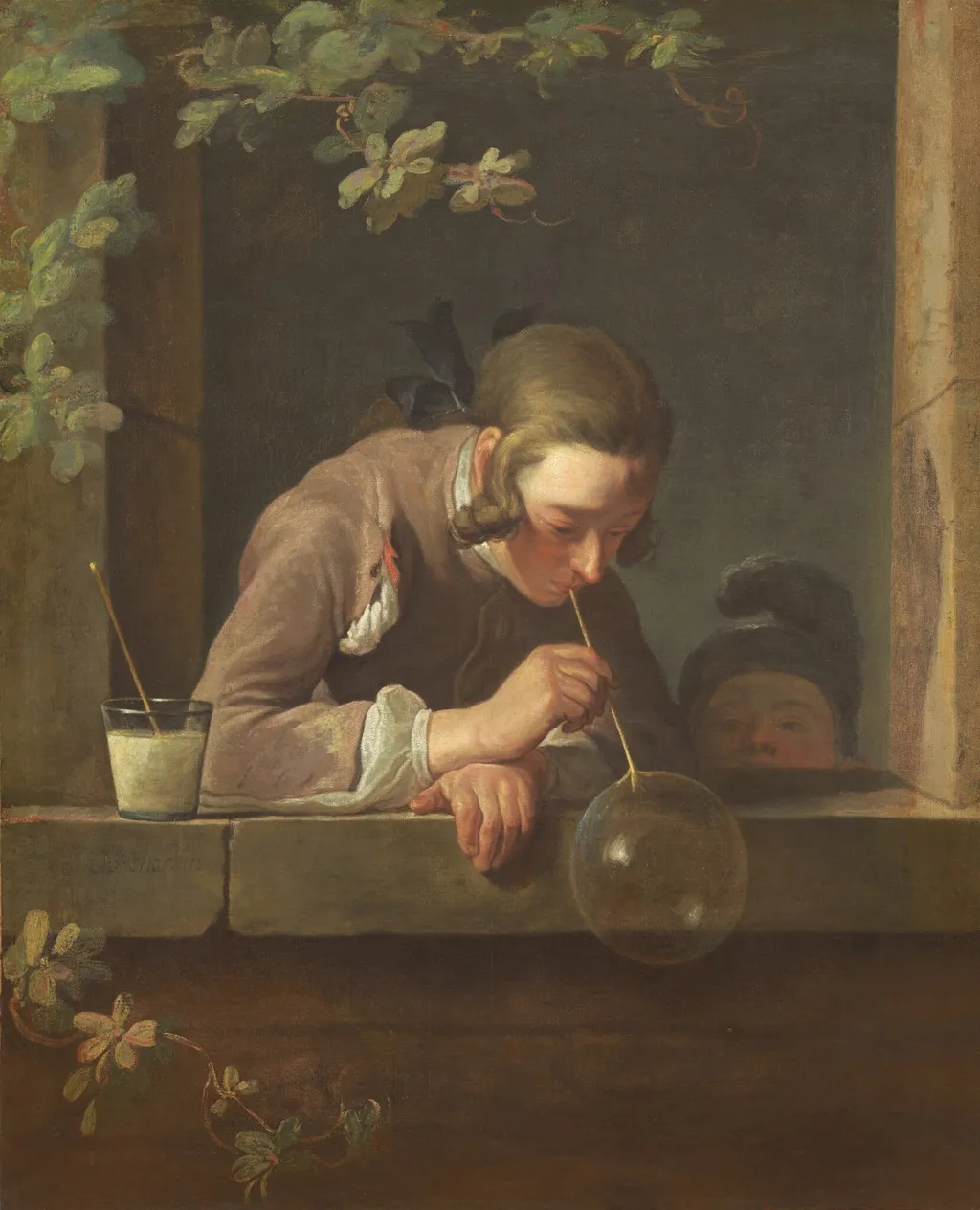
Soap Bubbles is an oil painting by the Baroque artist Jean-Baptiste-Siméon Chardin. It dates from 1734 and is held in the collection of the National Gallery of Art.
- Inscription
- Inscribed:lower left on windowsill in dark brown paint: J. S. Chardin
About this work
Technique & Style
Jean Siméon Chardin's Soap Bubbles is an oil painting executed on canvas.
Jean Siméon Chardin's Soap Bubbles is an oil painting executed on canvas. The work measures 93 cm in height and 74.6 cm in width. Created in 1733, the painting belongs to the genre tradition.
As an oil on canvas, the medium allows for the blending and subtle tonal gradations characteristic of Chardin's approach, though the sources do not provide further specifics regarding the artist's handling, the painting's current condition, or additional formal and stylistic qualities.
History & Provenance
Jean Siméon Chardin created the oil-on-canvas painting Soap Bubbles in 1733. The work's earliest documented ownership traces to Adolphe Eugène Gabriel Roehn in Paris by 1845, where it was noted in the artist's studio. By 1860, the painting belonged to Laurent Laperlier, a military administrator and collector in Algeria, who lent it to a Paris exhibition that year.
Following Laperlier's death, the work appeared at his sale at the Hôtel Drouot in April 1867, where it was purchased by Biesta. The painting subsequently passed through the Gimpel and Wildenstein galleries before being sold in 1905 to John Woodruff Simpson of New York. Upon Simpson's death in 1920, ownership transferred to his widow, Katherine Seney Simpson, who bequeathed the piece to the National Gallery of Art in Washington, D.C., in 1942.
Jean-Siméon Chardin's Soap Bubbles (1733) is held in the collection of the National Gallery of Art in Washington, D.C. The painting entered the museum as a gift in 1942 from Katherine Seney Simpson, having previously belonged to her husband, John Woodruff Simpson, who acquired it in 1905. Earlier owners included the dealer Gimpel and Wildenstein and the collector Laurent Laperlier, who lent the work to an exhibition in Paris in 1860. While specific inventory numbers are not cited in the available records, the provenance traces back to Adolphe Eugéne Gabriel Roehn by 1845.
The work was also included in the major 1979 Chardin retrospective organized by the Grand Palais in Paris, which subsequently traveled to the Cleveland Museum of Art and the Museum of Fine Arts, Boston.
Legacy
The painting's movement from private French collections to the National Gallery of Art in 1942 demonstrates its lasting significance; after being shown by collector Laurent Laperlier in 1860, it entered a public museum, where its display has reinforced scholarly appreciation of Chardin's genre scenes and contributed to the artist's sustained reputation. The work's meticulous handling of delicate subjects continues to inform studies of 18th‑century French still‑life, as evidenced by its inclusion in major exhibitions and catalogues.
Overview
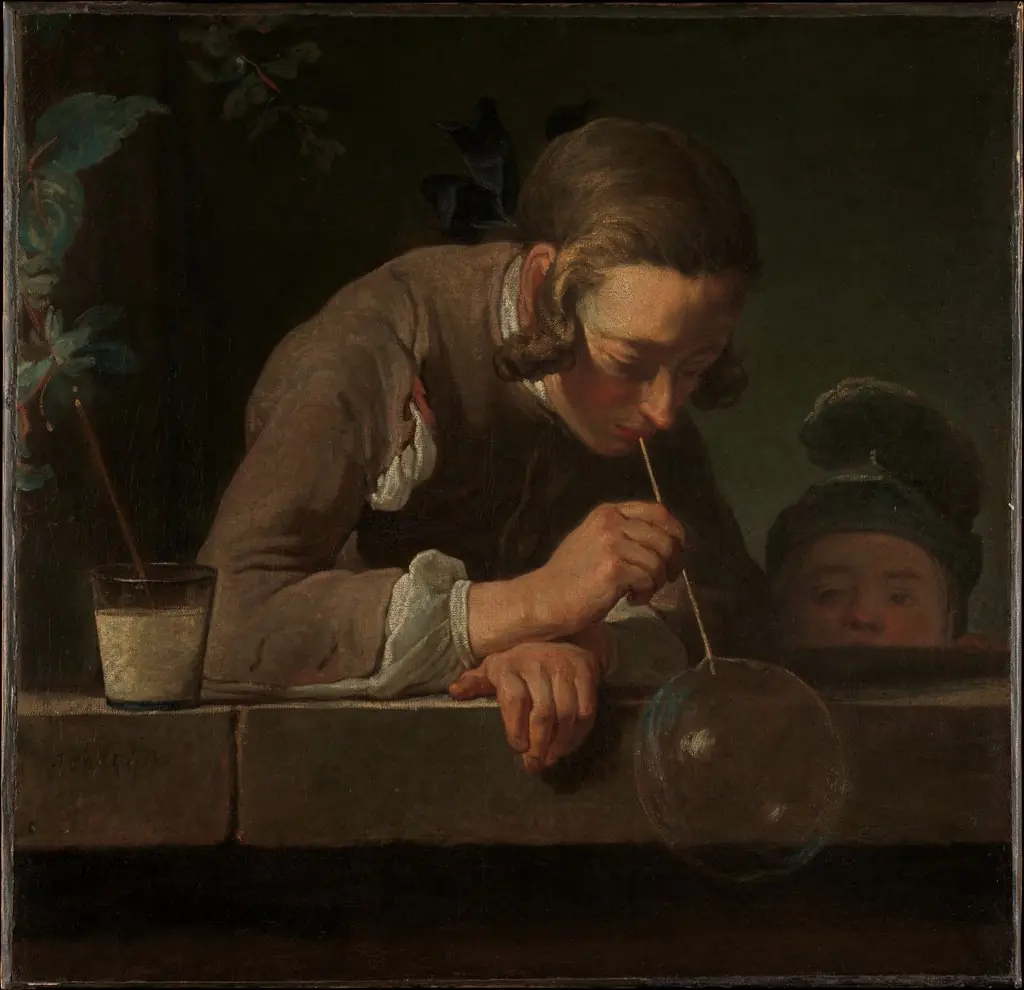
Painted in 1734, Jean Siméon Chardin's Soap Bubbles depicts a young boy leaning from a window, intently focused on blowing a large soap bubble. The composition centers on the figure, whose hands delicately hold a wand while a small cup of soapy water rests on the stone ledge. A second figure, partially illuminated, peers in from the exterior, observing the boy's activity.
Chardin employs a restrained palette and soft, diffused lighting to emphasize the translucency of the bubble and the quiet concentration of the moment. The dark interior background contrasts with the light falling on the boy's face and the fragile sphere, drawing the viewer's eye to the ephemeral nature of the subject. This work exemplifies Chardin's mastery of genre painting during the Rococo period, elevating a simple domestic scene into a meditation on transience and childhood innocence.
The painting reflects the artist's departure from the ornate styles of his contemporaries, favoring instead a naturalistic approach that captures the dignity of everyday life. It remains a significant example of 18th-century French art, showcasing Chardin's ability to infuse ordinary moments with profound emotional resonance.
Subject & Meaning
The painting depicts a young boy, his gaze fixed on the fragile sphere he creates, holding a wand and a small cup of soapy water. A partially illuminated second figure subtly observes from the background, adding a layer of narrative intrigue. The act of blowing bubbles has historically served as a memento mori, symbolizing the fleeting nature of life and the transient beauty of existence, themes frequently explored in 18th-century art.
Own this work as a print
Artist & collection
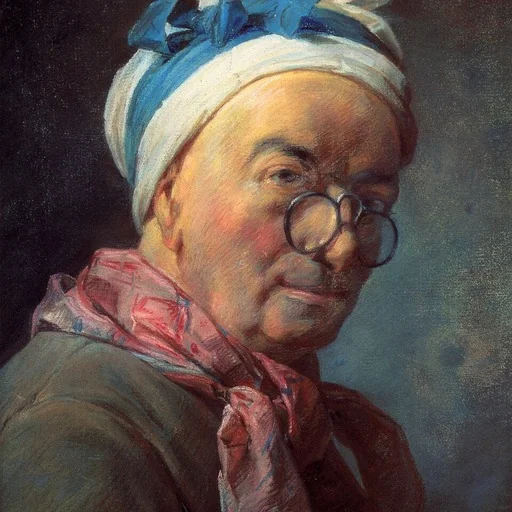
Artist
Jean Siméon Chardin (French:; November 2, 1699 – December 6, 1779) was an 18th-century French painter.