Artwork
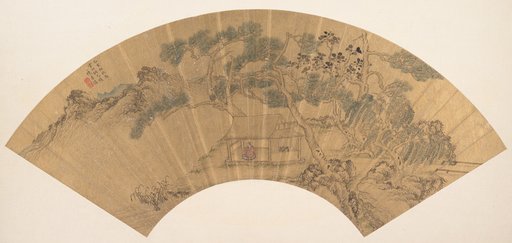
明 陳季淳 山水人物圖 扇頁|Landscape with figure
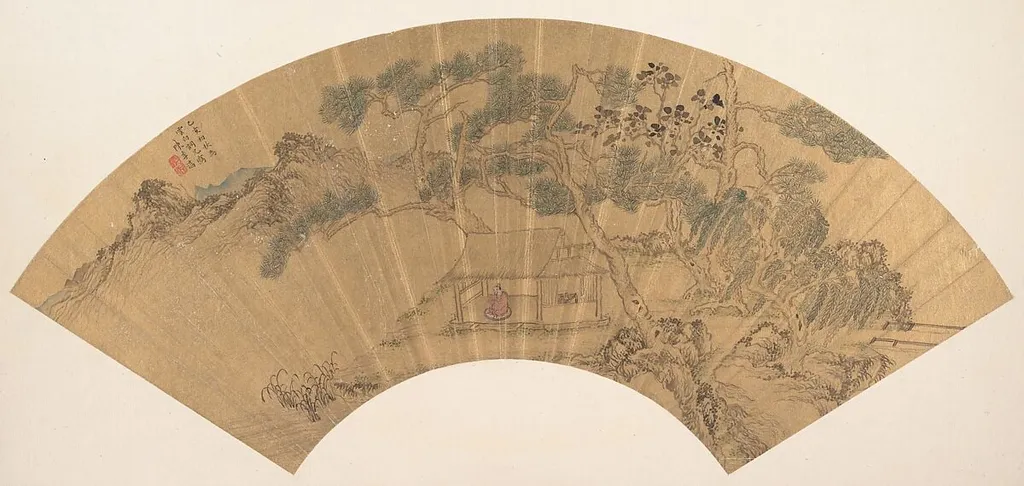
明 陳季淳 山水人物圖 扇頁|Landscape with figure is an ink painting by the Baroque artist Chen Jichun. It dates from 1635 and is held in the collection of the Metropolitan Museum of Art.
About this work
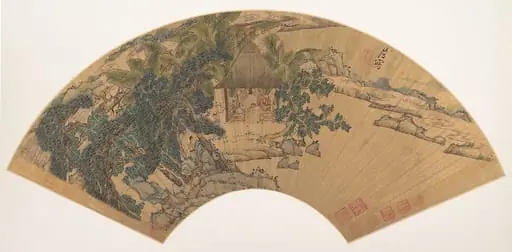
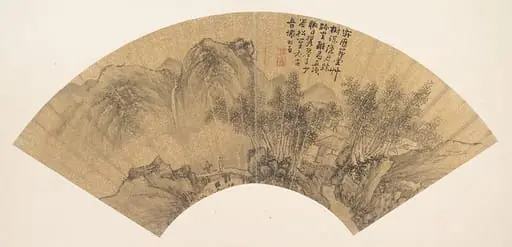
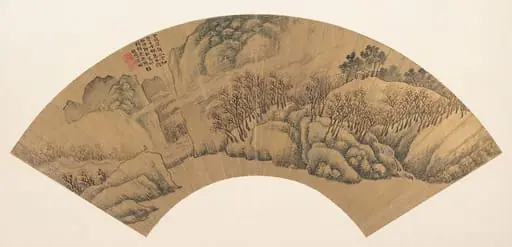
A tiny man in a red robe walks up a winding path toward a pavilion perched on a cliff, trees clinging to the rocks, mist swirling between peaks. It's painted on a folding fan now mounted in an album, the gold paper beneath making the ink and colors glow. Chen Jichun did it in 1635, when artists often gave fans to friends. For more, look up landscape paintings.
Subject & Meaning
As a folding fan leaf mounted as an album page, the artwork represents the Ming dynasty tradition of integrating poetic scenery with architectural structures.
Created in 1635 by Chen Jichun, this work is a landscape painting executed in ink and color on gold paper. The composition depicts a natural setting featuring trees and a pavilion, elements that define the scene's iconography. As a folding fan leaf mounted as an album page, the artwork represents the Ming dynasty tradition of integrating poetic scenery with architectural structures.
The presence of the pavilion within the wooded landscape suggests a retreat for scholarly contemplation or leisure, a common thematic focus in Chinese literati art of this period. While the specific narrative actions of any figures are not detailed in the available records, the combination of these natural and built elements serves to evoke an idealized environment for reflection.
Technique & Style
The work is a Chinese landscape painting executed in ink with subtle color washes on gold paper, mounted as a folding fan that has been converted into an album leaf. The support thus combines the fan’s delicate paper structure with the stability of an album leaf format, a handling typical of literati collectors. Chen Jichun dated the piece to 1635, and the composition features a pavilion set against a tree, motifs that define its genre.
The painting’s formal qualities reflect the controlled brushwork and restrained palette characteristic of early Qing dynasty landscape albums, while its material execution on gold paper enhances the luminous surface.
History & Provenance
The painting was executed in 1635 in China by Chen Jichun as a folding fan mounted as an album leaf, using ink and color on gold paper. Its subject depicts a pavilion and a tree. The work remained in China until it entered the collection of the Metropolitan Museum of Art, where it is recorded in the museum’s catalogue and displayed in the Asian art galleries.
The dating of 1635 is documented both in the artist’s internal catalogue entry and in the Metropolitan Museum of Art’s metadata, which list the inception date as 1635‑01‑01 and the place of creation as China.
Overview
Created in 1635 by the Chinese artist Chen Jichun, this work depicts a landscape with a solitary figure, executed in ink and color on gold paper. The composition features a tiny man clad in a red robe ascending a winding path that leads toward a pavilion perched precariously on a cliff edge. Surrounding the figure, trees cling tenaciously to the rocky outcrops, while mist swirls between the mountain peaks to create atmospheric depth.
The use of gold paper as a ground enhances the luminosity of the ink and pigments, causing the scene to glow. Originally a folding fan, the object has been mounted as an album leaf, a common practice in Chinese collecting that preserves individual fan paintings for study and display. This piece exemplifies the literati landscape tradition of the late Ming dynasty, emphasizing the harmony between the human figure and the vast natural world.
The specific date places the work in the final decades of the Ming, a period marked by both artistic refinement and impending political upheaval.
Context
During the Ming dynasty, folding fans were frequently exchanged as tokens of friendship or esteem among literati and artists. These objects served not only as practical items but also as canvases for intricate paintings and calligraphy, reflecting the refined tastes of their owners and creators. Chen Jichun's Landscape with figure exemplifies this cultural practice, embodying both artistic expression and social interaction within the period.
Artist & collection