Artwork
The Lorelei
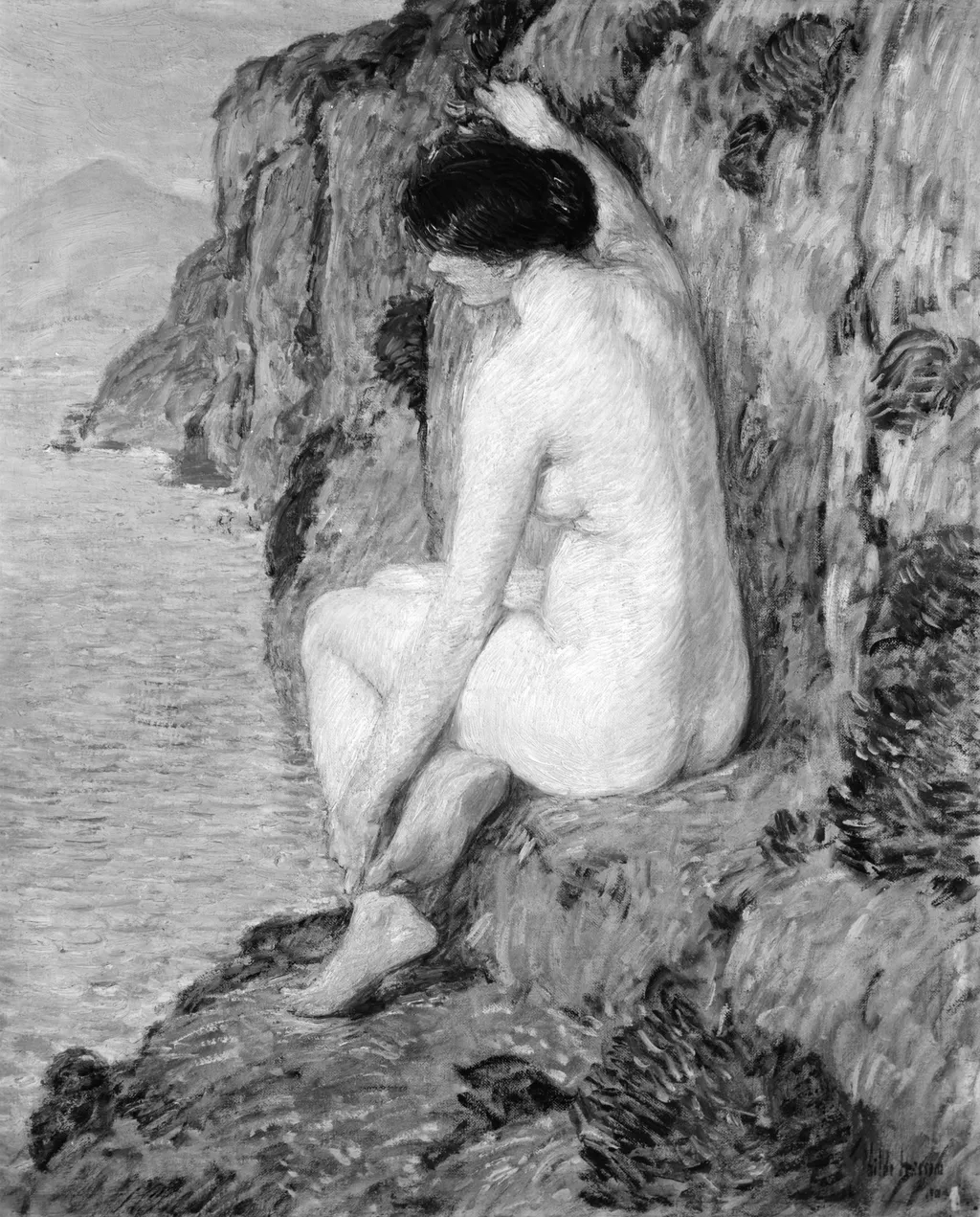
The Lorelei is an oil painting by the American Impressionist artist Childe Hassam. It dates from 1904 and is held in the collection of the Walters Art Museum.
About this work
Subject & Meaning
The work draws on German legend of the Lorelei rock, symbolizing allure and danger through its eroticized representation of a mythic female form.
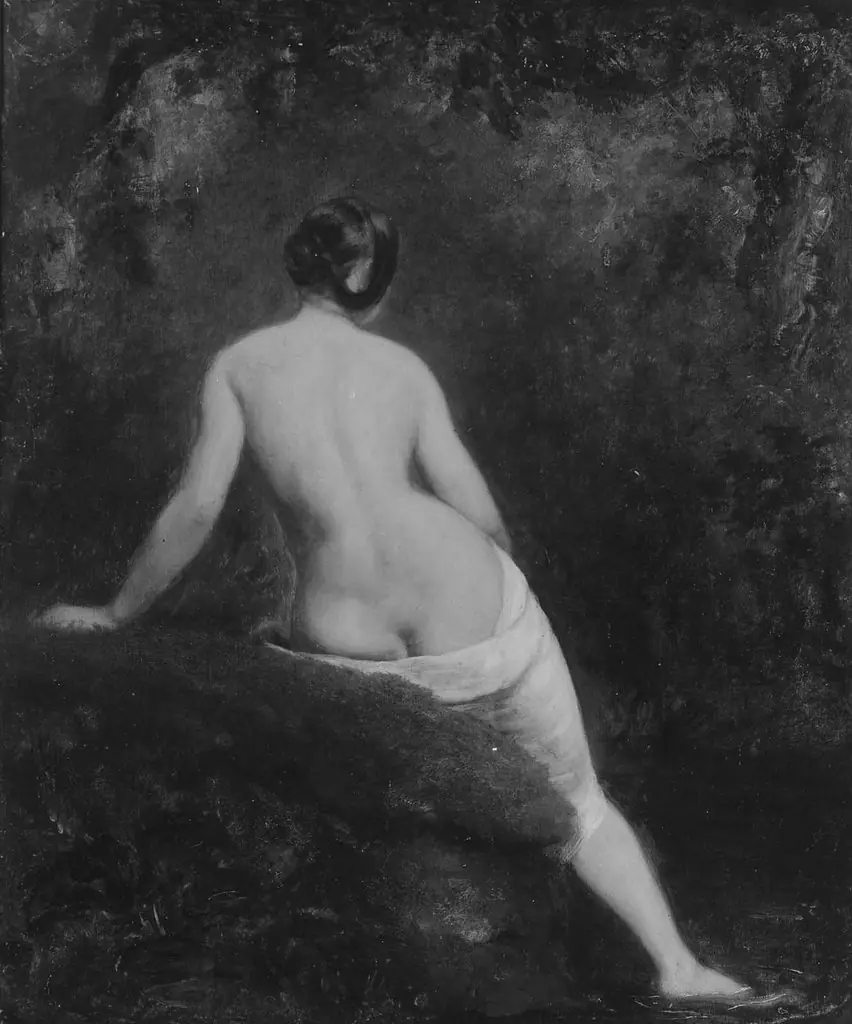
The painting shows a nude female figure seated on a rocky shore, identified as the mythological siren Lorelei, her posture emphasizing sensual curves and delicate anatomical details such as her chignon, intergluteal cleft, and arched foot. The work draws on German legend of the Lorelei rock, symbolizing allure and danger through its eroticized representation of a mythic female form. Hassam’s composition blends naturalistic landscape elements with symbolic eroticism, reflecting early 20th-century American interpretations of European mythological themes.
The sitter’s nudity and vulnerable pose convey both vulnerability and seductive power, linking the subject to broader symbolist traditions that equated mythic femininity with natural forces. The depiction underscores themes of beauty, temptation, and the tension between innocence and eroticism in mythological narratives.
The painting is housed in the Walters Art Museum, where it is cataloged as a mythological nude work blending American Impressionist technique with European literary inspiration.
Technique & Style
Executed in oil on canvas in 1904, the work measures 63.8 cm in height and 53.5 cm in width. Hassam renders the figure from behind with smooth, blended transitions in the flesh tones, while the surrounding landscape is handled with broader, more visible brushwork that suggests foliage and atmospheric effects. The composition emphasizes the sitter’s silhouette against a luminous backdrop, aligning with Hassam’s tonalist tendencies of the period.
The canvas support and oil medium are consistent with Hassam’s practice around 1904, and the visible handling reflects a deliberate contrast between the softly modeled body and the more schematic treatment of the setting.
History & Provenance
The work was painted by Childe Hassam in 1904, as indicated by both the artist’s records and the Walters Art Museum’s collection documentation. The painting depicts the Lorelei legend, a German mythological figure associated with a siren-like woman whose singing lured sailors to shipwreck.
It entered the Walters Art Museum collection where it remains held. The museum’s records list the painting as part of its holdings with dimensions of 63.8 cm in height and 53.5 cm in width.
The work is held at the Walters Art Museum, Baltimore, where it is recorded as accession number 37.1230. It was painted in 1904 and measures 63.8 cm in height by 53.5 cm in width.
The painting was included in the exhibition “American Impressionism: Childe Hassam and the Isles of Shoals” held at the Peabody Essex Museum, Salem, Massachusetts, from 19 April to 15 June 2003.
Context
Childe Hassam's 1904 oil painting The Lorelei, depicting a nude figure on a rocky shore inspired by the German legend of the Lorelei, entered the collection of the Walters Art Museum in Baltimore. The work, classified as a mythological painting and genre nude scene, was created during Hassam's active period in New York and reflects his engagement with literary and artistic themes beyond Impressionist cityscapes. Its precise composition, including documented details of the figure's pose and anatomy, aligns with early 20th-century American interpretations of mythological subjects.
Scholarship on Hassam's mythological works remains limited, though The Lorelei is recognized as part of his broader exploration of literary narratives. The painting's significance lies in its synthesis of contemporary artistic practice with enduring folklore, situating it within the trajectory of American Symbolist and Tonalist movements that adapted European legends for new audiences.
Overview
The Lorelei, executed in oil in 1904, is a mythologically themed work by American Impressionist Childe Hassam. The canvas presents a solitary female figure viewed in profile, her back turned toward the viewer, seated against a dark, undefined backdrop. The painting is part of the collection at the Walters Art Museum in Baltimore.
Own this work as a print
Artist & collection

Artist
Frederick Childe Hassam (; October 17, 1859 – August 27, 1935) was an American Impressionist painter, noted for his urban and coastal scenes.

![Nude [recto], by Childe Hassam](https://artifactworldgallery.com/img/childe-hassam--nude-recto--569fc48bc9ef425f-w320.webp)