Artwork
The Voyage of Life: Childhood
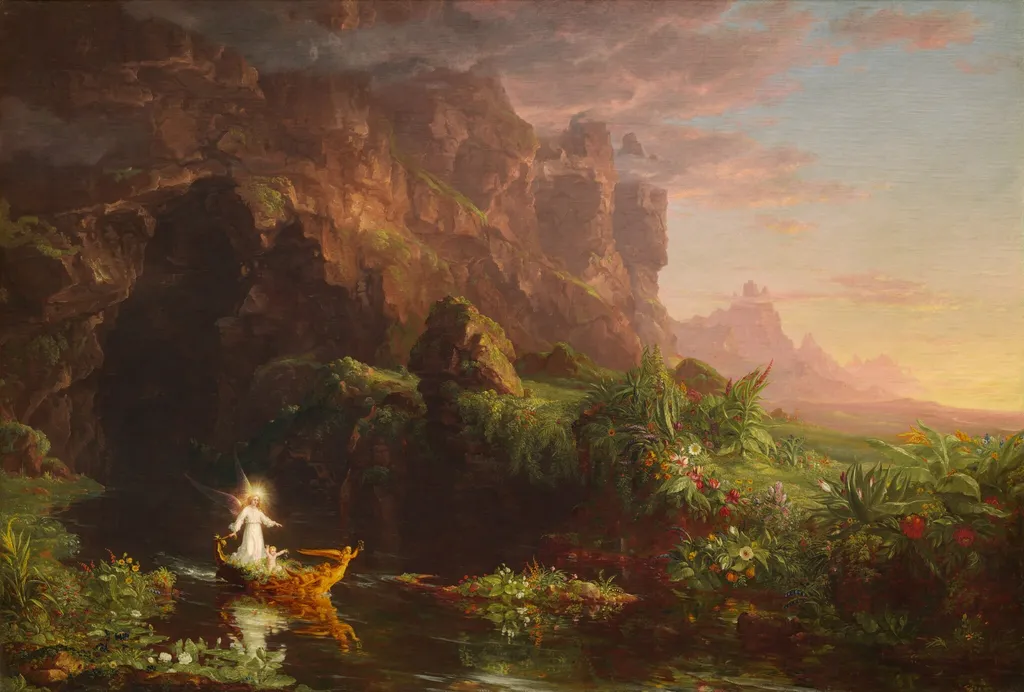
The Voyage of Life: Childhood is an oil painting by the Hudson River School artist Thomas Cole. It dates from 1842 and is held in the collection of the National Gallery of Art.
- Inscription
- Inscribed:lower left: 1842 / T. Cole / Rome
About this work
Technique & Style
The handling is meticulous yet atmospheric, using layered glazes to render foliage, water, and sky with translucent transitions and crisp highlights.
Executed in 1842, the painting is an oil on canvas with overall dimensions of 134.3 × 195.3 cm, typical of Cole's large-scale allegorical landscapes. The handling is meticulous yet atmospheric, using layered glazes to render foliage, water, and sky with translucent transitions and crisp highlights. The composition balances naturalistic detail, a gnarled oak, a winding river, with idealized form to convey innocence and guidance.
Stylistically, it synthesizes the Hudson River School's descriptive clarity with allegorical structure, employing luminous color harmonies and a balanced, pyramidal arrangement that focalizes the child's figure and the guardian angel.
History & Provenance
The Voyage of Life: Childhood was painted by Thomas Cole in 1842. Shortly after its completion, Cole sold the work to George K. Shoenberger of Cincinnati, with the transaction occurring as early as 1845 and no later than May 1846. Following Shoenberger's death on 20 January 1892, the painting passed to his heirs.
In 1908 it was acquired by Ernst H. Huenefeld, who then donated it the same year to Bethesda Hospital and the Deaconess Association of the Methodist Church of Cincinnati. The painting remained there until 17 May 1971, when it was sold through Hirschl & Adler Galleries to the National Gallery of Art, Washington, D.C., where it resides today. The institution's catalog does not list a specific accession number, and exhibition history is not mentioned in the available documentation.
Context
The Voyage of Life: Childhood, an 1842 oil on canvas allegorical landscape, is situated within the Hudson River School tradition. Contemporary notice appeared in a Boston Transcript article of 21 May 1846, which recorded the painting's ownership by a wealthy Cincinnati gentleman. Later scholarship includes its discussion in the 1969 Memorial Art Gallery exhibition catalogue of Thomas Cole and detailed chronological analyses by Paul D. Schweizer (1985) and Ellwood C. Parry III (1988).
The work entered the National Gallery of Art's collection in 1971, affirming its status as a key example of Cole's moralizing landscape series within American art history.
Overview
The Voyage of Life: Childhood is an 1842 oil on canvas by Thomas Cole, the second version of the first painting in his four-part allegorical series, The Voyage of Life. Originally created in 1840, the work depicts an infant voyager in a small boat gliding from a dark, shadowed cave into a sunlit, verdant landscape. The composition features a large, gnarled tree that arches over the scene, symbolizing nature's protective presence, while a guardian angel steers the boat from behind the child.
The setting represents spring and the beginning of the journey of life, characterized by calm waters and lush vegetation. Cole painted this series to illustrate the spiritual and physical progression of human existence through the four stages of life, using the American wilderness as a metaphorical backdrop. Childhood establishes the theme of innocence and divine guidance before the voyager assumes control in the subsequent stages.
As a foundational work of the Hudson River School, the painting demonstrates Cole's mastery in combining detailed naturalism with moral allegory, reflecting the 19th-century American belief in the spiritual significance of the natural world.
Subject & Meaning
This painting allegorically represents the beginning of life. A child, guided by an angel, sits in a boat adorned with an hourglass, symbolizing time. They navigate a tranquil river within a lush, vibrant landscape, overshadowed by a large, ancient tree.
This scene conveys the protected and hopeful innocence of childhood, suggesting a period of purity and potential before the complexities of adulthood unfold.
Own this work as a print
Artist & collection
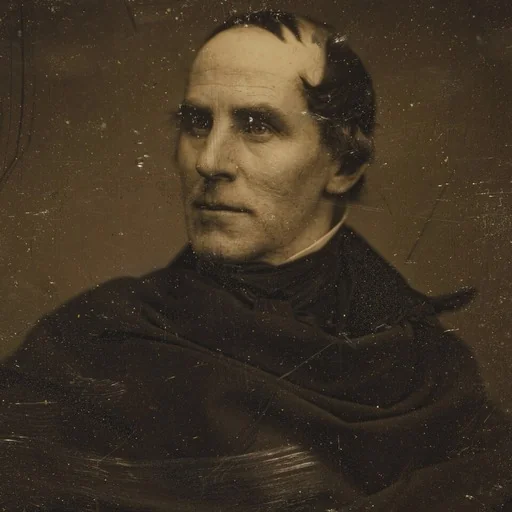
Artist
Thomas Cole (February 1, 1801 – February 11, 1848) was an Anglo-American artist who founded the Hudson River School art movement.