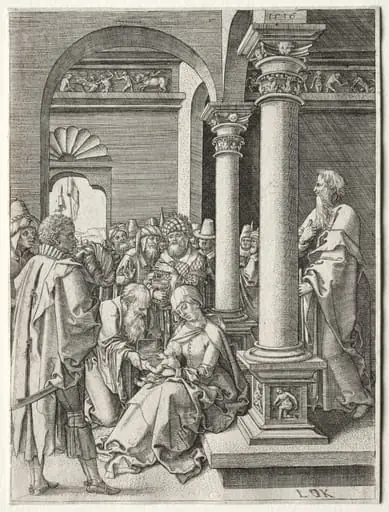
Artwork
Joachim's Offering Rejected
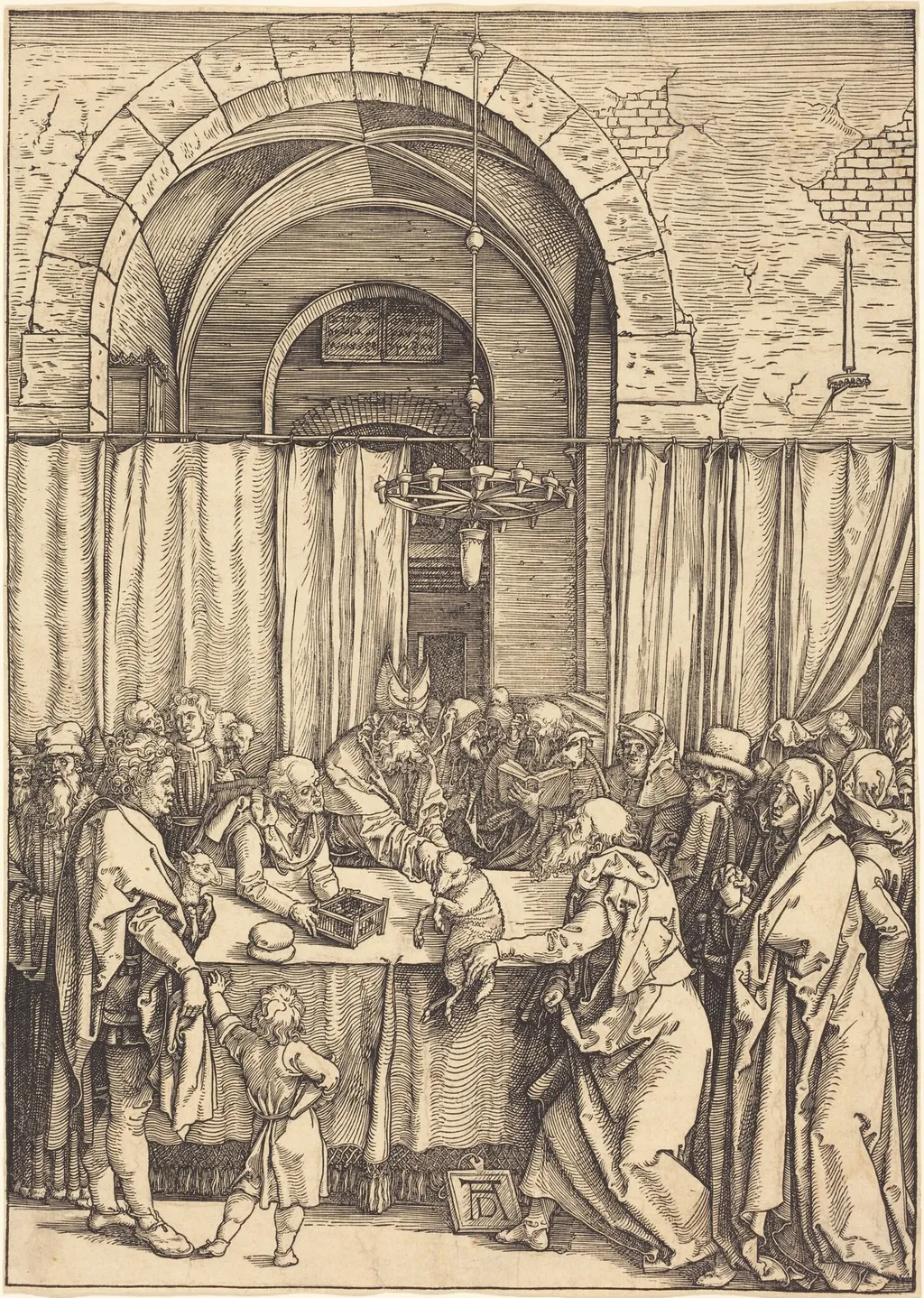
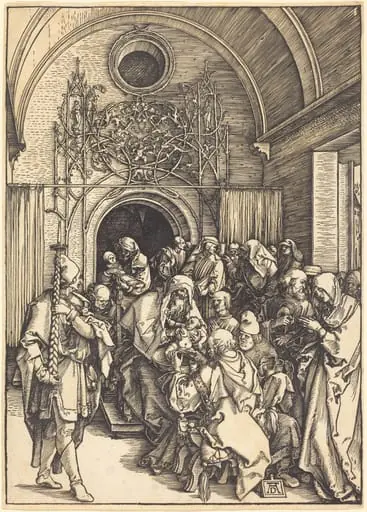
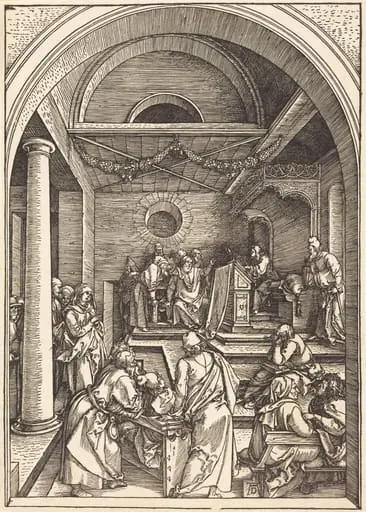
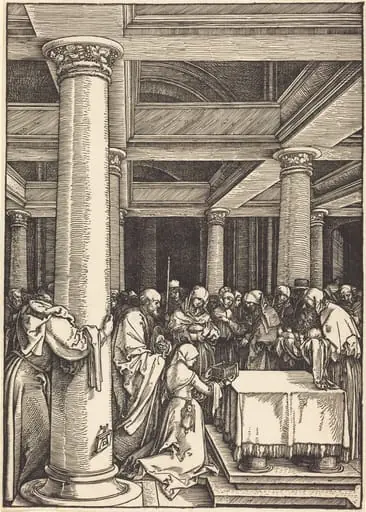
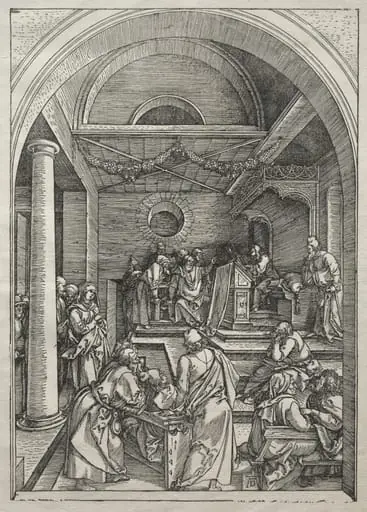
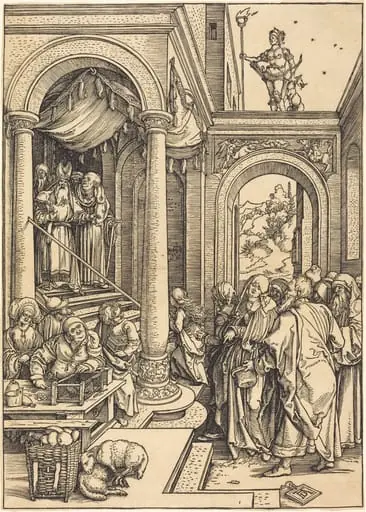
Joachim's Offering Rejected is an ink print by the Northern Renaissance artist Albrecht Dürer. It dates from 1504 and is held in the collection of the Metropolitan Museum of Art.
About this work
Subject & Meaning
By isolating this moment of exclusion, Dürer emphasizes themes of barrenness, divine testing, and ultimate vindication that frame the larger Marian cycle.
Albrecht Dürer's 1504 woodcut depicts Joachim, the father of the Virgin Mary, in a scene drawn from the New Testament apocryphal tradition. The image centers on Joachim's offering being rejected, a narrative episode in which the elderly Joachim presents his sacrifice at the Temple but is turned away by the priest because he is childless.
The work belongs to Dürer's Life of the Virgin series and is classified as religious art of the German Renaissance. Its main subject is Joachim himself, and the scene functions as a prefiguration of the Virgin's later significance, since Joachim's humiliation is followed by the annunciation of Mary's birth. By isolating this moment of exclusion, Dürer emphasizes themes of barrenness, divine testing, and ultimate vindication that frame the larger Marian cycle.
Technique & Style
Created in 1504 in Nuremberg, this work is a woodcut print executed on paper. As part of the Life of the Virgin series, the piece exemplifies German Renaissance stylistic traits through its religious subject matter depicting Joachim. The composition utilizes the linear precision characteristic of the woodcut medium to render the narrative scene. Surviving impressions measure approximately 30 cm in height by 21.3 cm in width.
History & Provenance
Albrecht Dürer created the woodcut titled Joachim's Offering Rejected in 1504 in Nuremberg. The work belongs to the Life of the Virgin series and portrays Joachim, a biblical figure from the New Testament. Its creation history is documented in contemporary records of Dürer's printmaking activity during the early 16th century.
The artwork measures 30 cm in height and 21.3 cm in width, executed on paper using woodcut technique. It has been part of several institutional collections including the National Gallery of Art in Washington, D.C., the Cleveland Museum of Art, and the Staatliche Graphische Sammlung München, reflecting a documented ownership chain through major European and American repositories.
Albrecht Dürer's 1504 woodcut Joachim's Offering Rejected is held in several major public institutions. The work forms part of the collections at the Metropolitan Museum of Art, the National Gallery of Art in Washington, D.C., the Staatliche Graphische Sammlung München, and the Cleveland Museum of Art. Specific holdings within the National Gallery of Art include examples from the Rosenwald Collection.
While the artwork was created in Nuremberg, the provided sources do not list specific inventory or accession numbers for these holdings, nor do they detail a history of exhibitions for this particular impression.
Overview
Created in 1504, 'Joachim's Offering Rejected' is a woodcut by Albrecht Dürer depicting a pivotal moment from the apocryphal Protoevangelium of James. The composition captures the narrative where Joachim, a pious but childless man, presents a lamb at the Temple in Jerusalem, only to have his sacrifice rejected by the high priest due to his perceived lack of divine favor. Dürer arranges the figures to emphasize the emotional weight of the scene: Joachim kneels in the foreground, his head bowed and hands tightly clutching the lamb, conveying deep humiliation and sorrow.
The priest stands in profile, gesturing dismissively, while other onlookers observe the rejection. Executed with the artist's characteristic precision, the woodcut utilizes dense cross-hatching and varied line weights to render complex textures, from the heavy folds of the priest's robes to the soft fleece of the animal and the architectural details of the temple setting. This work is part of Dürer's extensive series on the Life of the Virgin, produced during his mature period in Nuremberg.
It exemplifies the German Renaissance's fusion of Northern European attention to detail with Italianate principles of composition and human emotion, establishing a new standard for narrative clarity in printmaking.
Context
The image aligns with contemporary devotional practices that emphasized visual meditation on biblical stories. By illustrating a moment of failed offering, Dürer engages with theological discussions of faith, obedience, and divine providence prevalent in his era.
Own this work as a print
Artist & collection
Artist
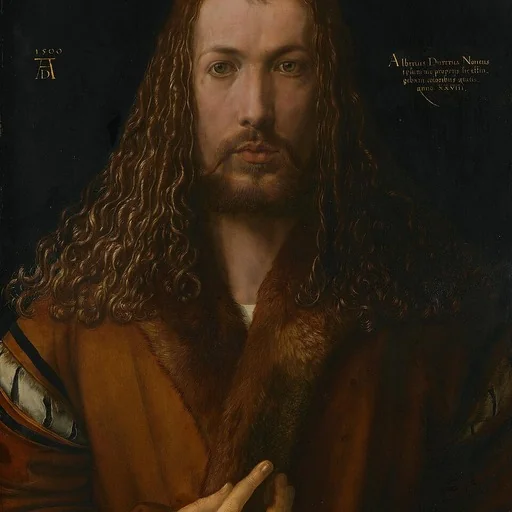
Albrecht Dürer spent his life in Nuremberg, a busy German city where artists traded prints like currency.

![Madonna and Child [obverse], by Albrecht Dürer](https://artifactworldgallery.com/img/albrecht-durer--madonna-and-child-obverse--d7b8ebf05d22ebe5-w320.webp)
![Lot and His Daughters [reverse], by Albrecht Dürer](https://artifactworldgallery.com/img/albrecht-durer--lot-and-his-daughters-reverse--b4ebf9b282faa17a-w320.webp)