Artwork
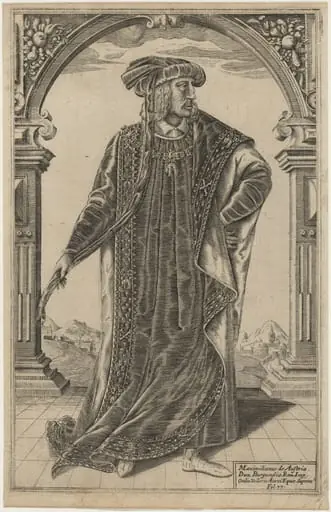
The Betrothal of Maximilian with Mary of Burgundy
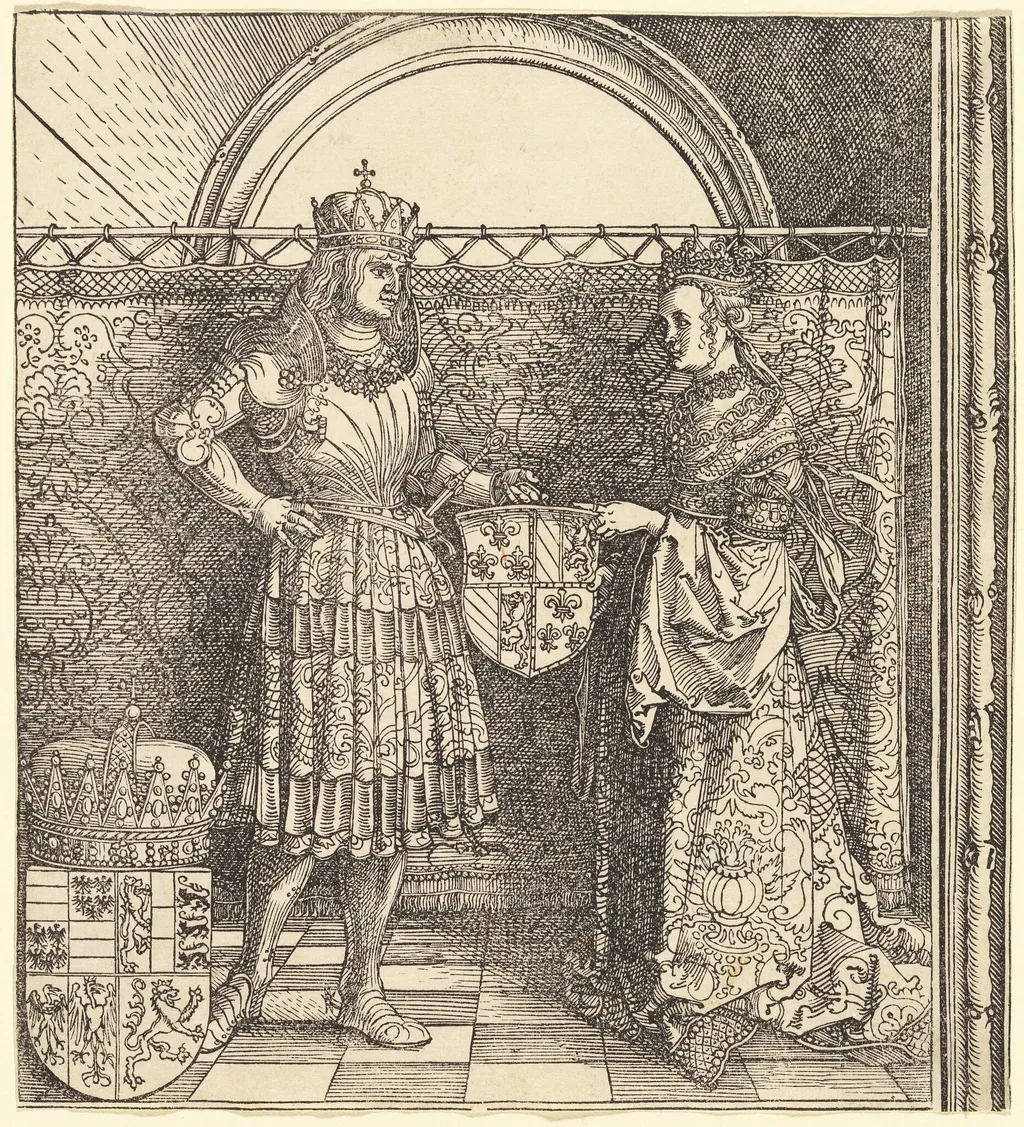
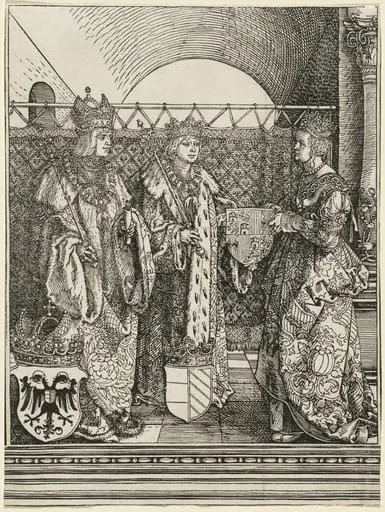
The Betrothal of Maximilian with Mary of Burgundy is an ink print by the Northern Renaissance artist Albrecht Dürer. It dates from 1511 and is held in the collection of the National Gallery of Art.
- Inscription
- Inscribed:verso, lower left, in graphite by a later hand: ge / a: 23320
About this work
Subject & Meaning
The print’s inclusion in the Habsburg propaganda program reflects the union’s strategic importance in consolidating power across central Europe.
The woodcut depicts the political marriage between Maximilian I, Holy Roman Emperor, and Mary, Duchess of Burgundy, formalized in 1477. Dürer’s composition centers on the couple exchanging rings under a canopy, flanked by courtly witnesses and heraldic devices. The scene underscores the dynastic alliance between the Habsburgs and the Burgundian Netherlands, reinforcing Maximilian’s claim to Burgundy through Mary’s inheritance.
Symbolic elements include the double-headed eagle and Burgundian cross, which signify imperial and territorial authority, respectively. The print’s inclusion in the Habsburg propaganda program reflects the union’s strategic importance in consolidating power across central Europe.
Technique & Style
Created in 1515, The Betrothal of Maximilian with Mary of Burgundy is a woodcut executed on laid paper. The work measures 17.4 cm in height and 15.8 cm in width. As a product of the German Renaissance movement originating in Nuremberg, the print utilizes the woodcut technique to depict the engagement of Maximilian I and Mary of Burgundy.
The medium of paper serves as the support for this linear design, characteristic of Albrecht Dürer's printmaking practice during this period.
History & Provenance
The Betrothal of Maximilian with Mary of Burgundy is a woodcut on laid paper produced by Albrecht Dürer in 1515, made in Nuremberg. The print entered the modern market through the dealer William Schab in New York, from whom it was purchased in 1962 by Lessing J. Rosenwald of Jenkintown, Pennsylvania. In 1964, Rosenwald gave the work to the National Gallery of Art in Washington, D.C., where it remains part of the Rosenwald Collection within the Gallery's prints holdings.
The woodcut is held by the National Gallery of Art in Washington, D.C., where it forms part of the Prints collection and the Rosenwald Collection. It entered the institution as a gift from Lessing J. Rosenwald in 1964, having been purchased by Rosenwald in 1962 from the dealer William Schab in New York.
No exhibition history is recorded in the available sources.
Overview
This 1511 woodcut by Albrecht Dürer records the ceremonial betrothal of Holy Roman Emperor Maximilian I to Mary of Burgundy. Executed on laid paper, the print condenses a pivotal dynastic alliance into a single, meticulously structured scene. Its linear precision and hierarchical composition reflect the conventions of early sixteenth-century Northern European printmaking.
Context
The betrothal symbolized the consolidation of Burgundian inheritance under Habsburg rule, a maneuver critical to Maximilian’s ambitions. By revisiting the moment in print, Dürer aligned his craft with the propagandistic needs of the imperial court, transforming a private ceremony into a public emblem of dynastic continuity and power.
Legacy
The woodcut exemplifies Dürer’s ability to distill complex historical narratives into compelling visual form. Its influence extended across subsequent generations of printmakers, who adopted its disciplined linearity and symbolic density. Today, it remains a key document in the study of Renaissance political imagery and print culture.
Own this work as a print
Artist & collection
Artist
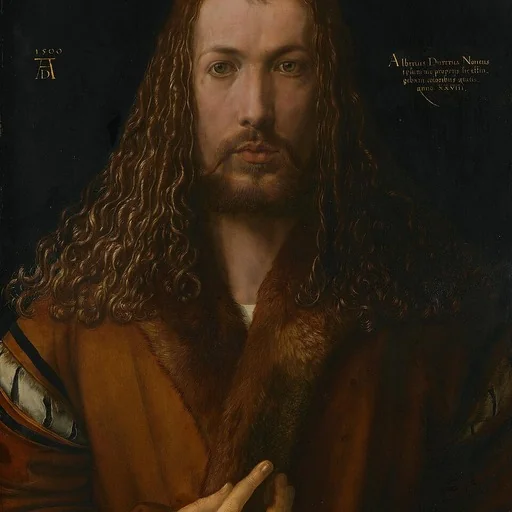
Albrecht Dürer spent his life in Nuremberg, a busy German city where artists traded prints like currency.

![Madonna and Child [obverse], by Albrecht Dürer](https://artifactworldgallery.com/img/albrecht-durer--madonna-and-child-obverse--d7b8ebf05d22ebe5-w320.webp)
![Lot and His Daughters [reverse], by Albrecht Dürer](https://artifactworldgallery.com/img/albrecht-durer--lot-and-his-daughters-reverse--b4ebf9b282faa17a-w320.webp)