Artwork
The Crucifixion
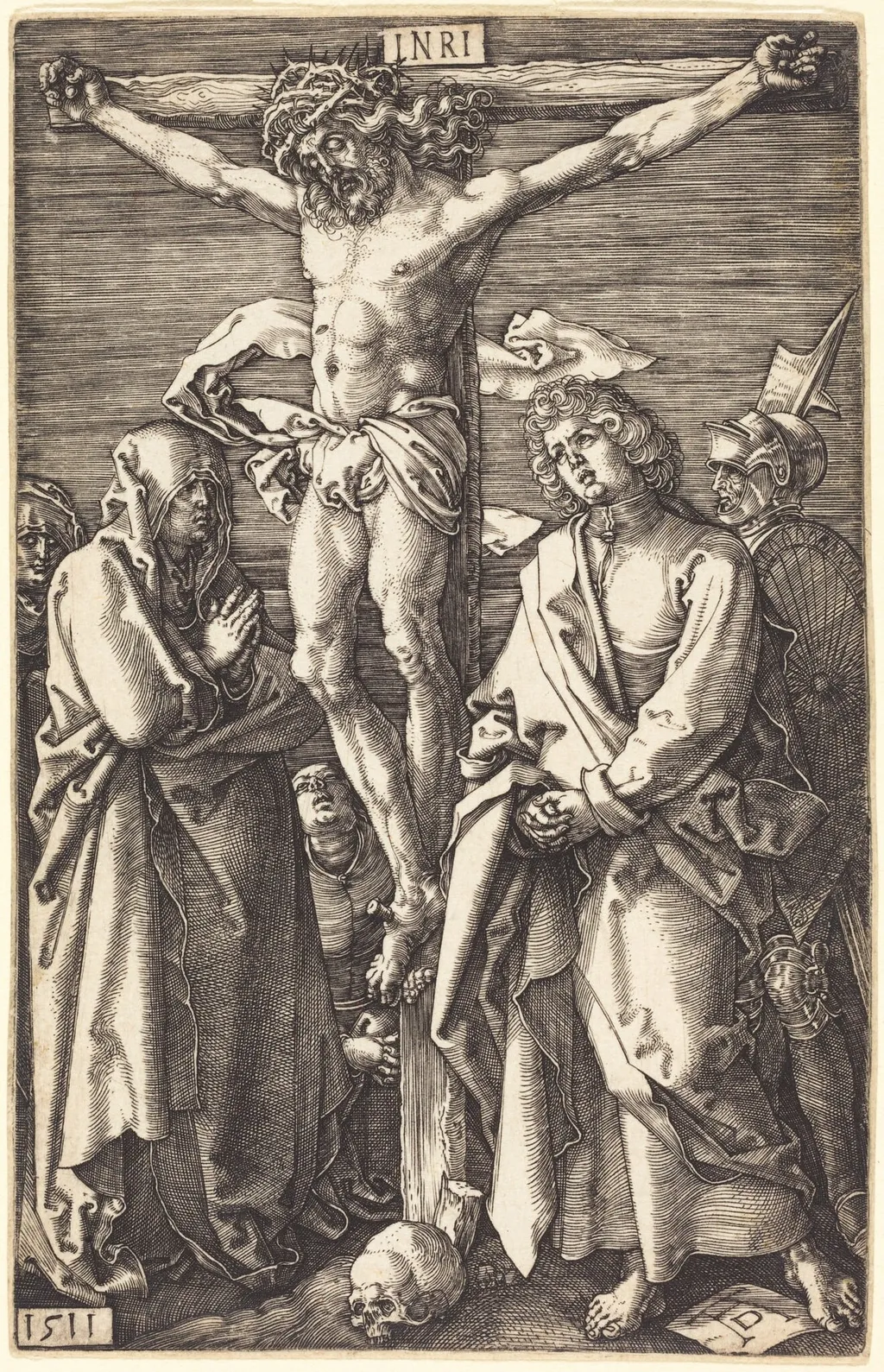
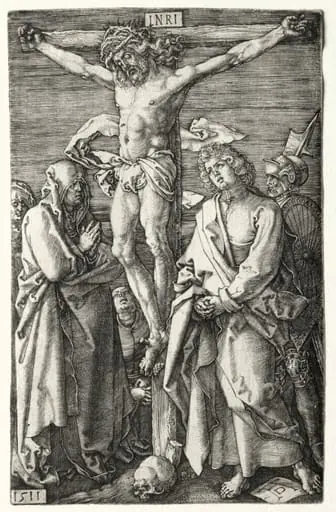
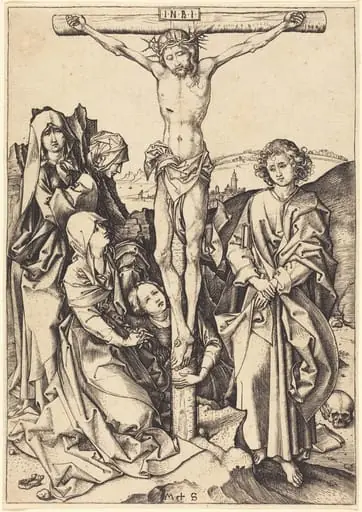
The Crucifixion is an ink print by the Northern Renaissance artist Albrecht Dürer. It dates from 1511 and is held in the collection of the National Gallery of Art.
- Inscription
- Inscribed:in plate, bottom left: 1511; in plate, bottom right: AD [artist's monogram]; verso, lower right, in graphite by a later hand: 11 [upside down]; verso, bottom left, in graphite by a later hand: NR [?] 25146; verso, bottom center, in graphite by a later hand: B.13
- Markings
- Marked:none
About this work
Subject & Meaning
Albrecht Dürer's 1511 engraving depicts the crucifixion of Jesus Christ, the central event of the Christian Passion narrative drawn from the New Testament.
Albrecht Dürer's 1511 engraving depicts the crucifixion of Jesus Christ, the central event of the Christian Passion narrative drawn from the New Testament. The work belongs to Dürer's Passion series, a group of prints devoted to the suffering and death of Christ, and is classified as religious art of the German Renaissance. As a print in the Passion cycle, the image functions both as a devotional object and as a meditation on Christ's sacrifice, presenting the Crucifixion as the principal subject rather than as an incidental element within a broader scene.
The composition is rendered as an engraving on laid paper, a medium that allowed Dürer to distribute the image widely and reinforce its devotional and didactic purpose among viewers beyond churches and private patrons.
Technique & Style
Executed in engraving, the composition is cut onto a copper plate with fine burin lines that modulate from deep blacks to delicate hatching, conveying volume and texture across the figures and landscape. The laid paper support bears faint chain lines and a watermark consistent with early sixteenth-century Nuremberg production, and the impression shows strong plate tone in the darker areas, indicating an early impression before extensive printing wear.
The stylistic handling emphasizes sculptural modeling through cross-hatching and stippling, particularly in the muscular torsion of Christ’s torso and the cascading drapery of the mourning figures. The cross and rocky Golgotha are rendered with precise linear perspective, anchoring the scene in a measured, rational space that heightens the emotional gravity of the event.
History & Provenance
Albrecht Dürer created the engraving The Crucifixion in 1511 in Nuremberg as part of his Passion series. The work was produced on laid paper and depicts the crucifixion of Jesus Christ according to the New Testament. Its documented ownership history begins with the Brentano-Birckenstock Collection in Vienna and Frankfurt.
It subsequently entered the collection of Arthur Friederich Theodor Bohnenberger in Stuttgart. In 1928, the print was purchased by Lessing J. Rosenwald in Jenkintown, Pennsylvania, before being gifted to the National Gallery of Art in Washington, D.C., in 1943. Other known holdings include the Cleveland Museum of Art.
The Crucifixion is held by the National Gallery of Art in Washington, D.C., where it entered the collection in 1943 as a gift from Lessing J. Rosenwald. Rosenwald, a resident of Jenkintown, Pennsylvania, had acquired the engraving in 1928. Earlier ownership traces back to Arthur Friederich Theodor Bohnenberger of Stuttgart (1826–1893) and, before that, to the Brentano-Birckenstock Collection in Vienna and Frankfurt.
According to Wikidata records, the print is also associated with the Cleveland Museum of Art and is catalogued within the Prints in the National Gallery of Art, Rosenwald Collection. No exhibition history beyond its provenance chain is documented in the provided sources.
Overview
Created in 1511, Albrecht Dürer's engraving The Crucifixion is a seminal work from his second series of the Large Passion. The composition centers on the figure of Christ on the cross, his head bowed in death, flanked by the Virgin Mary and Saint John the Evangelist who stand in the foreground. Dürer employs his mastery of the burin to create a dense network of fine lines and cross-hatching, generating deep chiaroscuro effects that define the muscular tension of the figures and the somber atmosphere of the scene.
The background features a dramatic, stormy sky and a landscape that recedes into the distance, populated by additional figures and architectural elements typical of the artist's Northern Renaissance style. This print exemplifies Dürer's technical innovation in translating painterly light and shadow into the medium of engraving, establishing a new standard for reproductive printmaking in the German Renaissance. The work reflects the artist's mature engagement with religious themes, combining intense emotional expression with precise anatomical observation and complex spatial organization.
Own this work as a print
Artist & collection
Artist
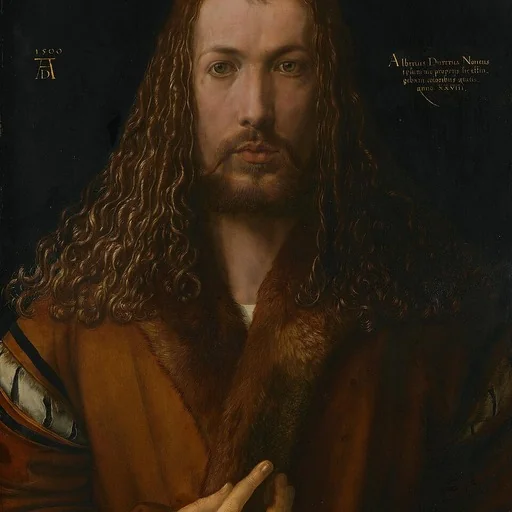
Albrecht Dürer spent his life in Nuremberg, a busy German city where artists traded prints like currency.

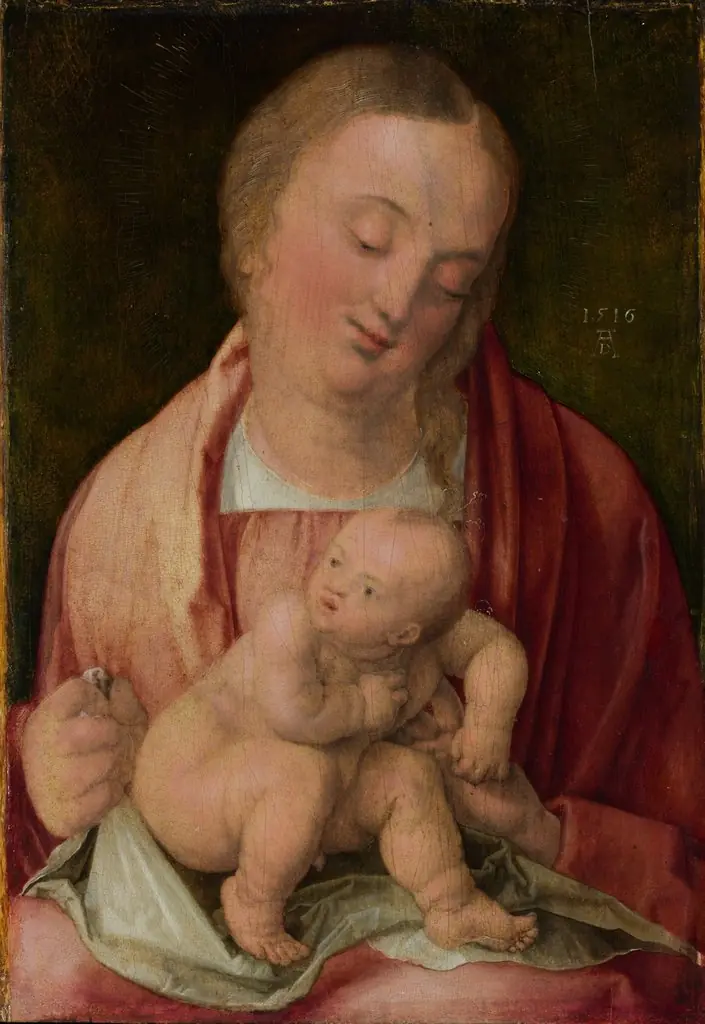
![Madonna and Child [obverse], by Albrecht Dürer](https://artifactworldgallery.com/img/albrecht-durer--madonna-and-child-obverse--d7b8ebf05d22ebe5-w320.webp)
![Lot and His Daughters [reverse], by Albrecht Dürer](https://artifactworldgallery.com/img/albrecht-durer--lot-and-his-daughters-reverse--b4ebf9b282faa17a-w320.webp)