Artwork
The Man of Sorrows Standing by the Column
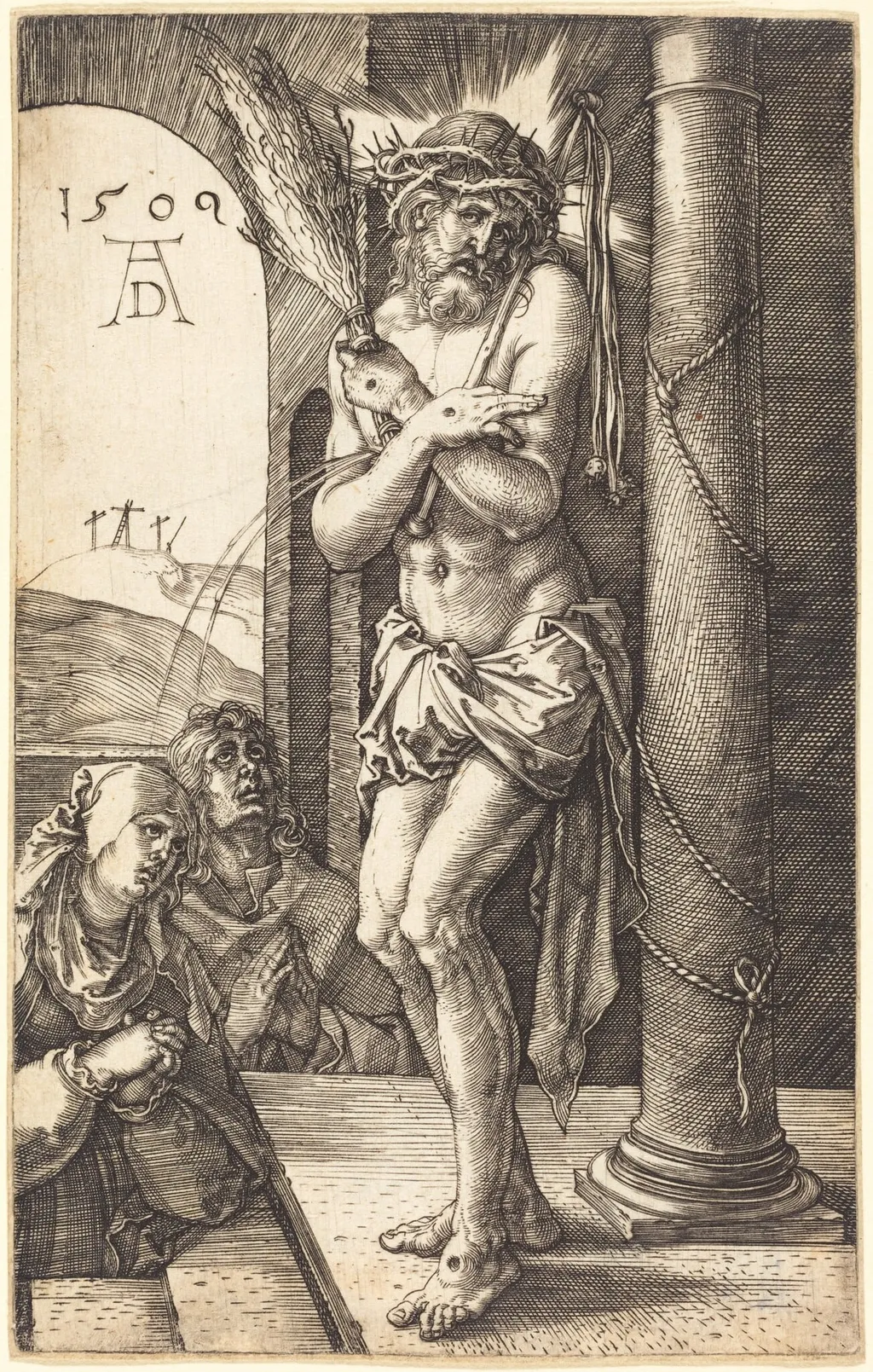
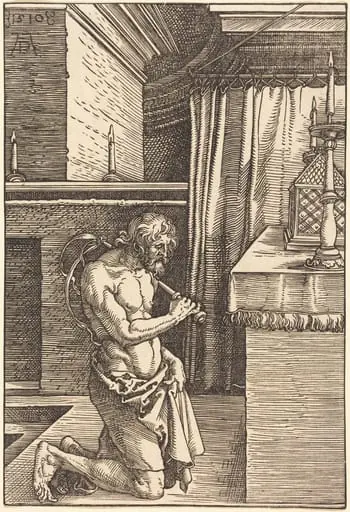
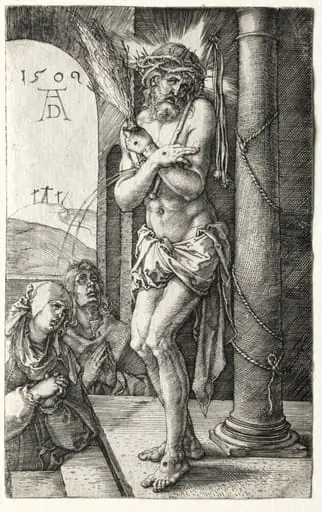
The Man of Sorrows Standing by the Column is an ink print by the Northern Renaissance artist Albrecht Dürer. It dates from 1509 and is held in the collection of the Metropolitan Museum of Art.
- Inscription
- Inscribed:recto, in plate, at upper left: 1509 / AD [artist's monogram]; verso, center, in graphite by a later hand: [illegible; sideways]; verso, lower left side, in graphite by a later hand: 1661 [?]; / GHN / a 19392; verso, lower center, in graphite by a later hand: 6105; verso, lower center, in graphite by a later hand: vnx [?] / NR [?] 25146; verso, lower right, in graphite by a later hand: 21 [upside down]; verso, bottom center, in graphite by a later hand: B. 3
- Markings
- Marked:none
About this work
Subject & Meaning
The specific inclusion of the column references the site of the Flagellation, reinforcing the theme of physical torment endured by the Savior.
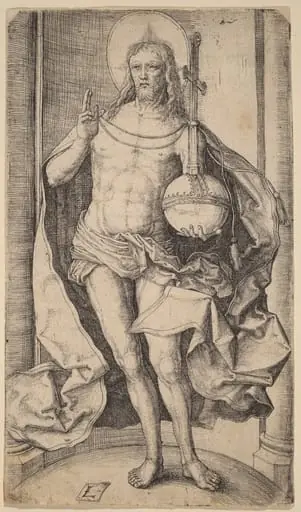
The engraving depicts the Man of Sorrows, a central figure in Christian iconography representing Jesus Christ standing by a column. This imagery, derived from the New Testament, visualizes the suffering and humiliation of Christ following his Passion. The composition includes the Virgin Mary and John the Baptist, who stand as witnesses to the scene.
Created as part of Dürer's Passion series, the work functions as a devotional object intended to evoke empathy and reflection on the redemptive sacrifice of Christ. The specific inclusion of the column references the site of the Flagellation, reinforcing the theme of physical torment endured by the Savior.
Technique & Style
Dürer's The Man of Sorrows Standing by the Column is an engraving executed in 1509 on laid paper, a support characteristic of early sixteenth-century printmaking. The composition, measuring roughly 119 by 75 mm, belongs to the German Renaissance and reflects the disciplined linear technique for which Dürer was renowned, with finely controlled hatching used to model the figure of Christ, the Virgin Mary, and John the Baptist against a sparse background. The work forms part of his Passion series, and its small scale and precise burin handling are typical of the artist's devotional prints intended for close, contemplative viewing.
The sources do not provide additional detail on condition, specific ink characteristics, or stylistic analysis beyond the medium, dimensions, and movement classification.
History & Provenance
Albrecht Dürer created this engraving, titled The Man of Sorrows Standing by the Column, in 1509. The work belongs to the artist's Passion series and was executed on laid paper.
The documented ownership history of a specific impression begins with the Brentano-Birckenstock Collection, which held the piece in Vienna and Frankfurt. It subsequently entered the collection of Arthur Friederich Theodor Bohnenberger in Stuttgart. In 1928, Lessing J. Rosenwald purchased the print, adding it to his holdings in Jenkintown, Pennsylvania. Rosenwald later donated the work to the National Gallery of Art in Washington, D.C., in 1943.
The engraving is held by the National Gallery of Art in Washington, D.C., where it entered the collection as a gift in 1943 from Lessing J. Rosenwald, who had purchased it in 1928. Earlier provenance traces through Arthur Friederich Theodor Bohnenberger of Stuttgart and the Brentano-Birckenstock Collection in Vienna and Frankfurt. The work also forms part of the Rosenwald Collection and is catalogued among Prints in the National Gallery of Art.
According to Wikidata, impressions of the engraving are additionally held by the Chester Beatty Library, the Cleveland Museum of Art, the Metropolitan Museum of Art, the Museum of Fine Arts, Houston, the Los Angeles County Museum of Art, and the Dallas Museum of Art, with the Cleveland Museum of Art also listed as a holding location alongside Washington.
No exhibition history is documented in the provided sources.
Overview
Albrecht Dürer's engraving The Man of Sorrows Standing by the Column, created in 1509, depicts the crucified Christ standing alone beside a stone column, a symbol of his flagellation. The figure is shown in a three-quarter view, his body bearing the visible wounds of the Passion, with a crown of thorns resting on his head and a red robe draped loosely over his shoulders. Dürer renders the scene with the precise, controlled line work characteristic of his mature printmaking, using dense cross-hatching to model the anatomy and convey the weight of the suffering figure against the stark background.
This work belongs to a series of devotional images produced during Dürer's second Italian journey and subsequent period in Nuremberg, reflecting the intense spiritual introspection of the German Renaissance. The composition emphasizes the isolation and humanity of Christ, inviting the viewer into a direct, empathetic encounter with the divine suffering. It stands as a significant example of Dürer's ability to synthesize Northern European detail with Italianate structural clarity, solidifying his reputation as a master of the engraving medium.
Own this work as a print
Artist & collection
Artist
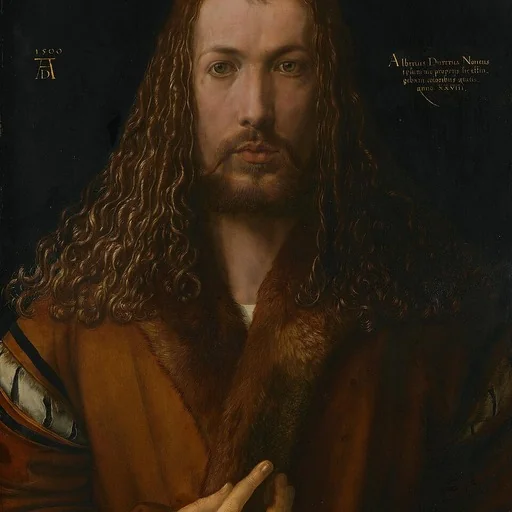
Albrecht Dürer spent his life in Nuremberg, a busy German city where artists traded prints like currency.

![Madonna and Child [obverse], by Albrecht Dürer](https://artifactworldgallery.com/img/albrecht-durer--madonna-and-child-obverse--d7b8ebf05d22ebe5-w320.webp)
![Lot and His Daughters [reverse], by Albrecht Dürer](https://artifactworldgallery.com/img/albrecht-durer--lot-and-his-daughters-reverse--b4ebf9b282faa17a-w320.webp)