Artwork
The Nativity
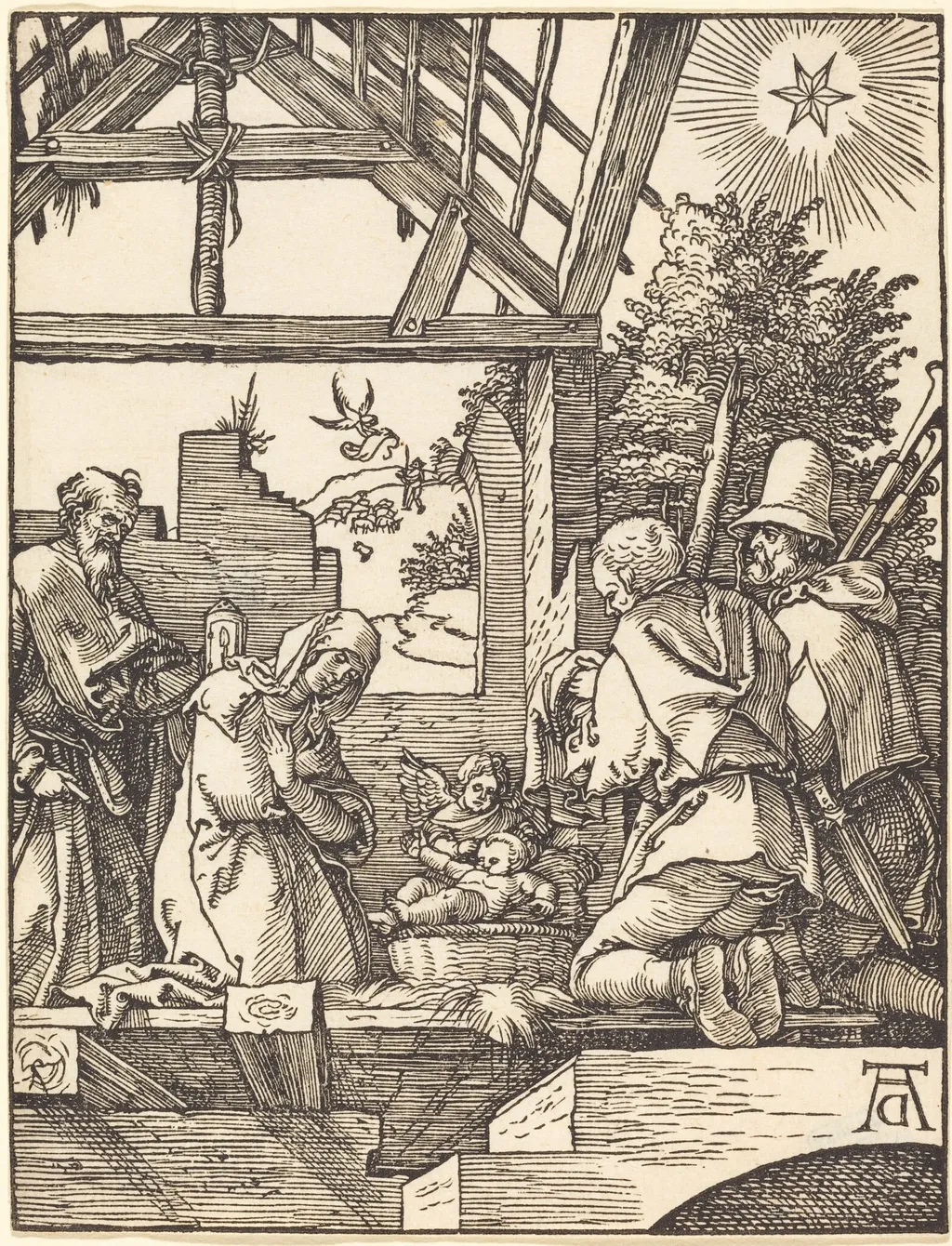
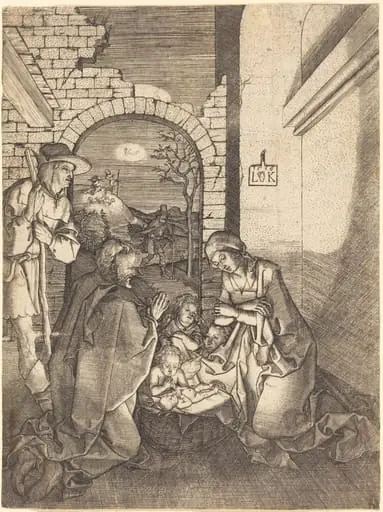
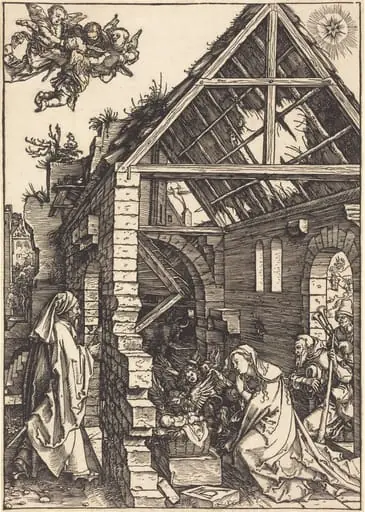
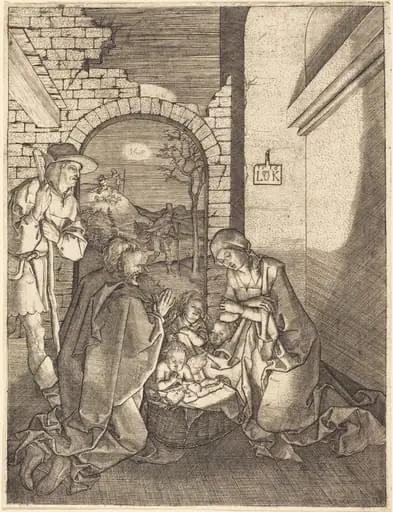
The Nativity is an ink print by the Northern Renaissance artist Albrecht Dürer. It dates from 1510 and is held in the collection of the British Museum.
- Inscription
- Inscribed:in block, lower right, on stairway: AD [artist's monogram] [backwards D]; verso, lower left, in graphite by a later hand: [indecipherable]; verso, lower right, in graphite by a later hand: 62; verso, lower right, in graphite by a later hand: 5
About this work
Subject & Meaning
The woodcut depicts the Nativity of Jesus with Mary prominently present as she kneels before the Christ Child, who lies on a cloth on the ground.
The woodcut depicts the Nativity of Jesus with Mary prominently present as she kneels before the Christ Child, who lies on a cloth on the ground. The scene draws on New Testament accounts, focusing on the moment of Christ’s birth rather than the traditional manger setting, emphasizing humility and divine incarnation. The composition aligns with the German Renaissance emphasis on narrative clarity and emotional restraint, omitting extraneous figures to concentrate on the central theological moment.
Technique & Style
Executed in woodcut, the composition is cut on a block and printed in black ink on laid paper. The design is characterized by fine, controlled lines that define figures and landscape elements, with hatching and cross-hatching modulating light and volume. The figures, including the reclining Virgin and the infant Christ, are rendered with careful anatomical definition and expressive restraint, while the surrounding architecture and animals are indicated through economical, descriptive strokes.
The print’s small scale and refined detail reflect Dürer’s mastery of the medium, aligning with his graphic innovations in the Little Passion series.
History & Provenance
Albrecht Dürer created the woodcut The Nativity in 1509 as part of his Little Passion series. The work depicts the birth of Jesus Christ and Mary within the context of the German Renaissance.
The known ownership chain for a specific impression begins with Joseph Daniel Böhm in Vienna, followed by Robert Scholtz in Budapest. The print subsequently passed through the hands of William Schab in New York before being purchased by Lessing J. Rosenwald in Jenkintown, Pennsylvania, in 1940. Rosenwald gifted this impression to the National Gallery of Art in Washington, D.C., in 1943.
This woodcut impression entered the collection of the National Gallery of Art in Washington, D.C., in 1943 as a gift from Lessing J. Rosenwald. Rosenwald had acquired the work in 1940 from the dealer William Schab in New York. Prior to this, the print belonged to Robert Scholtz of Budapest and Joseph Daniel Böhm of Vienna.
While other impressions of this 1509 work are held by institutions such as the Metropolitan Museum of Art, the British Museum, and the Cleveland Museum of Art, the specific provenance detailed here pertains to the Rosenwald donation.
Legacy
The Nativity woodcut shaped religious printmaking in the 16th century and remains a benchmark of German Renaissance art. Its stark composition and use of light influenced later printmakers who sought to convey sacred narrative with emotional immediacy. The work is held in major collections including the National Gallery of Art, the Cleveland Museum of Art, the British Museum, and the Metropolitan Museum of Art, reflecting its enduring scholarly and curatorial significance.
Overview
Albrecht Dürer’s The Nativity is a woodcut print executed around 1510, part of a broader series of devotional images. Produced on laid paper, the work reflects Dürer’s mastery of the medium, combining intricate linework with a composition designed for mass reproduction. Intended for sale to pilgrims and collectors, the print distills a sacred narrative into a compact, reproducible format.
Context
Woodcuts like The Nativity played a crucial role in disseminating religious imagery during the early 16th century. Dürer’s work emerged in a period of heightened demand for affordable, portable devotional art, catering to a growing audience of literate and pious viewers. The print’s composition reflects both traditional Christian iconography and Dürer’s innovative approach to spatial organization and light.
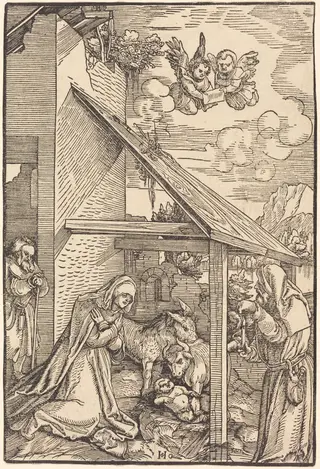
Own this work as a print
Artist & collection
Artist
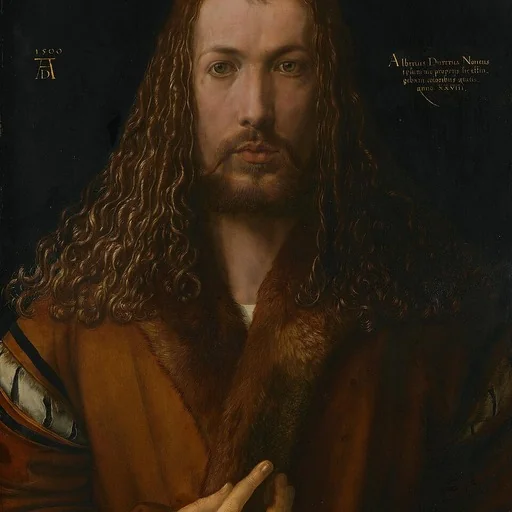
Albrecht Dürer spent his life in Nuremberg, a busy German city where artists traded prints like currency.

![Madonna and Child [obverse], by Albrecht Dürer](https://artifactworldgallery.com/img/albrecht-durer--madonna-and-child-obverse--d7b8ebf05d22ebe5-w320.webp)
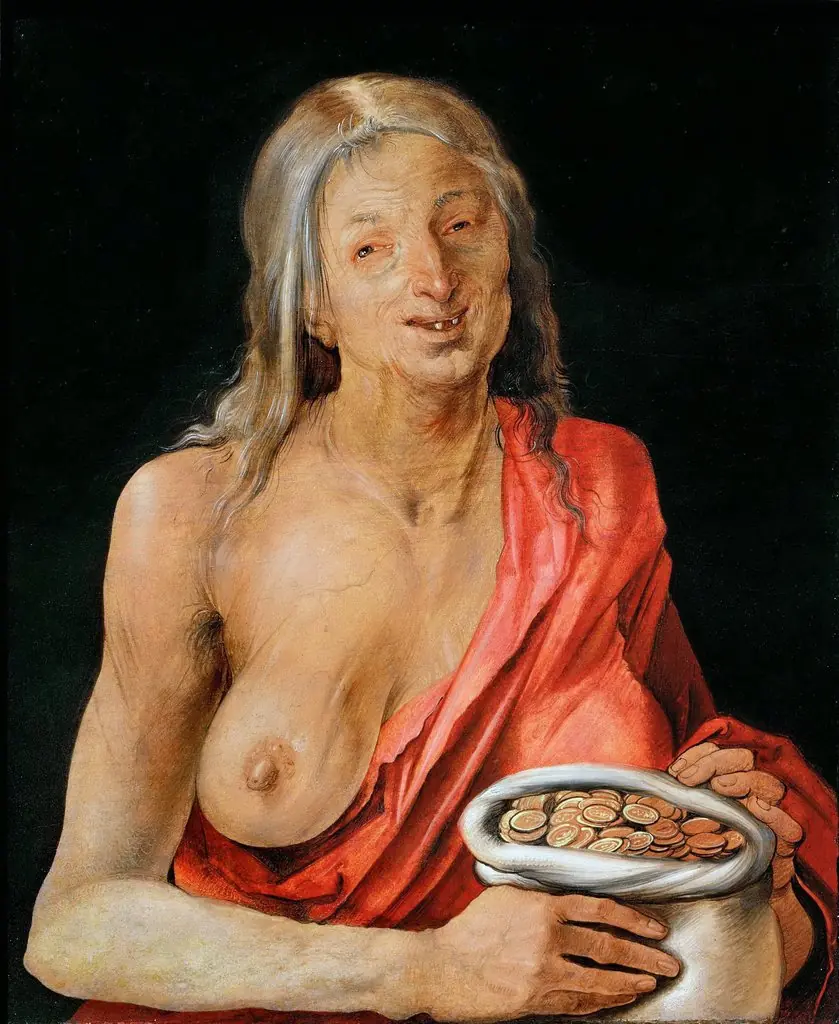
![Lot and His Daughters [reverse], by Albrecht Dürer](https://artifactworldgallery.com/img/albrecht-durer--lot-and-his-daughters-reverse--b4ebf9b282faa17a-w320.webp)
- The Nativity
 The Nativity
 The Nativity
 The Nativity
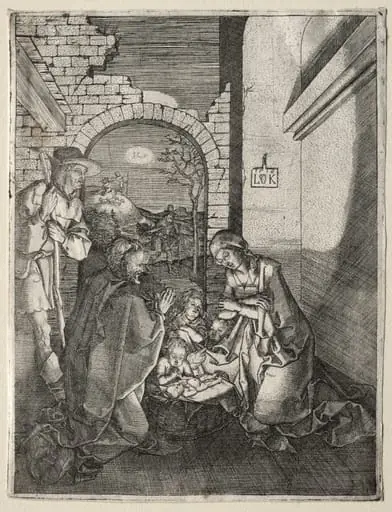 The Nativity
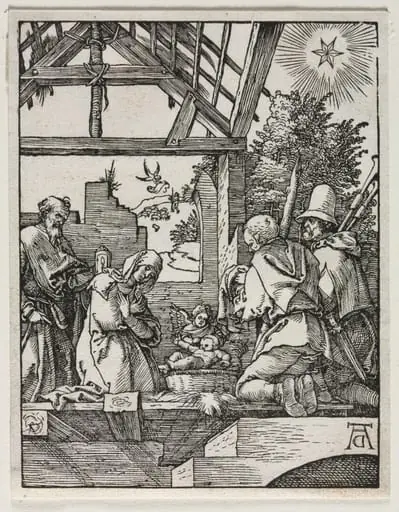 The Small Passion: The Nativity
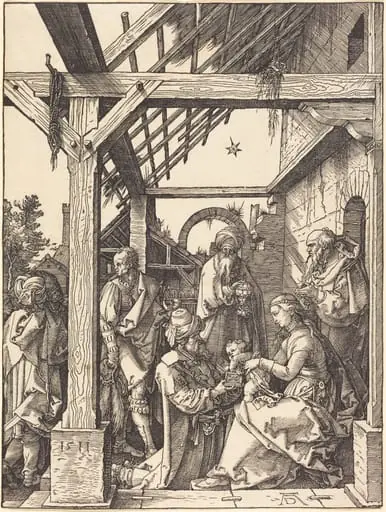 The Adoration of the Magi
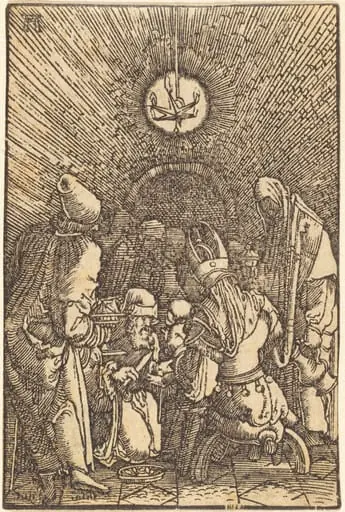 The Circumcision
 The Holy Family with Two Angels in a Vaulted Hall
 The Fall and Redemption of Man: The Nativity
 The Holy Family with the Three Hares
 The Holy Family with Saint Anne and Saint Joachim