Artwork
The Holy Family with the Three Hares
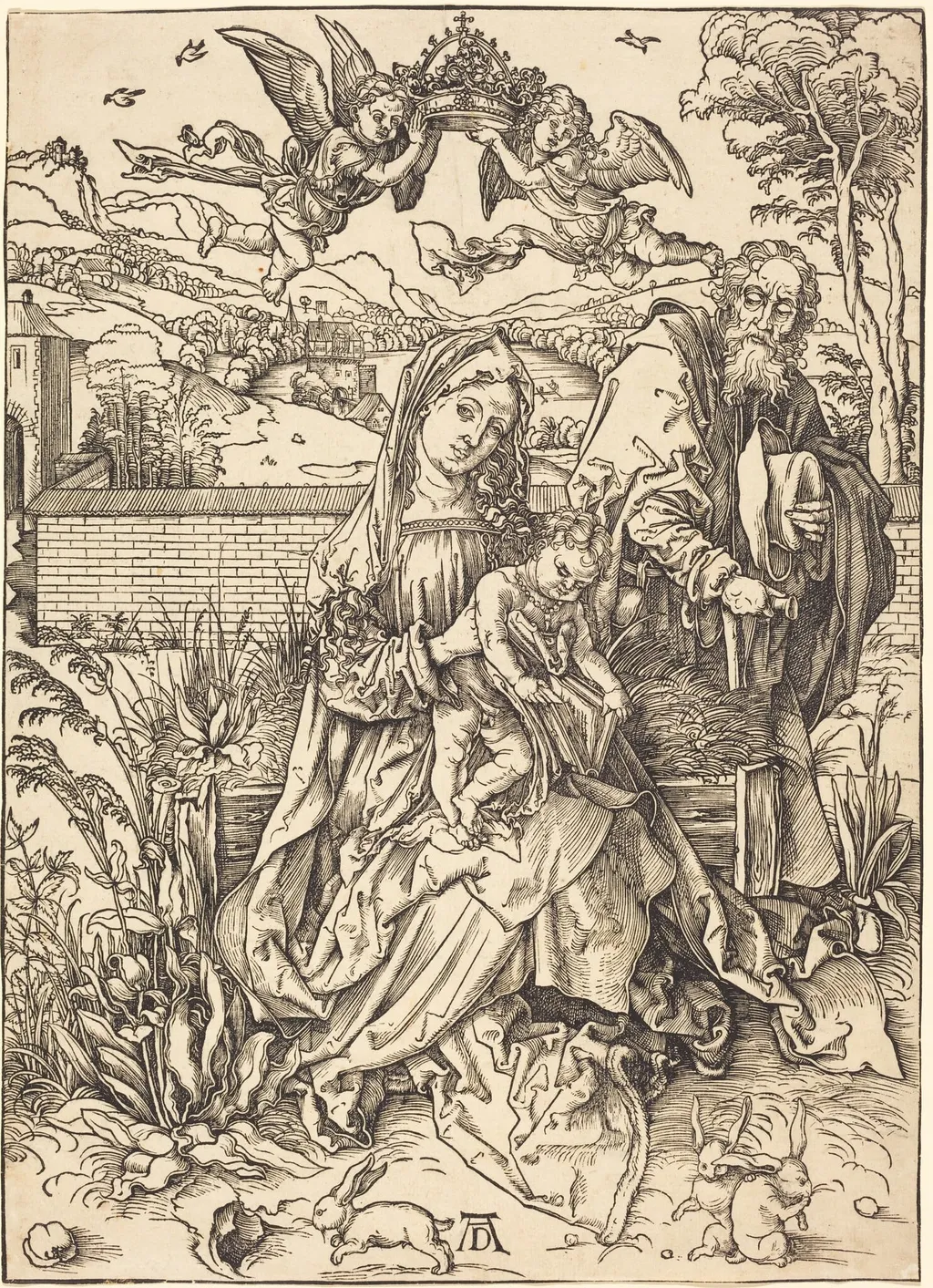
The Holy Family with the Three Hares is an ink print by the Northern Renaissance artist Albrecht Dürer. It dates from 1498 and is held in the collection of the National Gallery of Victoria.
About this work
Subject & Meaning
Mary is depicted presenting the child to the viewer, while Joseph, dressed as a Nordic peasant, stands guard to the right.
The woodcut shows the Holy Family, Mary, Joseph, and the infant Jesus, set within an enclosed garden (hortus conclusus), a traditional symbol of Mary’s perpetual virginity. The infant Jesus holds what is likely a book of scripture, underscoring his intimate connection with the Word of God. Mary is depicted presenting the child to the viewer, while Joseph, dressed as a Nordic peasant, stands guard to the right. In the foreground three hares give the work its name, with one hare appearing to seek refuge near the ‘stone’ of Christ. Above Mary, two flying angels hold a crown, a motif borrowed from Flemish painting. Together these elements convey themes of purity, divine incarnation, and the protective sanctity of the Holy Family.
Technique & Style
Executed in 1498 as a woodcut, the composition measures 39.5 × 28.5 cm on paper and is signed with Dürer’s monogram at the lower center. The figures are rendered with pronounced drapery folds that lend a sense of dynamic movement, yet their forms achieve a monumental solidity. The background expands into a distant landscape with detailed flora, a novelty in woodcut practice, while the scene is framed by an enclosed garden (hortus conclusus) that underscores Marian iconography. Two flying angels crown Mary above, while the Christ Child reads a book of scripture, indicating his role as the Word of God. The three hares at the lower edge introduce a symbolic motif associated with fertility and sight.
History & Provenance
The Holy Family with the Three Hares is a woodcut created by Albrecht Dürer in Nuremberg, where he was working as an engraver. The print bears Dürer's monogram at the lower center. Dating for the work varies slightly across sources: it is given as 1497 in one catalogue entry, while the French, Italian, and Spanish Wikipedia accounts all date it to 1498, and the English Wikipedia and Wikidata entries describe it as c. 1496 or place its inception between 1497 and 1498. Among the best surviving impressions, one is held by the Staatliche Kunsthalle Karlsruhe. Additional impressions are recorded in collections including the National Gallery of Canada, the National Gallery of Art in Washington, D.C., the Cleveland Museum of Art, the Art Institute of Chicago, the National Gallery of Victoria, and the Kunsthalle Mannheim, with the Washington holdings linked to the Rosenwald Collection. No commission or specific ownership chain beyond these institutional holdings is documented. The woodcut is held in the Staatliche Kunsthalle Karlsruhe, where it is catalogued as a key example of Dürer’s 1498 output. The work is signed with the artist’s monogram at the lower center and measures 39.5 × 28.5 cm. It has been included in major print exhibitions, most recently appearing in the 2022-2023 exhibition *Albrecht Dürer. Gravure et Renaissance* at the Musée Condé, Chantilly, accompanied by the catalogue raisonné published for the show.
Context
Created around 1497-1498 while Albrecht Dürer was working as an engraver in Nuremberg, this woodcut represents a significant advancement in the medium of printmaking. The work distinguishes itself through a rich landscape background and detailed botanical elements surrounding the grassy seat, features considered novel for woodcut art of the period. Although the composition retains the artist's characteristic emphasis on exaggerated drapery movement, the figures possess a decisive monumentality. Thematically, the piece aligns closely with Dürer's earlier Holy Family with the Butterfly but demonstrates clear stylistic progress. The inclusion of flying angels holding a crown above Mary derives from Flemish painting traditions, while the enclosed garden setting symbolizes Marian virginity. This synthesis of Northern European landscape detail with Italianate figure modeling underscores Dürer's pivotal role in elevating the technical and artistic status of the German Renaissance print.
Own this work as a print
Artist & collection
Artist
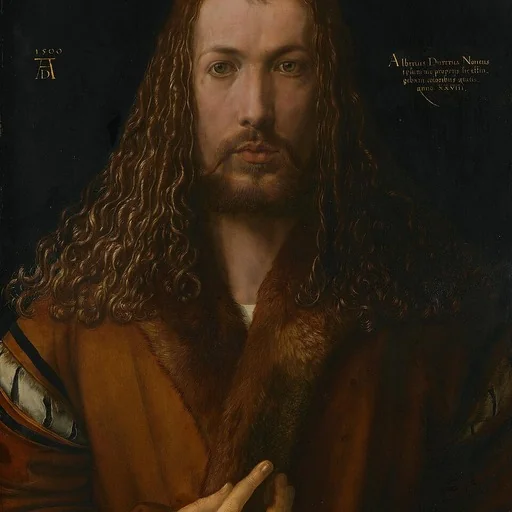
Albrecht Dürer spent his life in Nuremberg, a busy German city where artists traded prints like currency.

![Madonna and Child [obverse], by Albrecht Dürer](https://artifactworldgallery.com/img/albrecht-durer--madonna-and-child-obverse--d7b8ebf05d22ebe5-w320.webp)
![Lot and His Daughters [reverse], by Albrecht Dürer](https://artifactworldgallery.com/img/albrecht-durer--lot-and-his-daughters-reverse--b4ebf9b282faa17a-w320.webp)
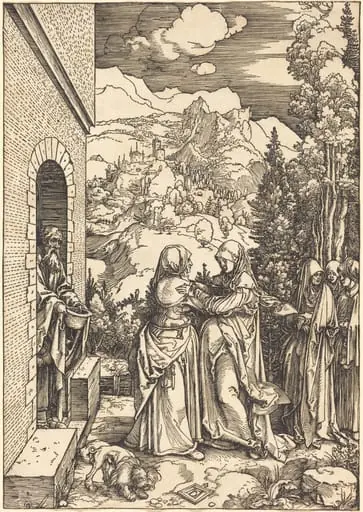 The Visitation
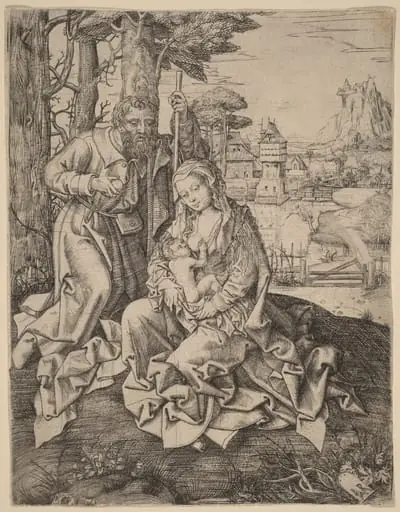 The Holy Family in a Landscape
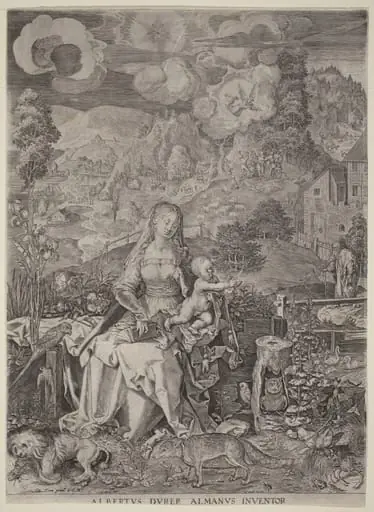 Virgin and Child in a Landscape
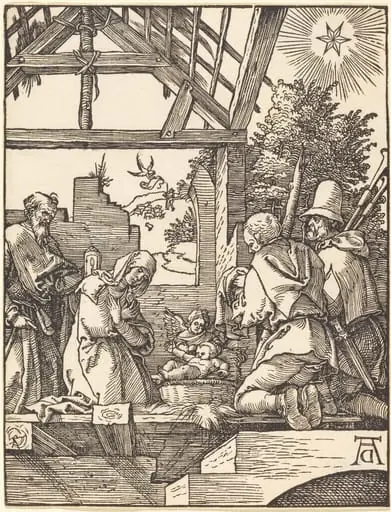 The Nativity
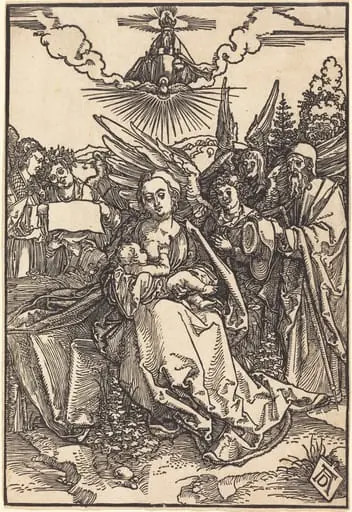 The Holy Family with Five Angels
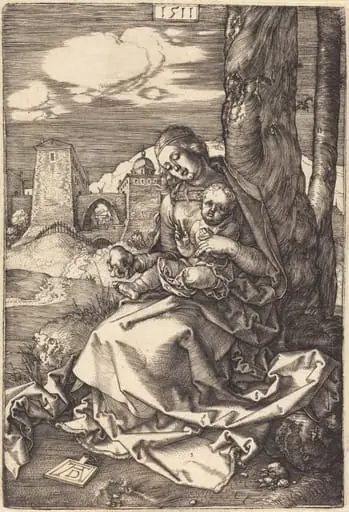 The Virgin and Child with the Pear
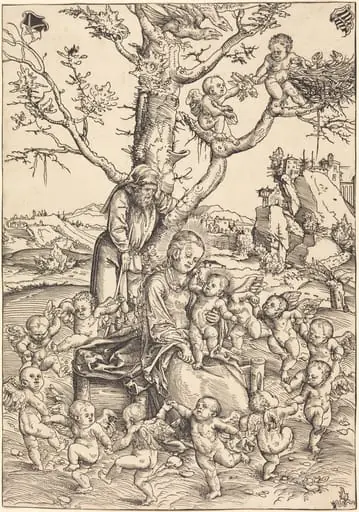 The Rest on the Flight into Egypt
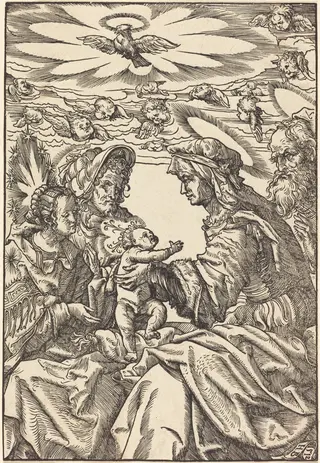 The Holy Family with Saint Anne and Saint Joachim
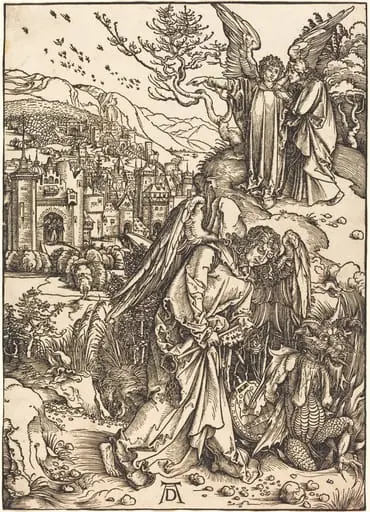 The Angel with the Key to the Bottomless Pit
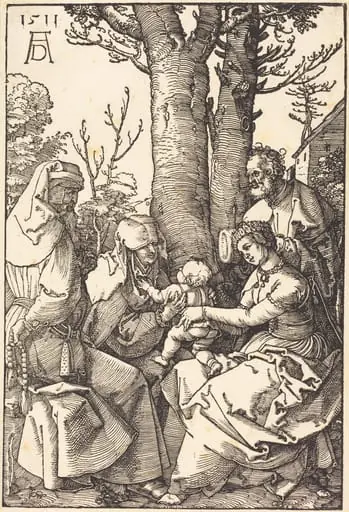 The Holy Family with Joachim and Anne under a Tree
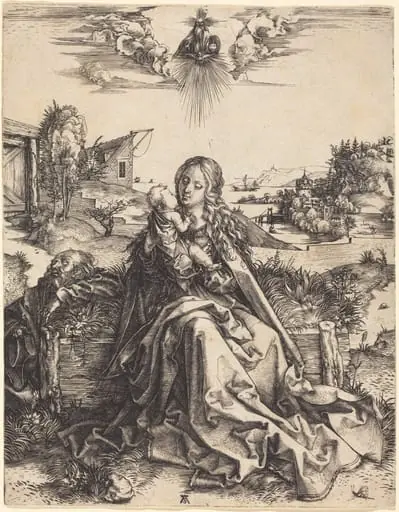 The Holy Family with the Mayfly
- Holy Family with the Three Hares