Artwork
The Nativity
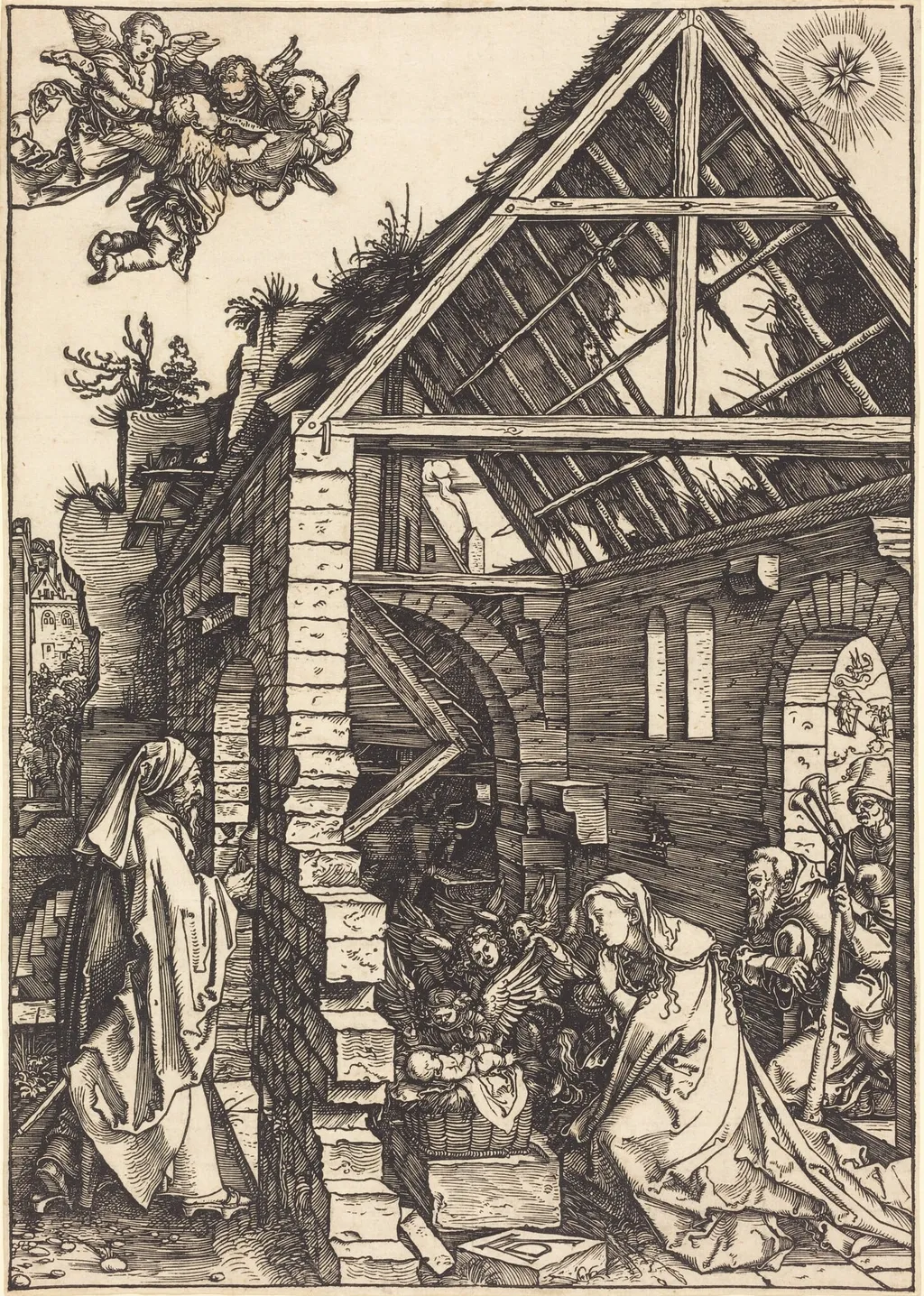
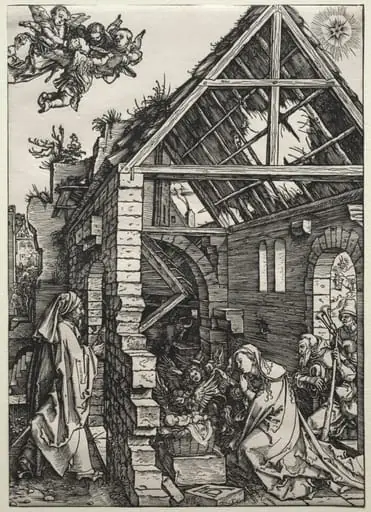
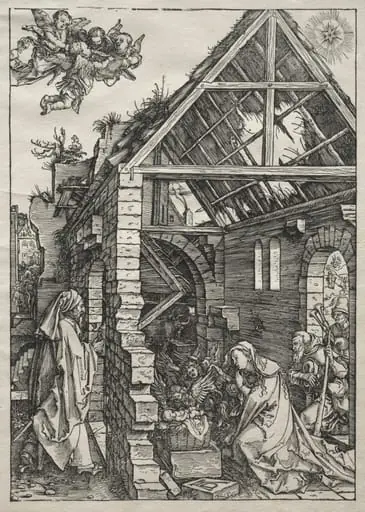
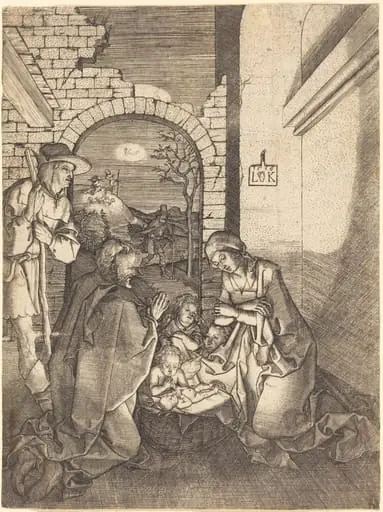
The Nativity is an ink print by the Northern Renaissance artist Albrecht Dürer. It dates from 1503 and is held in the collection of the Metropolitan Museum of Art.
About this work
Albrecht Dürer carved this Nativity in 1502–04. Mary kneels beside the baby Jesus wrapped in swaddling clothes. A donkey and ox peer over the edge of the manger.
The woodcut is only 11 x 7 inches, yet it hums with detail. Tiny towns sit in the background. Each line feels alive, like Dürer’s pencil danced across the block.
Look up Dürer, Albrecht next.
Subject & Meaning
Albrecht Dürer's 1502 woodcut, titled The Nativity, depicts the birth of Jesus Christ, focusing on the central figures of Mary and the infant Jesus.
Albrecht Dürer's 1502 woodcut, titled The Nativity, depicts the birth of Jesus Christ, focusing on the central figures of Mary and the infant Jesus. As part of the Life of the Virgin series, the work illustrates the biblical narrative found in the New Testament. The composition presents the core event of the Nativity, a foundational subject in Christian religious art.
Created during the German Renaissance in Nuremberg, the print serves as a visual representation of the incarnation, emphasizing the holy family within a religious context.
Technique & Style
Created in 1502 in Nuremberg, this work is a woodcut printed with ink on laid paper. As a print from the German Renaissance, it belongs to the series known as the Life of the Virgin. The composition depicts the Nativity of Jesus, featuring Mary and the Christ child as the central religious subjects.
Surviving examples measure approximately 29.9 cm in height by 21.1 cm in width. The piece is classified as a religious genre work based on narratives from the New Testament.
History & Provenance
The Nativity was created by Albrecht Dürer in Nuremberg in 1502, as part of the series Life of the Virgin. The woodcut was printed on laid paper and depicts the Nativity of Jesus, with Mary and the Christ Child as the central figures.
The work is held in multiple institutional collections, including the National Gallery of Art in Washington, D.C., where it is part of the Rosenwald Collection, as well as the Metropolitan Museum of Art, the Cleveland Museum of Art, the Chester Beatty Library, and the Staatliche Graphische Sammlung München. A separate inception date of 1504 is also recorded for the print.
The sources do not document a specific commissioner, patron, or earlier ownership chain for the woodcut, nor do they detail its early provenance before entering these public collections.
The Nativity is held in several public collections. According to the Wikidata record, impressions are located at the National Gallery of Art in Washington, D.C., the Chester Beatty Library, and the Cleveland Museum of Art, with the work also forming part of the collections of the Metropolitan Museum of Art and the Staatliche Graphische Sammlung München, as well as the Prints in the National Gallery of Art / Rosenwald Collection.
No specific accession numbers, catalog entries, or individual exhibition history entries are recorded in the available sources for this print.
Overview
The Nativity is a woodcut print on laid paper created by Albrecht Dürer around 1502-04. It measures 11 x 7 inches and depicts a scene from Christian tradition.
Own this work as a print
Artist & collection
Artist
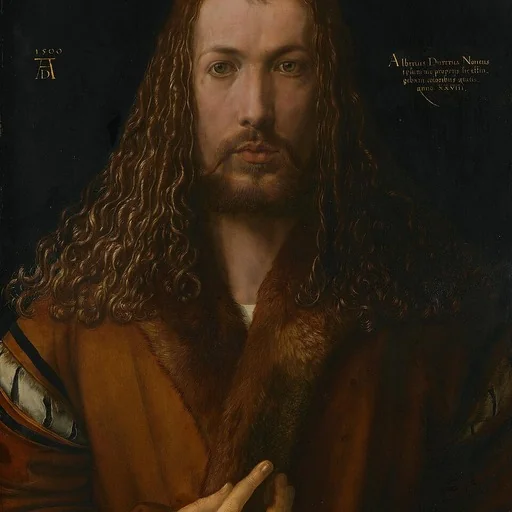
Albrecht Dürer spent his life in Nuremberg, a busy German city where artists traded prints like currency.

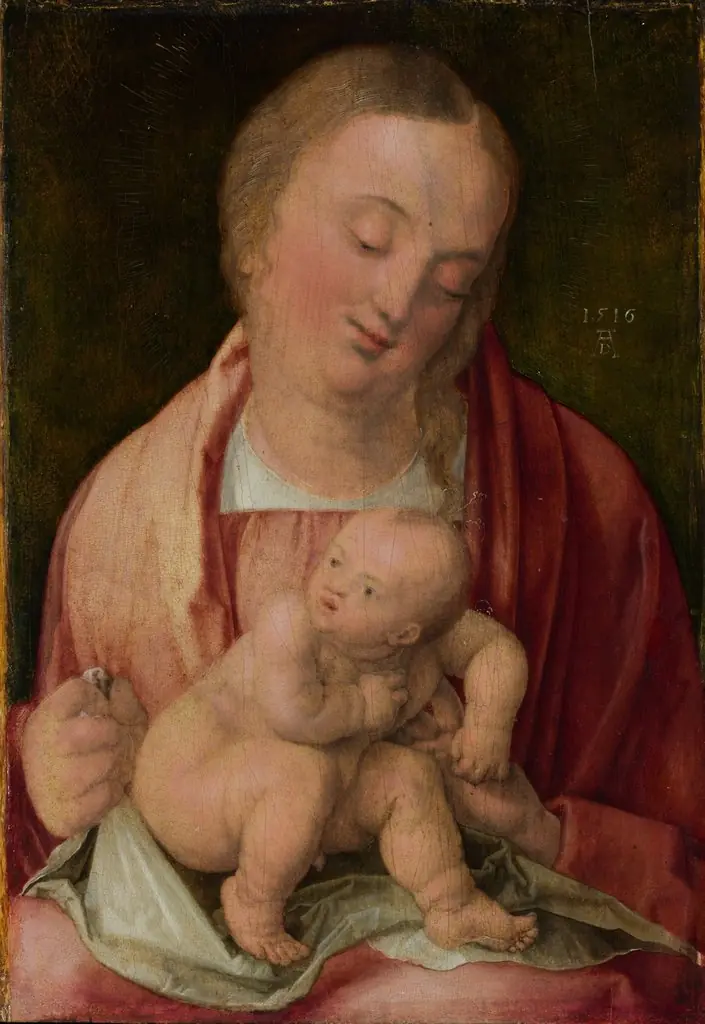
![Madonna and Child [obverse], by Albrecht Dürer](https://artifactworldgallery.com/img/albrecht-durer--madonna-and-child-obverse--d7b8ebf05d22ebe5-w320.webp)
![Lot and His Daughters [reverse], by Albrecht Dürer](https://artifactworldgallery.com/img/albrecht-durer--lot-and-his-daughters-reverse--b4ebf9b282faa17a-w320.webp)