Artwork
Mercy's Dream
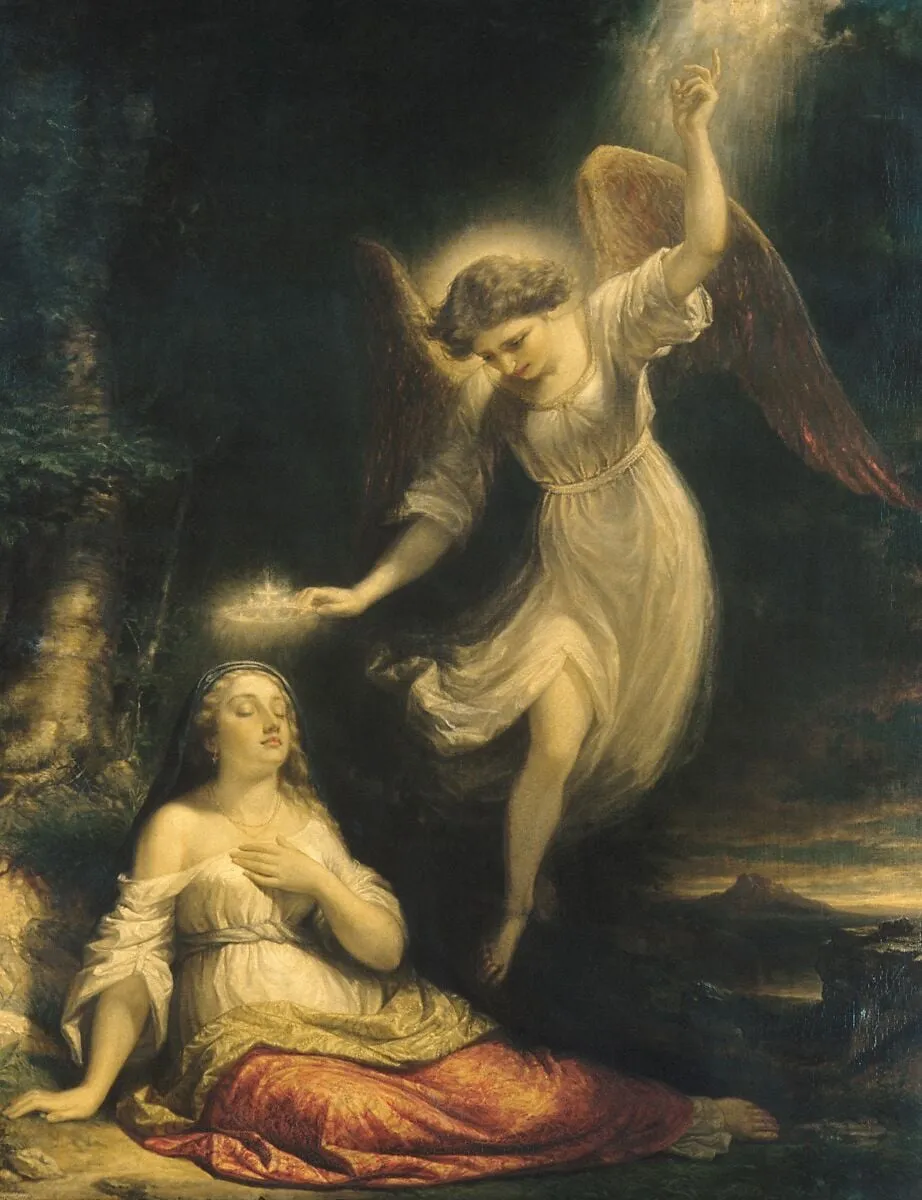
Mercy's Dream is an oil painting by the American Folk Art artist Daniel Huntington. It dates from 1858 and is held in the collection of the Metropolitan Museum of Art.
About this work
The angel’s gesture suggests the woman is being called to something higher, maybe heaven, maybe purpose.
A young woman sleeps in a white nightgown, her head resting on one hand. Above her, a glowing angel hovers, holding a palm branch and pointing upward.
This painting was made in 1858, when many Americans believed dreams could carry messages from God. The angel’s gesture suggests the woman is being called to something higher, maybe heaven, maybe purpose. The soft light and quiet mood make the scene feel private, like we’re peeking into her bedroom.
If you like this gentle, dreamy style, look up other works about angels.
Technique & Style
Mercy's Dream, executed by Daniel Huntington in 1858, is an oil painting on canvas. The work measures 213.4 centimeters in height and 168.3 centimeters in width. As a religious genre piece, the composition features the formal depiction of an angel and a woman.
The medium of oil paint on a canvas support allows for the detailed rendering characteristic of Huntington's style during this period. The painting remains part of the collection at the Metropolitan Museum of Art, specifically within the American Wing, where its physical condition and material integrity are preserved as a significant example of mid-19th-century American religious art.
History & Provenance
The painting Mercy’s Dream was created by Daniel Huntington in 1858, as indicated by both the artist’s records and the work’s classification in The American Wing. It was painted in oil on canvas and depicts a religious scene featuring an angel and a woman. By 1858, the work had entered the collection of the Metropolitan Museum of Art, where it remains housed.
No documented commission or early ownership history prior to its acquisition by the museum has been identified in available sources.
Daniel Huntington's 1858 oil painting, Mercy's Dream, is held in the collection of the Metropolitan Museum of Art in New York City. The work is classified within the museum's American Wing and depicts a religious scene featuring an angel and a woman. While the provided sources confirm the artwork's current location and institutional home, they do not specify a unique inventory or accession number for the piece.
Furthermore, the available documentation does not contain details regarding the painting's exhibition history or a chronological record of its public display. The physical dimensions are recorded as 213.4 centimeters in height and 168.3 centimeters in width, consistent with its status as a significant canvas within the museum's holdings of American religious art.
Overview
Daniel Huntington's 1858 oil on canvas, Mercy's Dream, presents a spiritual vision. The American artist, who initially engaged with the Hudson River School before primarily focusing on portraiture, created this work depicting a serene encounter between a sleeping woman and a celestial figure. The painting reflects a period interest in divine communication through dreams, rendered with a gentle and contemplative quality.
Subject & Meaning
The composition centers on a young woman in repose, clad in a white nightgown, seemingly lost in slumber. Above her, a luminous angel appears, holding a palm branch, a traditional symbol of triumph or peace, and gesturing heavenward. This angelic visitation, set against a backdrop of soft illumination and quietude, suggests a divine summons or revelation.
In 1858, many Americans interpreted dreams as potential conduits for messages from God, imbuing such scenes with profound spiritual significance.
Context
The mid-19th century in America was a time when spiritual beliefs often intersected with everyday experience, including the interpretation of dreams. Many people held the conviction that dreams could serve as direct channels for divine guidance or prophecy. Mercy's Dream taps into this cultural understanding, portraying a moment where the earthly and the celestial realms converge through a sleeping vision, offering a message of higher calling or purpose.
Artist & collection

Artist
Daniel Huntington (October 4, 1816 – April 19, 1906) was an American artist who belonged to the art movement known as the Hudson River School and later became a prominent portrait painter.