Artwork
Emigration
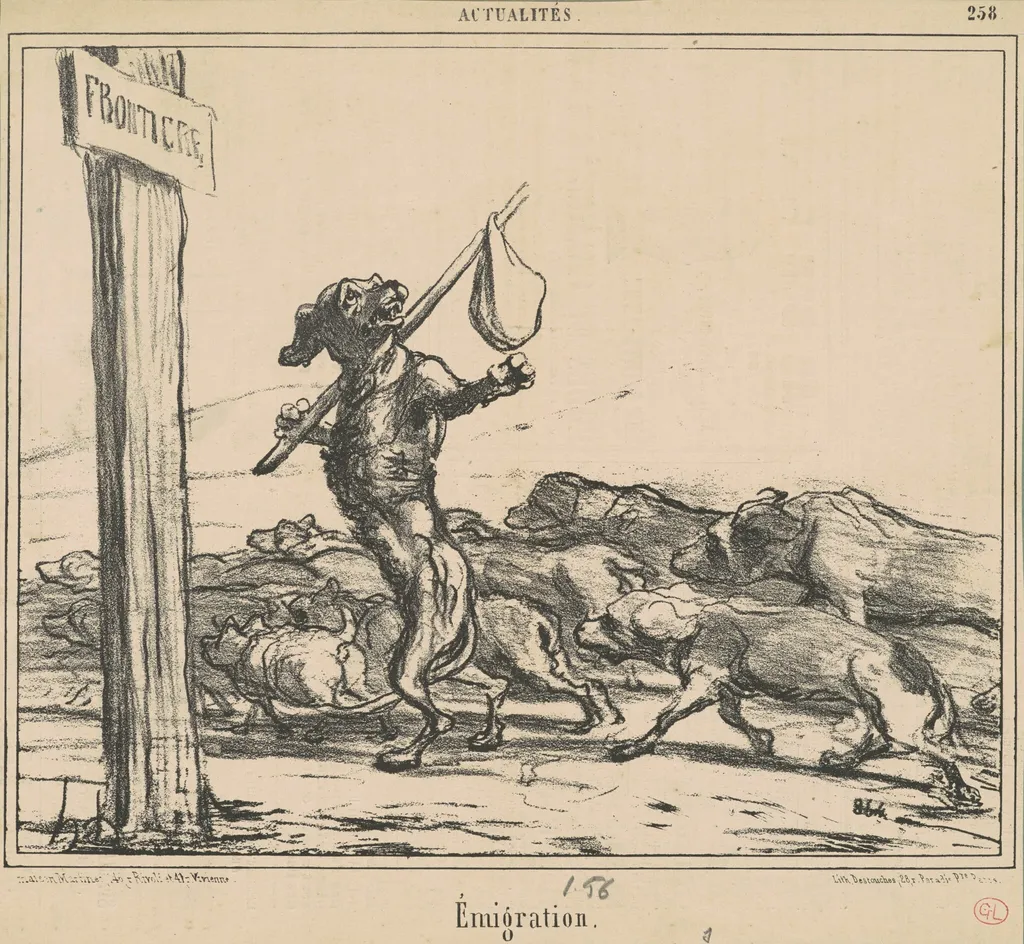
Emigration is an ink print by the Impressionist artist Honoré Daumier. It dates from 1856 and is held in the collection of the National Gallery of Art.
About this work
Overview
Honoré Daumier’s lithograph titled Emigration portrays a dog upright on its hind legs, guiding a procession of animals past a sign labeled 'Frontière.
Honoré Daumier’s lithograph titled Emigration portrays a dog upright on its hind legs, guiding a procession of animals past a sign labeled 'Frontière.' Created as a print, the work uses visual metaphor to engage with contemporary debates around movement and territorial boundaries. Its satirical tone invites viewers to reflect on human behavior through the lens of animal behavior, a common device in Daumier’s social commentary.
Subject & Meaning
The animals in the print, each distinct in form and demeanor, mimic human migrants, while the dog, unusually bipedal and authoritative, acts as a guide or enforcer. The border sign marks a threshold of exclusion, echoing real-world policies of the time. Daumier’s choice of animals avoids direct political figures, allowing the critique to resonate more broadly, implicating societal attitudes toward displacement without naming specific actors.
Technique & Style
Executed in lithography, the print relies on the tonal contrasts and fluid lines characteristic of the medium. Daumier’s sketch-like rendering captures movement and expression with minimal detail, emphasizing gesture over realism. The rough, energetic lines lend urgency to the scene, reinforcing the chaotic nature of migration. The absence of elaborate backgrounds focuses attention on the figures and the symbolic border they cross.
History & Provenance
Created during the mid-19th century, the work emerged amid rising tensions over national identity and immigration in France. Though exact publication details are sparse, it likely appeared in a periodical or satirical journal, where Daumier regularly contributed. Its survival as a standalone print suggests it resonated beyond its original context, preserved as part of broader collections of political caricature.
Context
In the decades following the 1848 revolutions, France grappled with internal displacement and restrictive border controls. Daumier’s imagery reflects public discourse on mobility, citizenship, and exclusion. By anthropomorphizing animals, he circumvented censorship while still challenging authority.
The work aligns with a tradition of visual satire that used absurdity to expose hypocrisy in governance and social norms.
Legacy
Emigration endures as an example of how visual metaphor can distill complex social issues into accessible imagery. Though not widely exhibited today, it remains referenced in studies of 19th-century political art and the use of satire in print media. Its influence is seen in later artists who employed animal allegory to critique power structures, continuing Daumier’s legacy of quiet, incisive observation.
Own this work as a print
Artist & collection
Artist
Honoré-Victorin Daumier (French: ; 26 February 1808 – 10 or 11 February 1879) was a French painter, sculptor, and printmaker, whose many works offer commentary on the social and political life in France, from the…