Artwork
Les Deux banqueteurs en joie
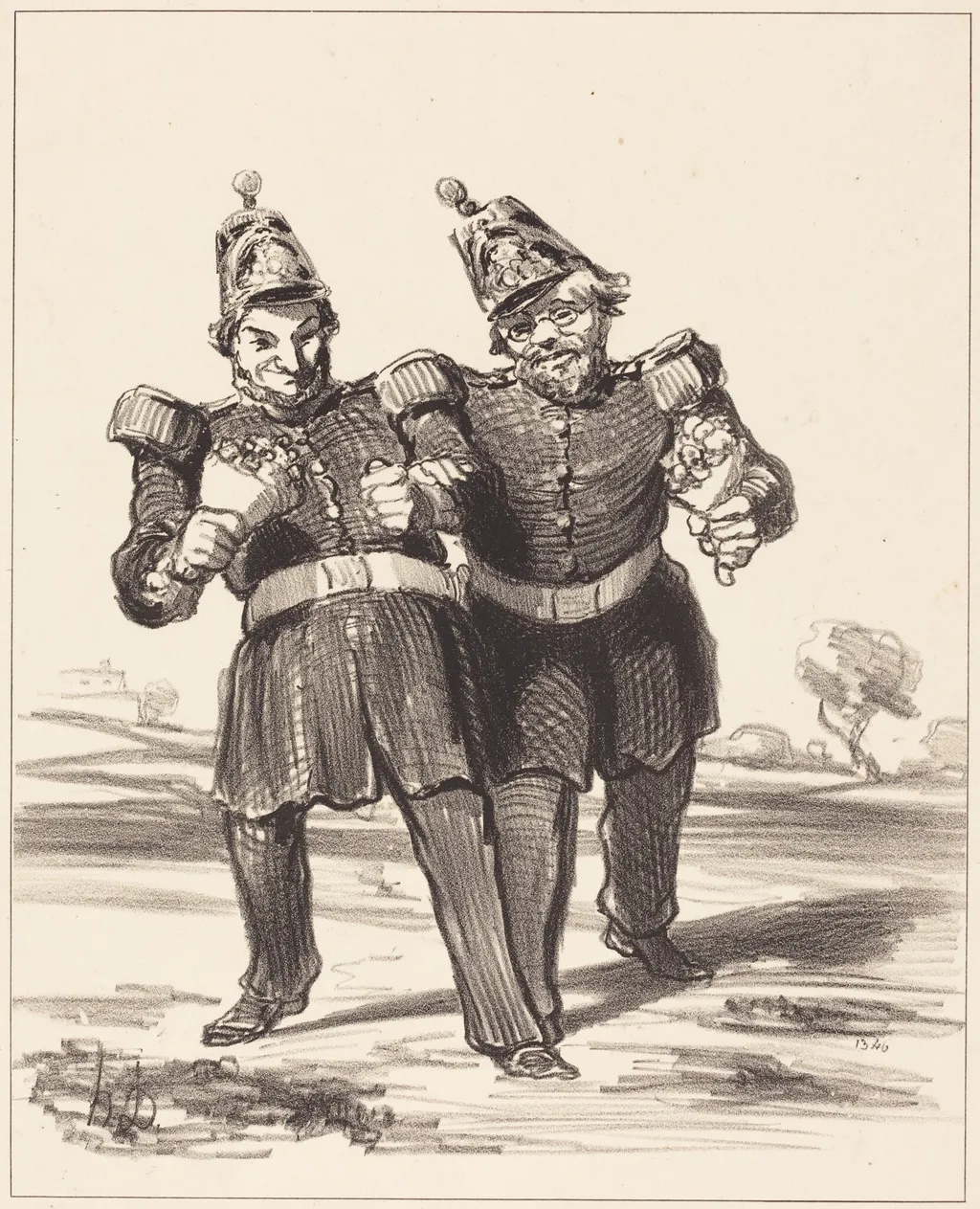
Les Deux banqueteurs en joie is an ink print by the Romanticist artist Honoré Daumier. It dates from 1849 and is held in the collection of the National Gallery of Art.
About this work
Overview
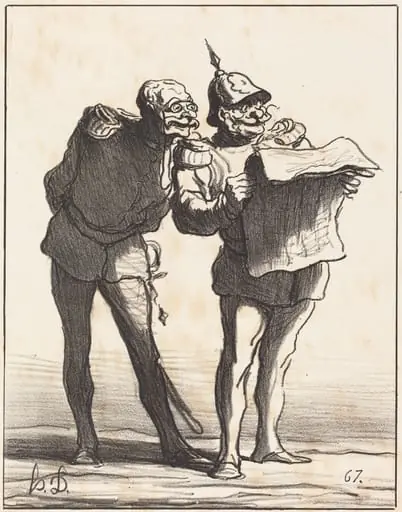
Created in 1849, this lithograph by Honoré Daumier portrays two men in elaborate military dress sharing a moment of laughter. The composition captures them in a jovial embrace on uneven terrain, with a distant ship visible on the horizon. Their exaggerated features, bulging hats, prominent glasses, and oversized gestures, underscore the work’s satirical tone, typical of Daumier’s printmaking.
Subject & Meaning
The figures appear as caricatured authority figures, likely representing military or governmental officials. By depicting them in a state of carefree revelry, Daumier lampoons the self‑importance of the ruling class, using humor to critique the power structures of his time. The exaggerated poses and facial expressions serve to diminish the dignity traditionally associated with such uniforms.
Technique & Style
Executed in lithography, the image relies on the artist’s direct drawing on a stone surface, allowing bold, fluid lines and stark contrasts. Daumier’s characteristic sketchy brushwork and exaggerated anatomy are evident, reinforcing the satirical intent. The medium’s capacity for rapid reproduction suited his work for periodicals, where the immediacy of the image amplified its social commentary.
History & Provenance
Over time, the lithograph entered museum collections, reflecting its significance as a document of mid‑nineteenth‑century political satire.
The print was originally published in the French satirical journals La Caricature and Le Charivari, venues that disseminated Daumier’s political cartoons to a broad readership. These publications were central to his reputation as a keen observer of French society. Over time, the lithograph entered museum collections, reflecting its significance as a document of mid‑nineteenth‑century political satire.
Context
Produced during a period of heightened republican sentiment in France, the work reflects Daumier’s opposition to monarchical and clerical authority. The 1840s saw intense political debate, and Daumery’s prints often targeted the military and aristocracy, groups associated with the old regime. By embedding his critique within a humorous scene, he engaged viewers in a subtle yet pointed dialogue about power and folly.
Own this work as a print
Artist & collection
Artist
Honoré-Victorin Daumier (French: ; 26 February 1808 – 10 or 11 February 1879) was a French painter, sculptor, and printmaker, whose many works offer commentary on the social and political life in France, from the…