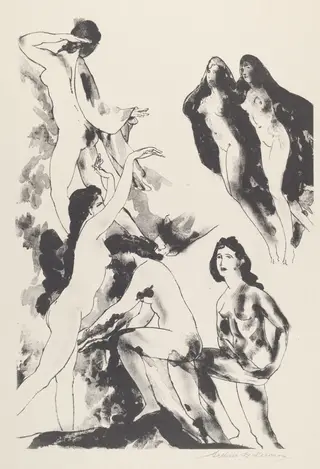
Artwork
Release at the Gates
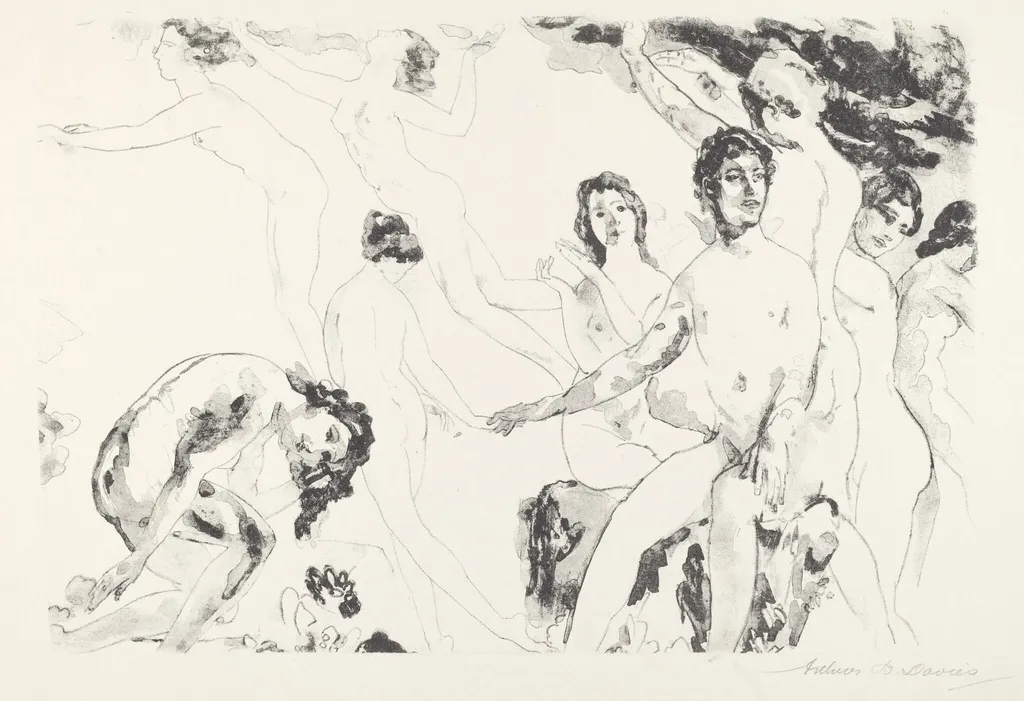
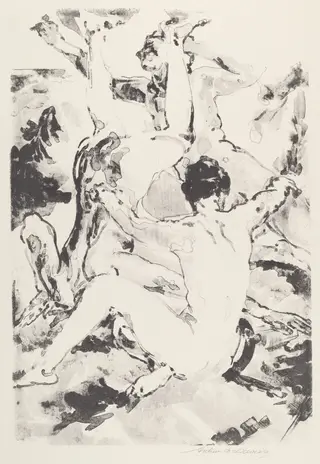
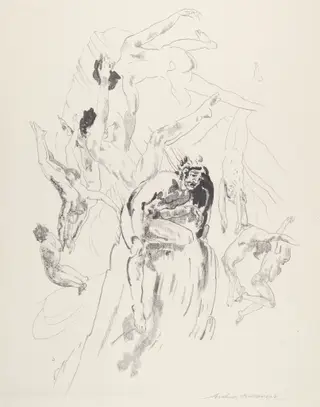
Release at the Gates is an ink print by Arthur B. Davies. It dates from 1920 and is held in the collection of the National Gallery of Art.
- Inscription
- Inscribed:lower right in graphite: Arthur B. Davies; lower right verso in graphite by unknown hand: Gi 41.7
- Markings
- Marked:BS: Favor Ruhl & Co Kensington
About this work
Overview
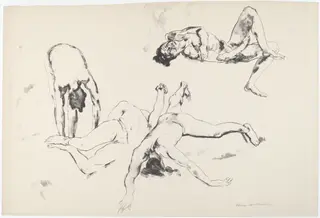
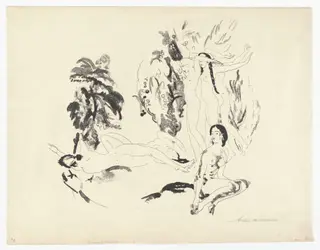
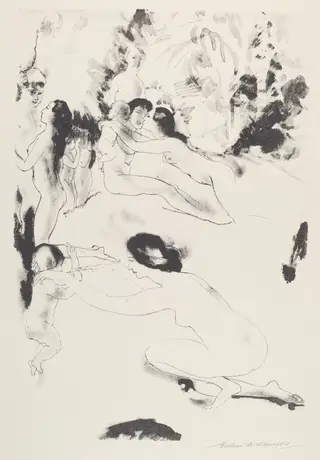
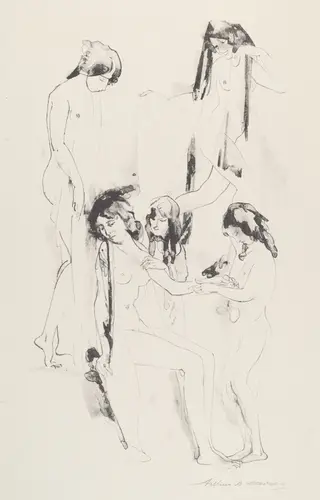
Created in 1920, Release at the Gates is a lithograph in black on wove paper by Arthur B. Davies. The work belongs to a series of prints where Davies explored abstract, introspective themes using the lithographic process. Its minimal palette and textured surface reflect his interest in evoking mood over narrative clarity, aligning with broader early 20th-century experiments in graphic art.
Subject & Meaning
Their forms dissolve into smudged contours, suggesting emotional or psychological states rather than physical presence.
The image presents four indistinct figures entwined in a shadowed, ambiguous space. Their forms dissolve into smudged contours, suggesting emotional or psychological states rather than physical presence. The lack of defined features and spatial orientation invites interpretation as a metaphor for inner turmoil, collective release, or the dissolution of individual identity within a larger, unseen force.
Technique & Style
Davies employed lithotint to achieve subtle tonal gradations in black ink, layering loose, gestural marks to create a sense of movement and instability. The sketchlike quality, with its scratchy lines and uneven ink distribution, mimics rapid drawing rather than polished execution. The pale paper grounds the composition, amplifying the contrast and reinforcing the work’s ephemeral, unfinished character.
History & Provenance
Produced during a period when Davies was actively involved in promoting modernist art in America, this print emerged from his personal exploration beyond his more conventional paintings. It was likely printed in a small edition, consistent with his interest in printmaking as a medium for intimate, experimental expression rather than mass distribution.
Context
In the aftermath of World War I, many artists turned to abstraction to convey disillusionment and spiritual searching. Davies, though associated with the Ashcan School earlier, moved toward symbolic and mystical imagery in his later work. Release at the Gates reflects this shift, resonating with contemporary European Symbolist and Expressionist currents while remaining rooted in American sensibilities.
Legacy
The print stands as a quiet example of Davies’s engagement with the expressive potential of printmaking. Though less known than his paintings, works like this reveal his commitment to exploring psychological depth through non-narrative forms. It contributed to a broader recognition of lithography as a vehicle for personal, avant-garde expression in early American modernism.
Own this work as a print
Artist & collection
Artist
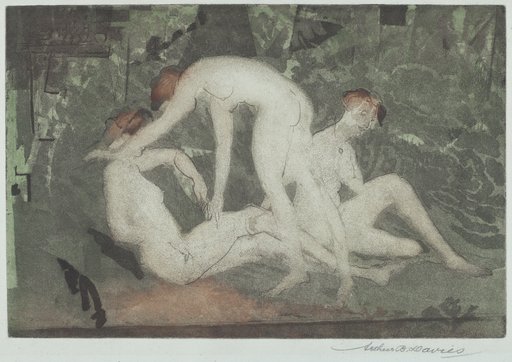
Arthur Bowen Davies (September 26, 1862 – October 24, 1928) was an avant-garde American artist and influential advocate of modern art in the United States c. 1910–1928.