Artwork
A Horse Hitched to a Post
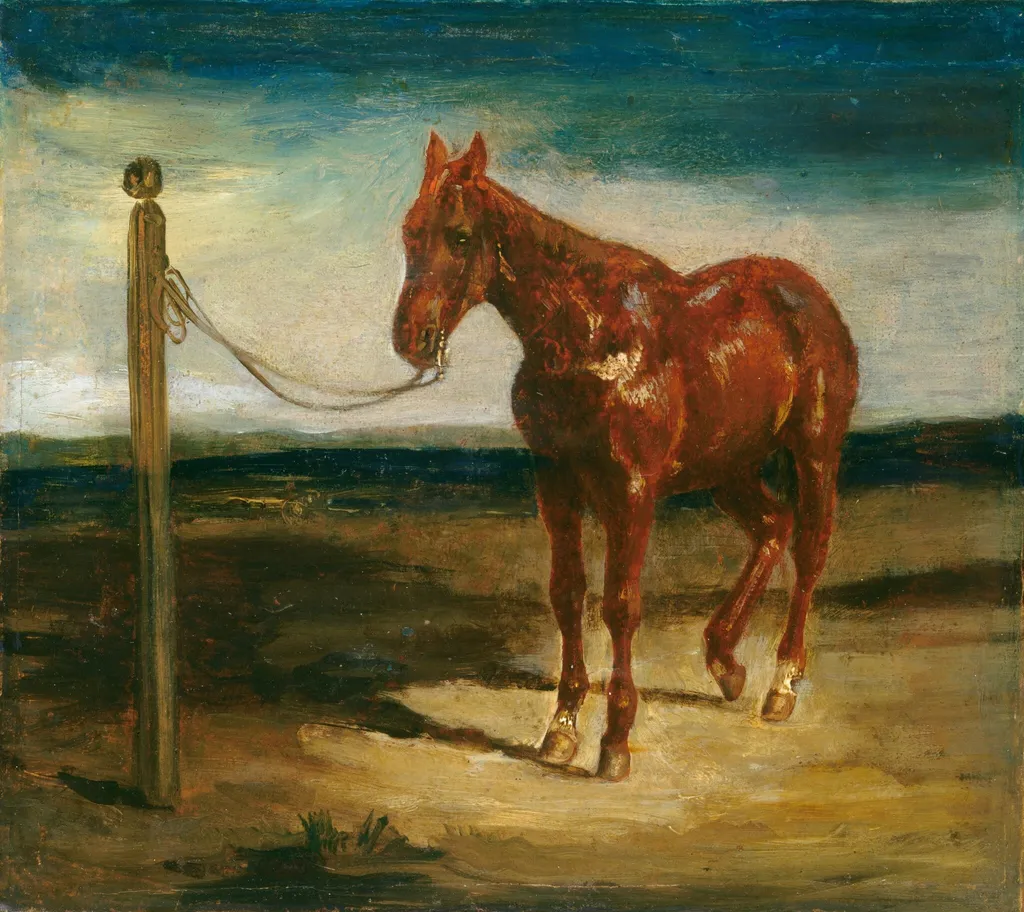
A Horse Hitched to a Post is an oil painting by the Romanticist artist Eugène Delacroix. It dates from 1820 and is held in the collection of the National Gallery of Art.
About this work
Overview
It documents the young artist's disciplined study of equine subjects, a preoccupation that would animate his most ambitious historical compositions.
A Horse Hitched to a Post is a small oil on canvas painted by Eugène Delacroix around 1820, measuring 19.4 by 21.3 cm. The work is held by the National Gallery of Art in Washington, D.C., where it entered in 1994 as a gift from Mr. and Mrs. Paul Mellon. Created early in Delacroix's career, before his first major Salon success with The Barque of Dante in 1822, the painting offers crucial insight into the development of one of Romanticism's central figures. It documents the young artist's disciplined study of equine subjects, a preoccupation that would animate his most ambitious historical compositions. Despite its modest scale, the work exemplifies Delacroix's emerging approach to color, brushwork, and the expressive potential of animal painting.
Subject & Meaning
The painting depicts a single chestnut horse tethered to a wooden post by a rope, positioned slightly off-center and facing left with its head turned toward the viewer. One foreleg is lifted, suggesting alertness or restlessness rather than repose. The post, topped with a rounded finial, anchors the left edge of the composition, while a flat, open landscape stretches behind with a dark horizon line and pale, cloudy sky that deepens to blue at the top. Sparse vegetation appears near the bottom edge. The rope connecting horse to post creates a visual and symbolic tether, generating what scholars have described as an almost mournful, static quality despite the animal's potential for movement. The subject carries no overt narrative or mythological program; rather, it presents the horse as an object of concentrated observation, its physical presence and emotional state rendered with directness. The lifted leg and turned head introduce a note of tension, as if the animal has been interrupted or is awaiting release. This unspoken melancholy, conveyed through composition rather than action, aligns with Romanticism's broader interest in subjective experience and the sublime in everyday subjects.
Technique & Style
Delacroix executed the work in oil on canvas with a loose, visible brushwork that reveals the labor of painting itself. Thick, textured strokes model the horse's body, while broader, flatter handling characterizes the sky and distant land. The palette is dominated by earthy browns and reds for theRhino and ground, contrasted with cool blues and grays in the sky. Light falls from the left, casting a long shadow of the horse and post across the sandy foreground. The surface shows some unevenness, with areas where underlayers peek through, and small patches of lighter pigment suggest wear or highlights on the horse's coat. This economical yet confident application suggests rapid execution from life, with paint applied in bold, gestural strokes that define Delacroix's emerging approach. The vertical post counterbalances the horse structurally, creating a contained composition. The artist's handling of different material textures, distinguishing the gleaming coat of the horse from the worn wooden post, demonstrates his early sensitivity to the expressive possibilities of paint itself. Some surface irregularities may indicate age or deliberate working methods, with the visible underlayers contributing to the work's sense of immediacy.
History & Provenance
The painting's documented history begins with Delacroix's posthumous sale at Hôtel Drouot, Paris, in February 1864, where it appeared as lot 84. It then passed to Etienne-François Haro, and subsequently to his son Henri Haro. The Haro family retained the work until a sale in Neuilly-sur-Seine on 22 February 1934, where it was lot 13. It entered the Dubourg collection before being acquired by Wildenstein & Co., New York, in 1959. Paul Mellon purchased it in 1960, and he and his wife kept it at their residence in Upperville, Virginia, until gifting it to the National Gallery of Art in 1994, where it bears accession number 1994.59.17. The work has been exhibited at least twice: at the Société Nationale des Beaux-Arts, Paris, in 1864, as part of the Oeuvres d'Eugène Delacroix exhibition, and at the Atelier Delacroix in Paris in 1932 for Eugène Delacroix et ses Amis, where it was listed as no. 40. Lee Johnson's critical catalogue of 1981 records it under the variant title A Bay Attached to a Post in a Field.
Context
Painted around 1820, this study emerges from a pivotal moment in Delacroix's formation. Before achieving recognition with The Barque of Dante in 1822, the young artist was developing his visual vocabulary through careful observation of horses in motion, stillness, and various states of alertness. The influence of Théodore Géricault is discernible in the direct anatomical observation and the treatment of the horse as a vehicle for physical and emotional energy. Géricault's own equine studies had established a model for Romantic animal painting that Delacroix adapted and extended. The horse would become central to Delacroix's most ambitious historical and Romantic subjects, including charging cavalry, rearing stallions, and animals in combat. This early study thus documents the observational foundation for later achievements. The work also belongs to a broader tradition of French equine painting, yet its informal, sketch-like quality distinguishes it from the more finished productions of academic ateliers. Critical attention has emphasized how the painting reveals Delacroix's working methods and his commitment to direct visual experience as the basis for art, even as the curatorial discourse has increasingly highlighted the materiality of its execution and the social labor embedded in its production.
Legacy
While A Horse Hitched to a Post has not achieved the iconic status of Delacroix's major Salon paintings, its significance has grown with scholarly recognition of the artist's working methods and the importance of his studies. The painting's provenance through major collectors and dealers, including the Haro family, Wildenstein & Co., and finally the Mellons, attests to its sustained esteem among connoisseurs. Its donation to the National Gallery of Art in 1994 secured its place in one of the world's preeminent public collections, ensuring broad accessibility. The work contributes to understanding Delacroix's development by demonstrating that his later mastery of equine subjects in grand historical narratives was founded on such intimate, observational studies. For art historians, it exemplifies the Romantic valorization of the sketch and study as authentic expressions of artistic vision. The painting has also entered contemporary critical discourse around materiality and the labor of artistic production, with its visible brushwork and exposed underlayers serving as evidence of the physical act of painting. This interpretive shift reflects broader changes in art historical methodology, moving from purely formal analysis toward considerations of making and material culture, while the work itself remains a touchstone for understanding how Delacroix's artistic identity was forged through sustained engagement with a single, resonant subject.
Own this work as a print
Artist & collection
Artist
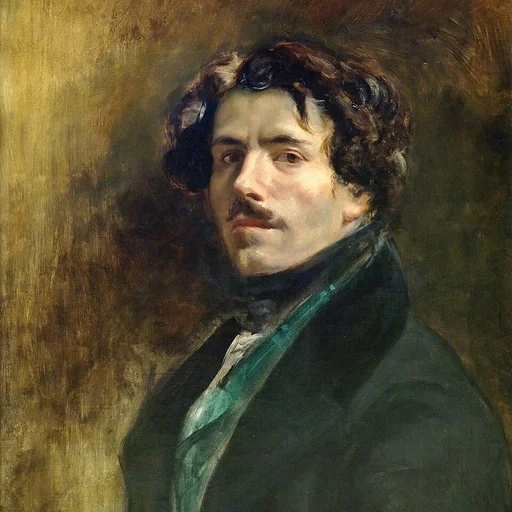
Ferdinand Victor Eugène Delacroix ( DEL-ə-krwah, -KRWAH; French:; 26 April 1798 – 13 August 1863) was a French Romantic artist who was regarded as the leader of the French Romantic school.