Artwork
The Trojans Repairing Their Ships in Sicily
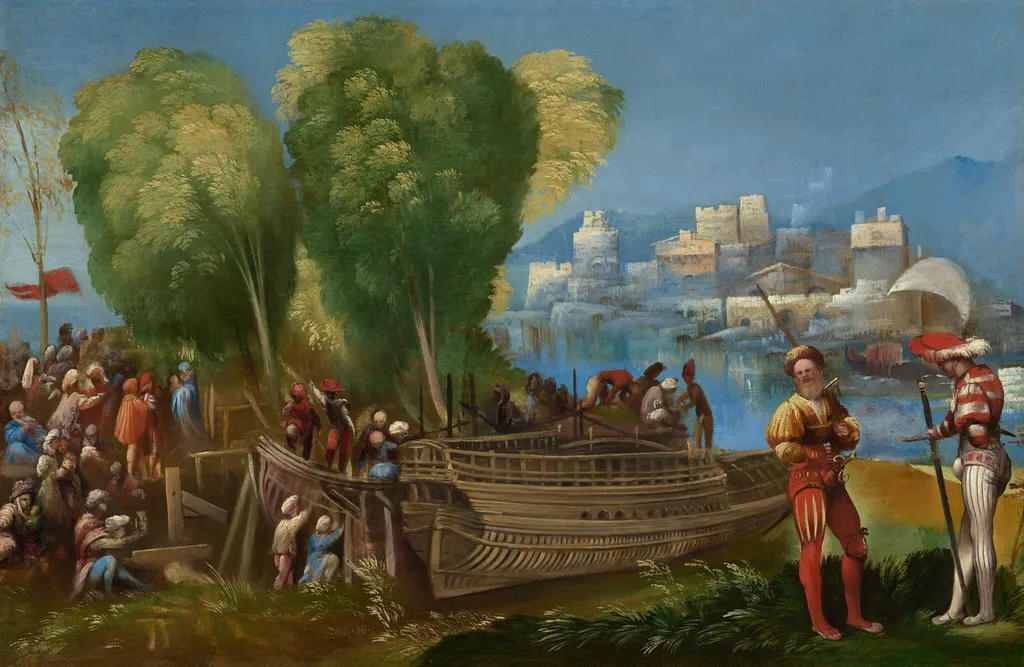
The Trojans Repairing Their Ships in Sicily is an oil painting by the Mannerist artist Dosso Dossi. It dates from 1520 and is held in the collection of the National Gallery of Art.
About this work
Subject & Meaning
The crew labors to repair the damaged ship at center, while the distant city of Carthage appears in the background, signifying the heroes’ destined arrival.
The painting depicts an episode from Book I of Virgil’s Aeneid: Aeneas and his companion Achates, after a shipwreck, on the Libyan coast. The crew labors to repair the damaged ship at center, while the distant city of Carthage appears in the background, signifying the heroes’ destined arrival. The rare iconography initially led scholars to interpret the scene as a generic legendary episode or the landing of the Argonauts.
The work was part of a series of ten Aeneid-based paintings created for the Camerino d’Alabastro of Alfonso I d’Este, reinforcing the courtly humanist program that celebrated the epic’s themes of fate, duty, and the foundation of Rome.
Technique & Style
Dosso Dossi executed this work in oil on canvas, with dimensions 58.7 × 87.6 cm. The support was originally part of a continuous frieze for the Camerino d'Alabastro. Stylistically, the painting exhibits Dosso's recognizable handling of foliage: trees are rendered in brilliant greens that resemble fluffy cotton balls, a hallmark of his manner. Atmospheric effects are achieved through bluish tones that carry strong atmospheric notations, as seen in the almost unreal view of Carthage in the background.
The figures wear bright, showy costumes and are arranged in a clear narrative. Condition-wise, the canvas was later cut into two halves in the late nineteenth or early twentieth century, but was recomposed for a 2023 exhibition.
History & Provenance
The painting was commissioned around 1520–1521 by Alfonso I d’Este, Duke of Ferrara, for the Camerino d’Alabastro in the Castello Estense. It remained in the Este family through his son Ercole II and grandson Alfonso II until the rooms were dismantled in 1598. By 1608 it was in the collection of Cardinal Scipione Borghese in Rome, where it stayed through inheritance within the Borghese family until at least 1693.
After a period of obscurity, it resurfaced in Madrid by 1847 in the possession of José de Madrazo y Agudo, and later possibly his son Federico. It was purchased around 1861 by José de Salamanca. In the 20th century, the canvas, which had been cut from a larger composition, passed through Hans Wendland, Kunsthandel AG, and Julius Böhler before being acquired by Count Alessandro Contini-Bonacossi in 1927.
The Samuel H. Kress Foundation bought it in 1936 and gifted it to the National Gallery of Art in 1939.
The painting is held in the collection of the National Gallery of Art in Washington, D.C., as part of the Samuel H. Kress Collection, to which it was gifted in 1939. It was originally one of ten canvases from the Camerino d'Alabastro of Alfonso I d'Este. In 2023, the work was temporarily reunited with its separated counterpart for the exhibition 'Dosso Dossi. Il fregio di Enea' at the Galleria Borghese in Rome.
Context
The painting belongs to a series of ten Aeneid-themed canvases by Dosso Dossi and his brother Battista for the Camerino d'Alabastro of Alfonso I d'Este, a key Ferrarese court commission of the early 1520s. Its rare iconography initially puzzled critics, who variously speculated it depicted a generic legendary scene or the Argonauts' landing. Scholarship later identified the episode as Aeneas and Achates after their shipwreck on the Libyan coast from the Aeneid Book I. The work's place in art history is secured by its role in the Camerino frieze, a sophisticated literary and mythological program of the Ferrarese Renaissance, and by its later passage through the Borghese and Kress collections.
Legacy
The painting's legacy is notably tied to its reemergence in the 21st century. Originally part of a ten-canvas frieze of the Aeneid by Dosso and his brother Battista, it was later cut in two during the 20th century. In 2023, the canvas was physically reunited for the exhibition 'Dosso Dossi: Il fregio di Enea' at the Galleria Borghese in Rome, where it was displayed alongside its other half (now NGA 2021.6.1).
This exhibition highlighted the series’ scholarly importance and restored the painting’s original compositional unity, underscoring its continued influence as a key example of Ferrarese Renaissance court art.
Overview
Dosso Dossi's "The Trojans Repairing Their Ships in Sicily" is an oil on canvas painting. It depicts a scene from Virgil's Aeneid, showing Aeneas's followers mending their vessels on a rocky coast. Despite its compact size, the work is rich in detail and vibrant color, characteristic of Dossi's style. The composition draws the viewer into a narrative moment of recovery and preparation.
Own this work as a print
Artist & collection

Artist
Giovanni di Niccolò de Luteri, better known as Dosso Dossi (c. 1489–1542) was an Italian Renaissance painter who belonged to the School of Ferrara, painting in a style mainly influenced by Venetian painting, in…



- River view with Large Rock
 Coastal Landscape with two Men Fighting
 Nächtliche Hafenlandschaft mit Leuchtturm
 Miraculous Fishing
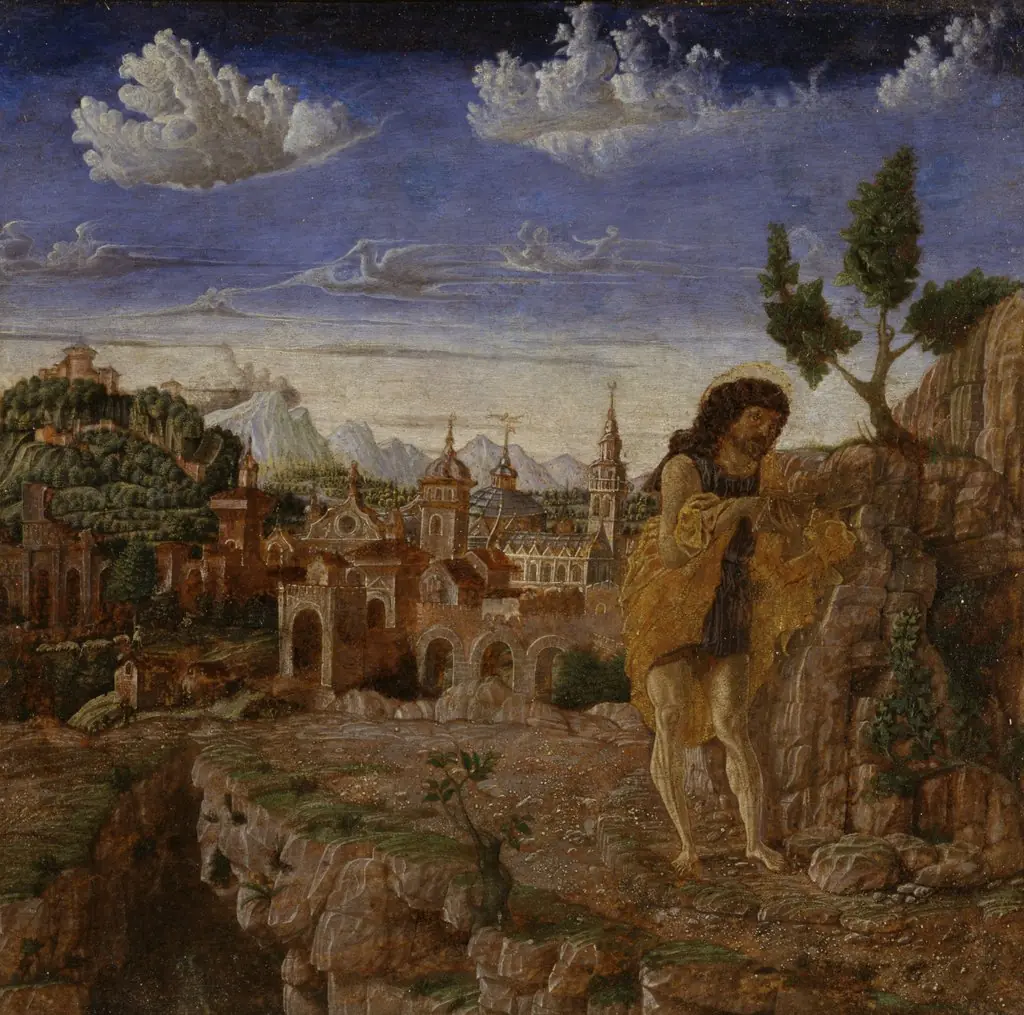 Saint John the Baptist in a Landscape
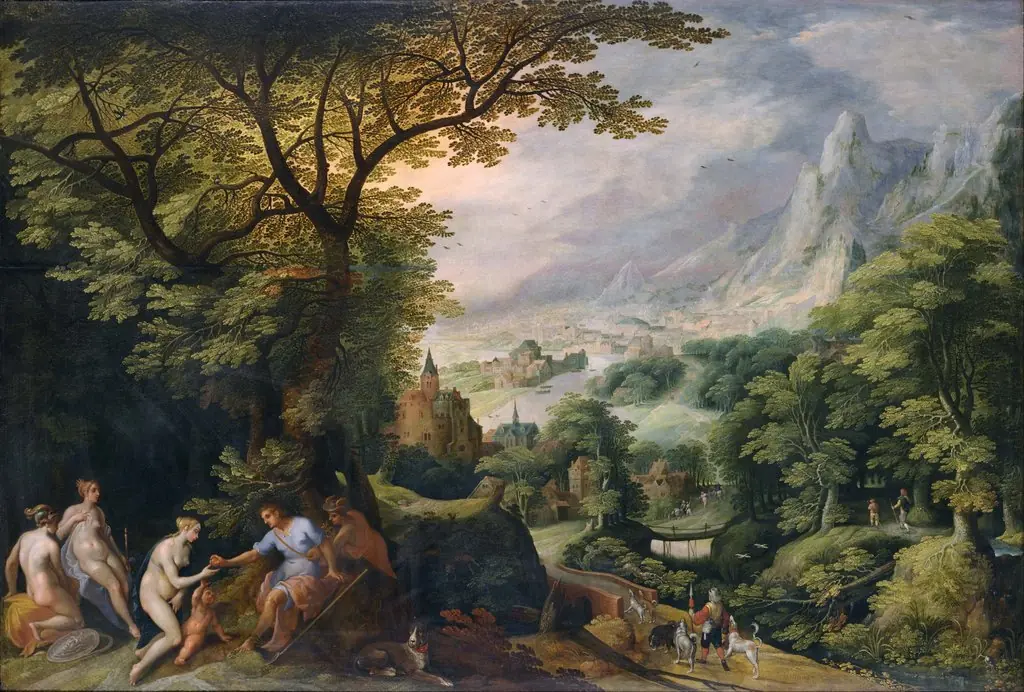 Landscape with the Judgement of Paris
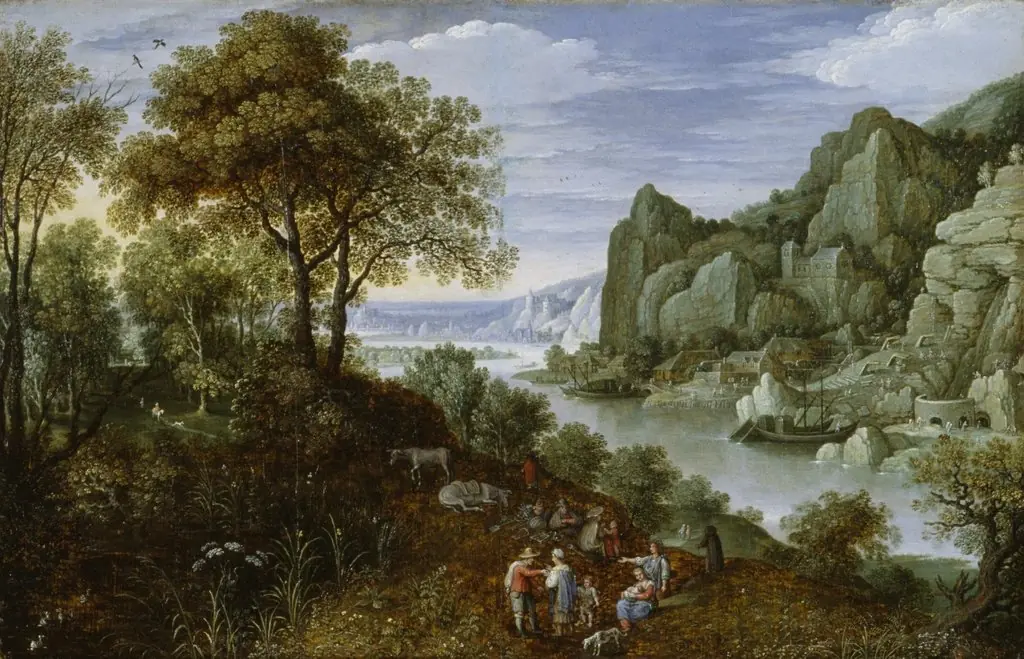 Mining Operations along a River
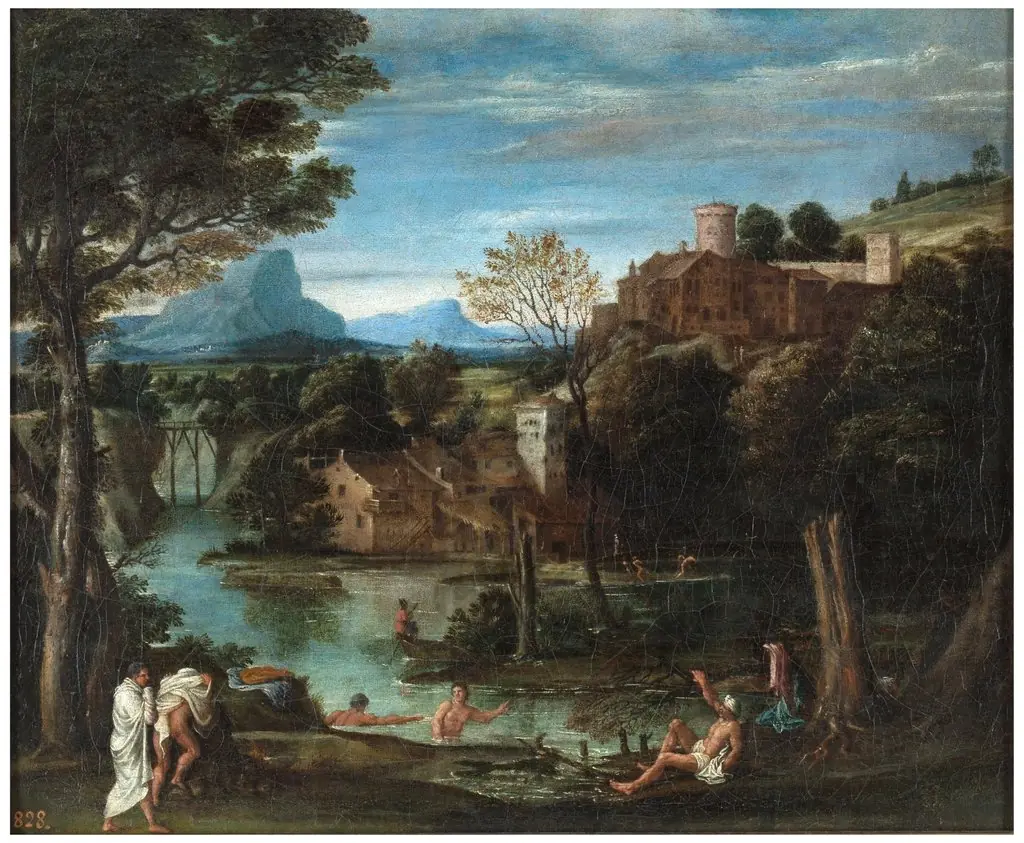 Landscape with river and bathers
 A Roman River Scene with a Castle and a Bridge
 Scenes from a Legend
 Julius Caesar and the Crossing of the Rubicon (scene from the story of Alexander the Great)