Artwork
The Trojans Building the Temple to Venus and Making Offerings at Anchises's Grave in Sicily
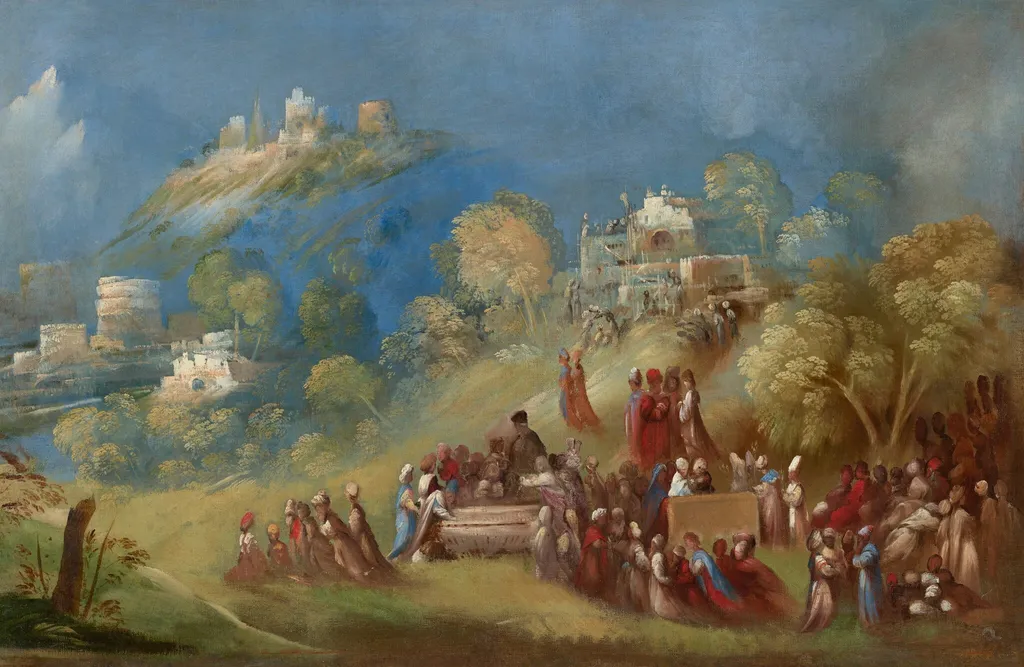
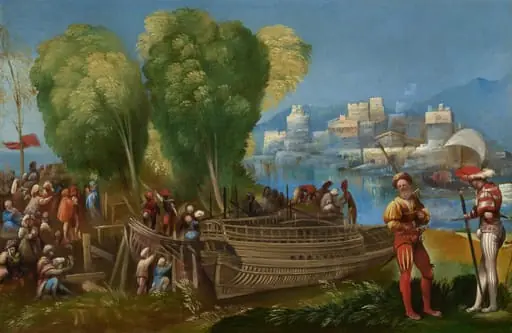
The Trojans Building the Temple to Venus and Making Offerings at Anchises's Grave in Sicily is an oil painting by the Mannerist artist Dosso Dossi. It dates from 1520 and is held in the collection of the National Gallery of Art.
About this work
Subject & Meaning
These scenes were positioned above mythologies by other masters to decorate the private study of Alfonso I d'Este.
The painting depicts a scene from Virgil's Aeneid, specifically illustrating the Trojans constructing a temple dedicated to Venus in Sicily while simultaneously making offerings at the grave of Anchises. Created as part of a larger frieze for the Camerino d’Alabastro, the work functions as one half of a divided canvas that originally formed a continuous narrative cycle of ten paintings by Dosso Dossi. These scenes were positioned above mythologies by other masters to decorate the private study of Alfonso I d'Este.
The subject matter emphasizes the pious duties of Aeneas and his followers, honoring their divine protector and deceased ancestor within the context of classical antiquity.
Technique & Style
The painting is executed in oil on canvas, a medium typical for Dosso Dossi’s mythological works of the 1520s.
Its handling is consistent with northern Italian Renaissance practice: fluid, layered glazes build luminous passages, while matte areas anchor the composition’s density. The palette favors warm ochres, deep greens, and Venetian reds, with highlights in pale pink and gold that subtly model forms.
Formal qualities include a dynamic, low horizon that compresses space, pushing figures and architecture forward. Figures are arranged in rhythmic clusters, their gestures and gazes guiding the viewer across the scene. The architecture, columns, arches, and a stepped temple, is rendered with measured perspective yet softened by atmospheric recession, aligning with Dosso’s tendency to fuse Venetian colorism with Ferrarese linear precision.
History & Provenance
Dosso Dossi executed this oil-on-canvas painting in 1520, commissioned by Alfonso I d'Este, Duke of Ferrara, for the Camerino d'Alabastro within the Castello Estense. The work originally formed part of a frieze depicting scenes from Virgil's Aeneid and was likely one of ten canvases created for the room. Following the Duke's death, the painting passed by inheritance to his son Ercole II and subsequently to Alfonso II.
By 1608, it had left the Este collection and was acquired by Cardinal Scipione Borghese in Rome. The work remained in the Borghese family for generations before appearing in the collection of José de Madrazo y Agudo in Madrid by 1847. It was likely purchased by José de Salamanca y Mayol around 1861 and later entered a private collection in southern France by 1900.
The painting was acquired by the National Gallery of Art in Washington, D.C., in 2021 following a sale at Christie's.
The painting is currently held by the National Gallery of Art in Washington, D.C., where it was acquired in 2021. Its accession number is 2021.1.1. The work's history begins with a commission around 1520 for the Camerino d'Alabastro in the Castello Estense, Ferrara.
It later entered the collection of Cardinal Scipione Borghese in Rome before passing through the Borghese family line. In the 19th century, the canvas was in Madrid, owned successively by José de Madrazo, Federico Madrazo, and the Marqués of Salamanca. By approximately 1900, it had moved to a private collection in southern France.
The work was sold at Christie's in New York on April 21, 2021, before being purchased by the National Gallery of Art later that year.
Context
Critical reception of the painting has been shaped by its fragmented history and rarity as a surviving large-scale narrative from Dosso Dossi's mature period. Scholarship emphasizes the work's significance within the artist's oeuvre, particularly its role as part of a decorative cycle inspired by Virgil’s Aeneid, originally conceived as a frieze within the Este ducal chambers. The painting's complex provenance, spanning Este patronage, Borghese inheritance, and 19th-century European collections, reflects shifting artistic tastes and the transnational movement of Renaissance works.
Its stylistic features, including the synthesis of mythological subject matter with emotive coloration, have prompted analysis of Dosso Dossi's position between the Venetian school's chromaticism and the narrative traditions of northern Italian painting. The work's survival in two halves, separated in the late 19th century, has informed studies on the preservation and fragmentation of Renaissance decorative programs.
Overview
Dosso Dossi’s oil on canvas, painted around 1520, depicts a mythological episode titled The Trojans Building the Temple to Venus and Making Offerings at Anchores’s Grave in Sicily. A multitude of figures occupies a rolling, verdant landscape, centered on a wooden coffin being carried, while a partially erected temple and a distant castle frame the scene.
Own this work as a print
Artist & collection

Artist
Giovanni di Niccolò de Luteri, better known as Dosso Dossi (c. 1489–1542) was an Italian Renaissance painter who belonged to the School of Ferrara, painting in a style mainly influenced by Venetian painting, in…