Artwork
Saint Lucretia
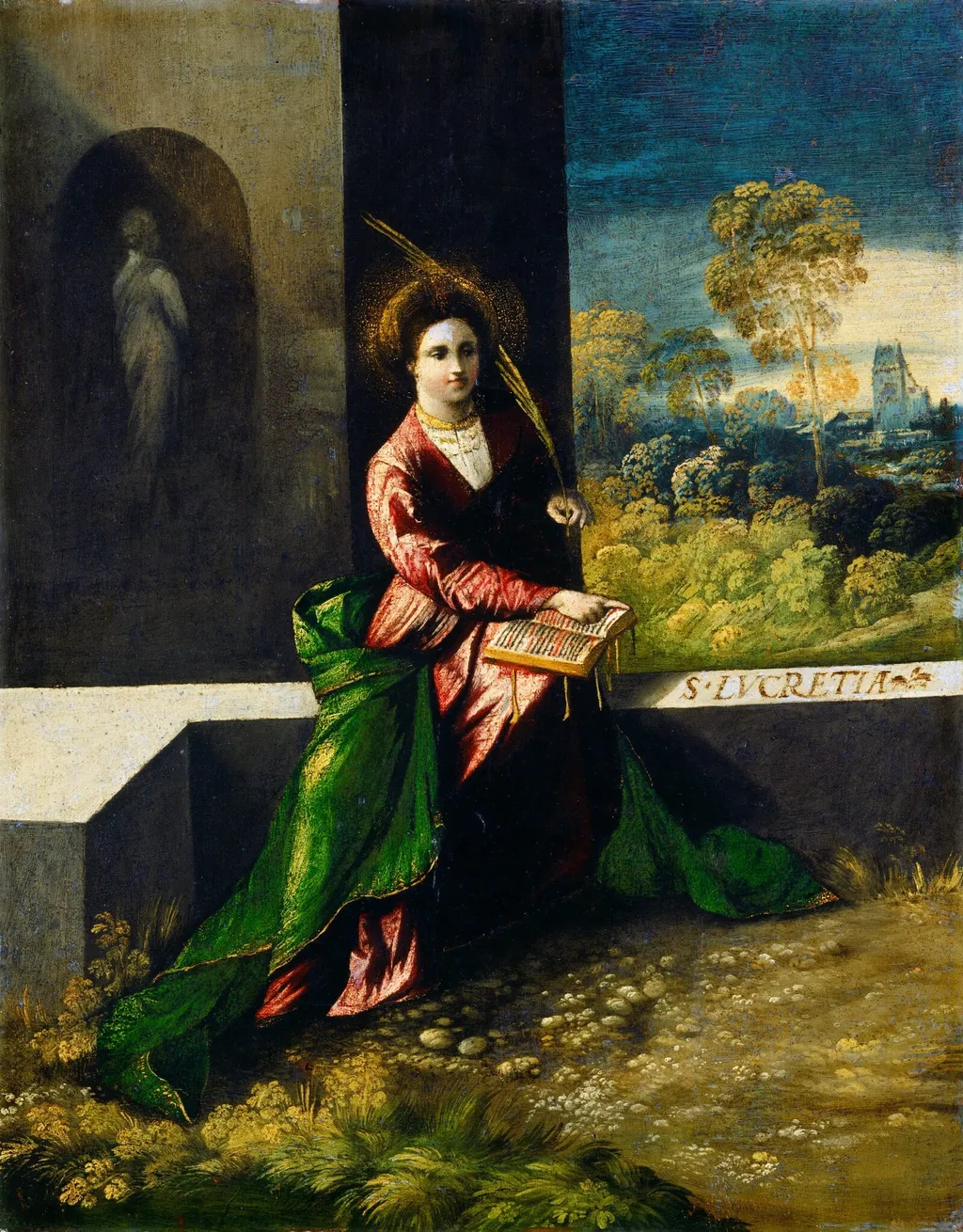
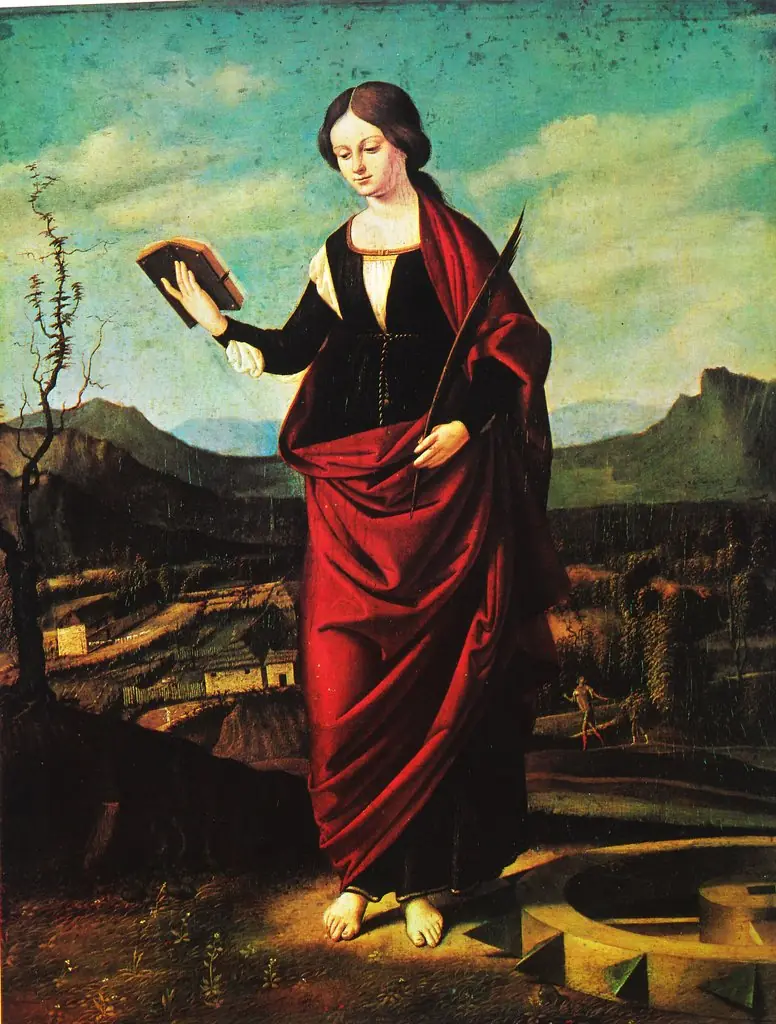
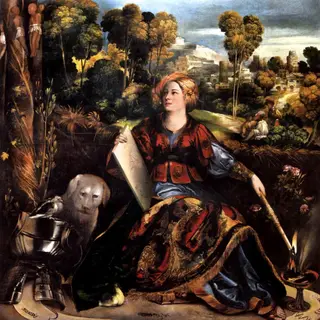
Saint Lucretia is an oil painting by the Mannerist artist Dosso Dossi. It dates from 1520 and is held in the collection of the National Gallery of Art.
- Inscription
- Inscribed:center right on parapet: S . LVCRETIA
About this work
Subject & Meaning
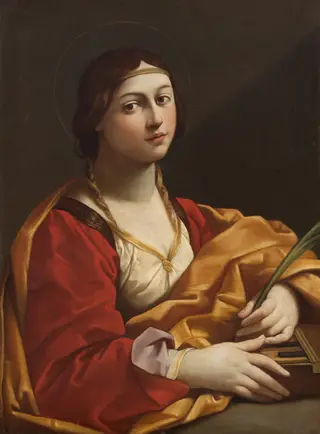
Dosso Dossi's Saint Lucretia (1520) depicts the Christian martyr Lucretia of Mérida, identified by her traditional attributes: a palm branch and an open book.
Dosso Dossi's Saint Lucretia (1520) depicts the Christian martyr Lucretia of Mérida, identified by her traditional attributes: a palm branch and an open book. The palm branch signifies martyrdom, underscoring her sacrifice and sanctity, while the book likely represents scripture or her pious devotion. As a religious work, the painting conveys themes of faith and perseverance, emphasizing Lucretia's moral resolve in the face of persecution.
Commissioned for a Ferrarese patron, the image aligns with Renaissance devotional practices, portraying the saint as an exemplar of virtue and spiritual fortitude.
Technique & Style
Executed in 1520, this religious painting utilizes oil paint applied to a wooden panel support. The work depicts the figure of Saint Lucretia, who is characterized by the inclusion of specific iconographic attributes: a book and a palm branch. As a piece attributed to Dosso Dossi, the composition adheres to the conventions of early sixteenth-century religious art. The panel is held in the Samuel H. Kress Collection at the National Gallery of Art.
History & Provenance
The painting was likely commissioned by Alfonso I d'Este, Duca di Ferrara, and later entered the Barberini family, appearing in the posthumous inventories of Cardinal Antonio Barberini (d. 1671) and his nephew Maffeo Barberini (d. 1685). It remained in the Roman collection of Ugo Ferraguti, who sold it at the Ferraguti auction in Galleria Tavazzi, Rome, on 12–24 December 1932 (lot 390). By 1933 the work was owned by Dr. A. Porcella, who exhibited it in Ferrara.
Jacob M. Heimann acquired the piece before its 1938 sale to the Samuel H. Kress Foundation, which gifted the work to the National Gallery of Art in 1939, where it has remained since.
Overview
Dosso Dossi's oil on panel painting, "Saint Lucretia," presents the titular figure in a moment of quiet contemplation. Unlike many contemporary depictions that emphasized dramatic narratives, this work focuses on a serene portrayal of the saint. The artist employs a restrained palette and straightforward composition to direct the viewer's attention entirely to Lucretia, who holds a book and a palm branch. This approach highlights her inner state rather than external action.
Context
During the period of its creation, many artworks depicting saints emphasized dramatic episodes of their lives, such as martyrdoms or miracles, to evoke strong emotional responses. "Saint Lucretia" diverges from this trend by presenting the saint in a moment of quietude. This choice reflects an alternative approach to religious art, inviting contemplation and personal reflection rather than spectacle, distinguishing it from more theatrical contemporary works.
Own this work as a print
Artist & collection

Artist
Giovanni di Niccolò de Luteri, better known as Dosso Dossi (c. 1489–1542) was an Italian Renaissance painter who belonged to the School of Ferrara, painting in a style mainly influenced by Venetian painting, in…