Artwork
An Allegory of Fortune
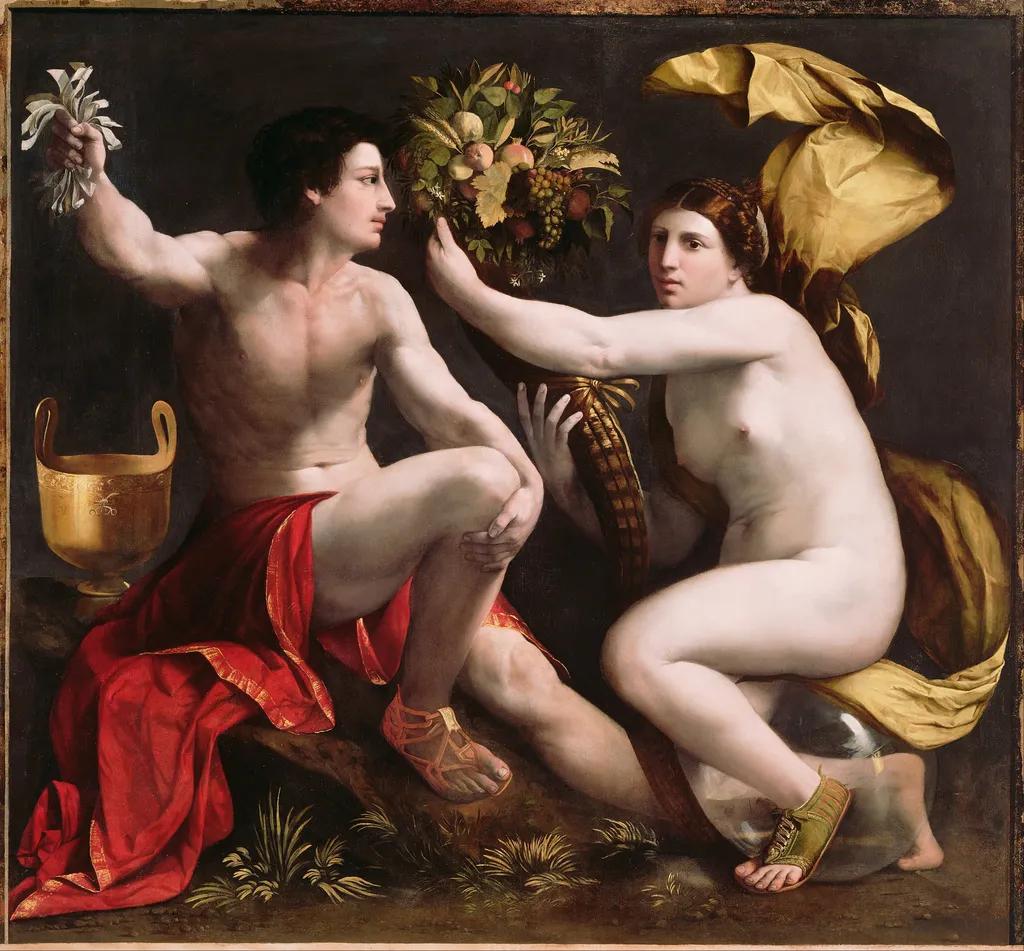
An Allegory of Fortune is an oil painting by the Mannerist artist Dosso Dossi. It dates from 1530 and is held in the collection of the J. Paul Getty Museum.
About this work
Subject & Meaning
The cornucopia, an attribute inherited from the Greek goddess Tyche, signifies abundance and fertility, reinforcing Fortune’s role as a dispenser of prosperity.
The painting presents two allegorical figures set against a dark background: Chance and Fortune. Chance is depicted as a muscular youth wearing a red and gold draped cloth, holding lottery tickets in his right hand and standing beside a high-handled cup. Fortune, a female figure, holds a cornucopia and stands atop a large, fragile bubble, underscoring her instability.
Her flowing mantle signals mutability, while her footwear symbolizes the inescapable power of fate in human destiny. The cornucopia, an attribute inherited from the Greek goddess Tyche, signifies abundance and fertility, reinforcing Fortune’s role as a dispenser of prosperity. Together, these elements convey the Renaissance idea of Fortune as capricious and transient, subject to the whims of Chance and the immutable force of Fate.
Technique & Style
An Allegory of Fortune is an oil painting executed on a canvas support, measuring 179 by 217 centimeters. Created by Dosso Dossi, the work dates to approximately 1530, though some scholarship suggests a later range of 1535 to 1538. The composition features two primary figures set against a dark background, emphasizing their symbolic presence through stark contrast.
The handling of the paint highlights the textures of the subjects' attributes, such as the floating mantle of Fortune and the athletic form of the male figure. Stylistically, the work employs specific iconography to convey themes of instability and fate; Fortune stands upon a large, bursting soap bubble while wearing sandals, and the male figure holds lottery tickets. The use of a dark void for the background isolates the figures, focusing attention on the allegorical narrative of chance and abundance.
History & Provenance
The work was commissioned by Isabella d'Este and executed by Dosso Dossi around 1530, as documented in contemporary records and the artist’s catalogue raisonné. The painting, executed in oil on canvas measuring approximately 179 × 217 cm, reflects the allegorical tradition of Renaissance court culture and was likely produced to celebrate the patron’s fortunes. It entered the collection of the J. Paul Getty Museum in Los Angeles, where it remains on permanent display; museum records indicate acquisition from the d'Este family holdings, though the exact transfer date is unspecified.
An Allegory of Fortune is held in the collection of the J. Paul Getty Museum, located at the Getty Center in Los Angeles. The work is an oil painting on canvas measuring 179 by 217 cm. While some references date the piece to approximately 1530, other scholarship places its creation between 1535 and 1538. The painting was commissioned by Isabella d'Este.
It was featured in the exhibition "Dosso Dossi: Painter of Court in Renaissance Ferrara," organized at the Palazzo dei Diamanti in Ferrara, which ran from September 26 to December 14, 1998.
Context
An Allegory of Fortune is situated within Dosso Dossi’s late output in the School of Ferrara, where allegory and inventive iconography were central to his courtly practice under Alfonso I d’Este. The painting’s pairing of Fortuna with a male personification of Chance reflects a humanist tradition that reinterprets classical Tyche, blending ancient attributes such as the cornucopia with contemporary motifs like lottery tickets to signal the mutable, capricious nature of fortune. Its inclusion in the 1998 exhibition Dosso Dossi: Pittore di corte a Ferrara nel Rinascimento at Palazzo dei Diamanti confirms the work’s role in consolidating the artist’s allegorical idiom during the 1530s, situating it alongside studies of mythological invention and courtly display.
Scholarly attention has emphasized the painting’s programmatic engagement with Renaissance emblematics, particularly the instability of worldly success. Commentators note the floating drapery and bursting bubble as deliberate visual metaphors for Fortuna’s evanescence, a reading reinforced by the Getty’s conservation record and exhibition catalogues that contextualize the work within Ferrarese intellectual circles influenced by neo-Platonic thought.
Overview
Dosso Dossi, a painter from the Italian Renaissance Ferrara school, completed An Allegory of Fortune in 1530 using oil paint. This work exemplifies his interest in mythological and allegorical themes, often characterized by a dream-like quality. The painting is an interpretation of Fortuna or Tyche, the personification of luck and destiny, and is currently housed at the J. Paul Getty Museum.
Own this work as a print
Artist & collection

Artist
Giovanni di Niccolò de Luteri, better known as Dosso Dossi (c. 1489–1542) was an Italian Renaissance painter who belonged to the School of Ferrara, painting in a style mainly influenced by Venetian painting, in…