Artwork
Garden at Vaucresson
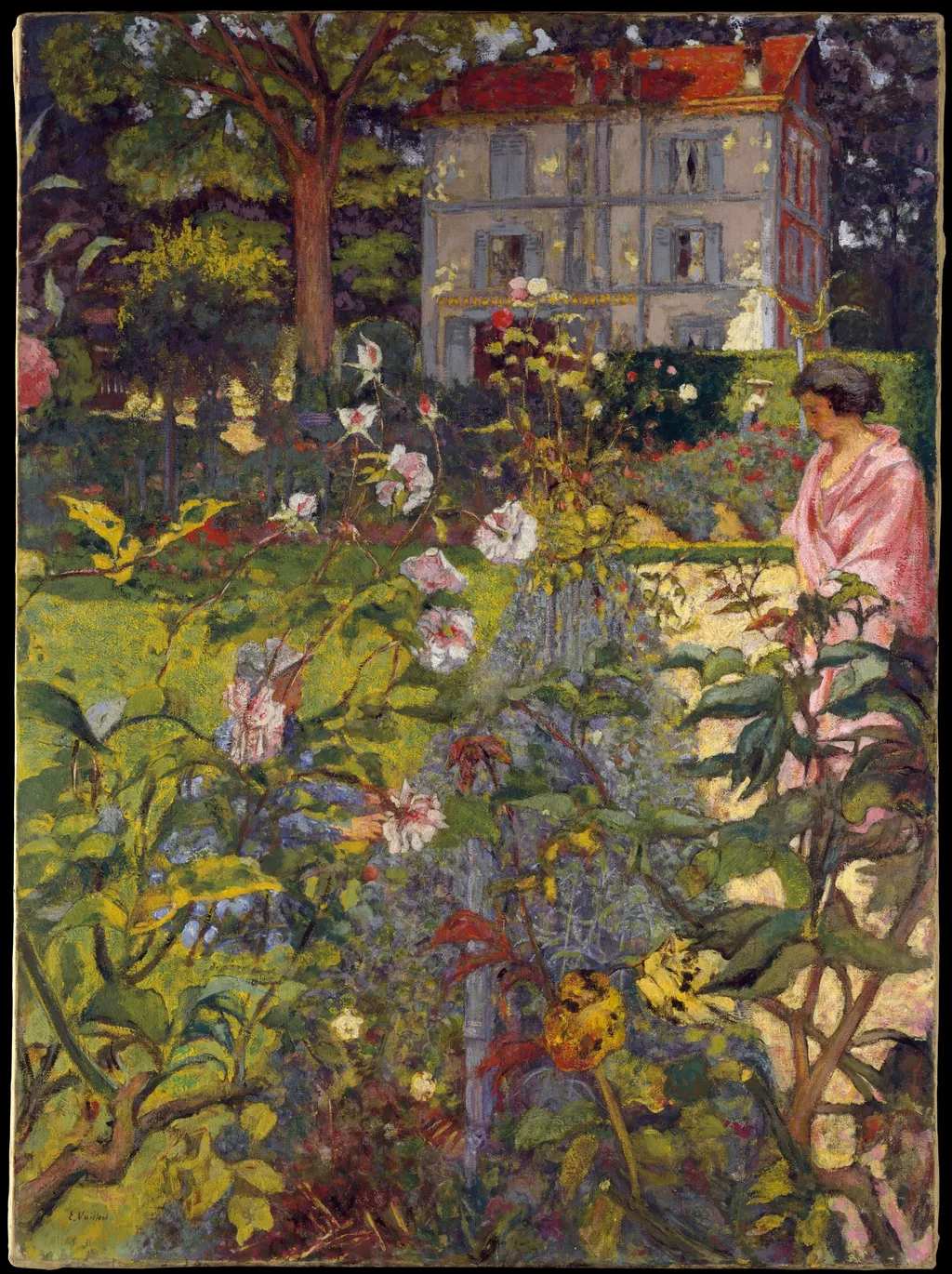
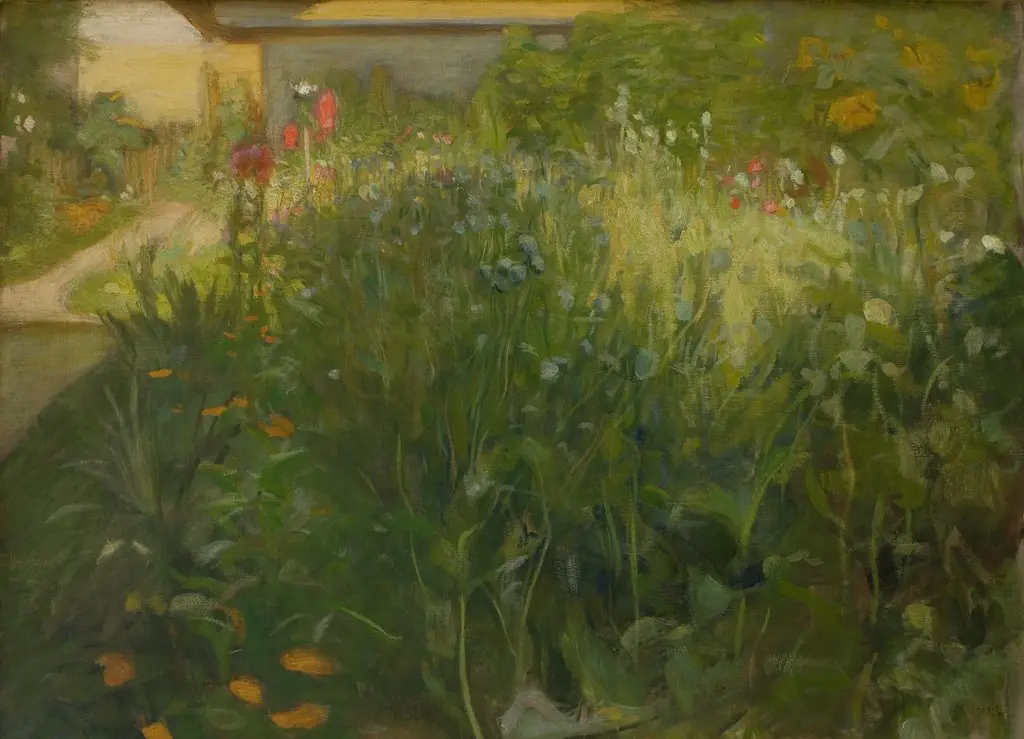
Garden at Vaucresson is a distemper painting by the Les Nabis artist Édouard Vuillard. It dates from 1923 and is held in the collection of the Metropolitan Museum of Art.
About this work
Subject & Meaning
The work depicts a private garden in Vaucresson, where Vuillard stayed during summers at the home of his close friend and art dealer Jos Hessel and Lucy Hessel, his lover and frequent model. Two women appear: Lucy, in a blue dress kneeling amid flowers, her figure partly concealed by foliage, and Marcelle Aron, Lucy's niece, standing in a pink kimono at the edge of the composition. The scene's dense floral patterns and flattened spatial arrangement reflect Vuillard's Nabis-influenced decorative style, yet the hidden positioning of Lucy, Vuillard's clandestine beloved, conveys the secrecy and compromise of their real-life relationship.
The serene garden setting thus becomes a coded space of intimacy and concealment, where figures are absorbed into their environment, underscoring themes of privacy and emotional restraint.
Technique & Style
The handling privileges overall pattern over naturalistic modeling, aligning with his Nabis training and later intimiste practice.
Garden at Vaucresson (1923) is painted in distemper on canvas, a medium Vuillard favored for its matte finish and capacity to absorb flat, decorative color areas. The composition unfolds as a dense, patterned surface where figures and foliage coalesce into rhythmic, interwoven forms. Vuillard's handling emphasizes planar compression and muted, harmonized tones, pinks, greens, and creams, arranged in broad, unmodulated planes that flatten space and suppress individual detail.
The standing woman in the pink kimono and the kneeling figure in blue are absorbed into the surrounding floral motifs, their contours dissolving into the decorative weave of the garden's flora. The handling privileges overall pattern over naturalistic modeling, aligning with his Nabis training and later intimiste practice. The work, in the Metropolitan Museum of Art's collection since 1952, reflects Vuillard's layered adjustments over time, including reworking in 1926, 1935, and 1936.
History & Provenance
The painting Garden at Vaucresson was executed by Édouard Vuillard in 1923 while he was staying at the villa of his friend Jos Hessel in Vaucresson. The work, initially painted in distemper on canvas, was later reworked in 1926, 1935 and 1936, as noted in contemporary records. It remained in the Hessel family collection until after Vuillard's death in 1940, when the couple's daughter transferred the piece to the United States; the Metropolitan Museum of Art acquired it in 1952.
Following the deaths of Vuillard, Lucy Hessel, and Jos Hessel during the early 1940s, the Hessels' daughter transported a portion of their art collection to the United States. The painting was subsequently acquired by the Metropolitan Museum of Art in New York in 1952, where it is held today. Specific inventory or accession numbers are not documented in the provided sources, nor are details of its exhibition history prior to or following its institutional acquisition.
Context
Although Vuillard's decorative style was long dismissed as dated during the dominance of abstract art, a late-twentieth-century reassessment highlighted the quiet intimacy and subtle psychological tension in works such as Garden at Vaucresson, noting how the painting's floral surface conceals a veiled dialogue between Lucy Hessel and her niece Marcelle Aron. Scholarship, exemplified by Kathryn Calley Galitz's entry in the Metropolitan Museum's Masterpieces of European Painting (2007), situates the canvas within Vuillard's 'intimités', domestic scenes drawn from his close circle, and connects its figural camouflage to Japanese print influences and the artist's complex relationship with the Hessel family, who owned the work until its 1952 acquisition by the Met.
Legacy
After Vuillard's death in 1940 the painting remained in the Hessel family collection and was acquired by the Metropolitan Museum of Art in 1952, ensuring its preservation and public access. Its inclusion in the Met's European paintings catalogue and frequent citation in museum publications helped sustain scholarly interest. Early twentieth-century criticism dismissed Vuillard's decorative style, but later reassessments highlighted the work's synthesis of intimité and Japonisme.
The piece is regularly referenced in surveys of the Nabi group and in analyses of gender and domestic space, cementing its reputation as a key example of Vuillard's late oeuvre.
Overview
Garden at Vaucresson depicts a lively outdoor space, dominated by an abundance of colorful flowers and verdant foliage. In the distance, a house with a distinctive red roof is visible. A woman, dressed in pink, stands subtly to the right, her back mostly turned, making her an integrated element of the landscape rather than a central focus. The overall impression is one of natural vitality and uncultivated beauty.
Own this work as a print
Artist & collection
Artist
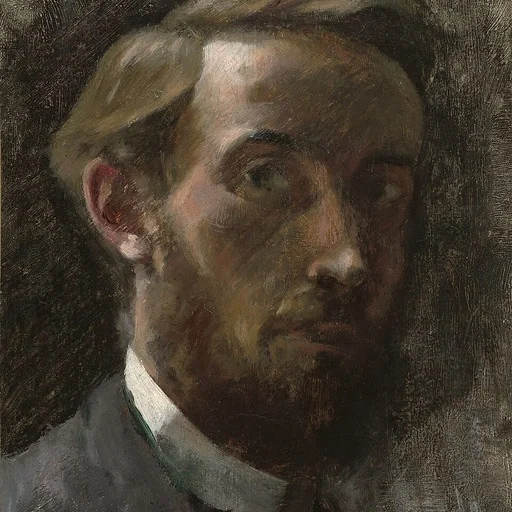
Jean-Édouard Vuillard (French:; 11 November 1868 – 21 June 1940) was a French painter, decorative artist, and printmaker.

![Phlox [a corner of a country garden], by Ernest Albert Chadwick](https://artifactworldgallery.com/img/ernest-albert-chadwick--phlox-a-corner-of-a-country-garden--692a6ad859748433-w320.webp)