Artwork
Woman in the Garden
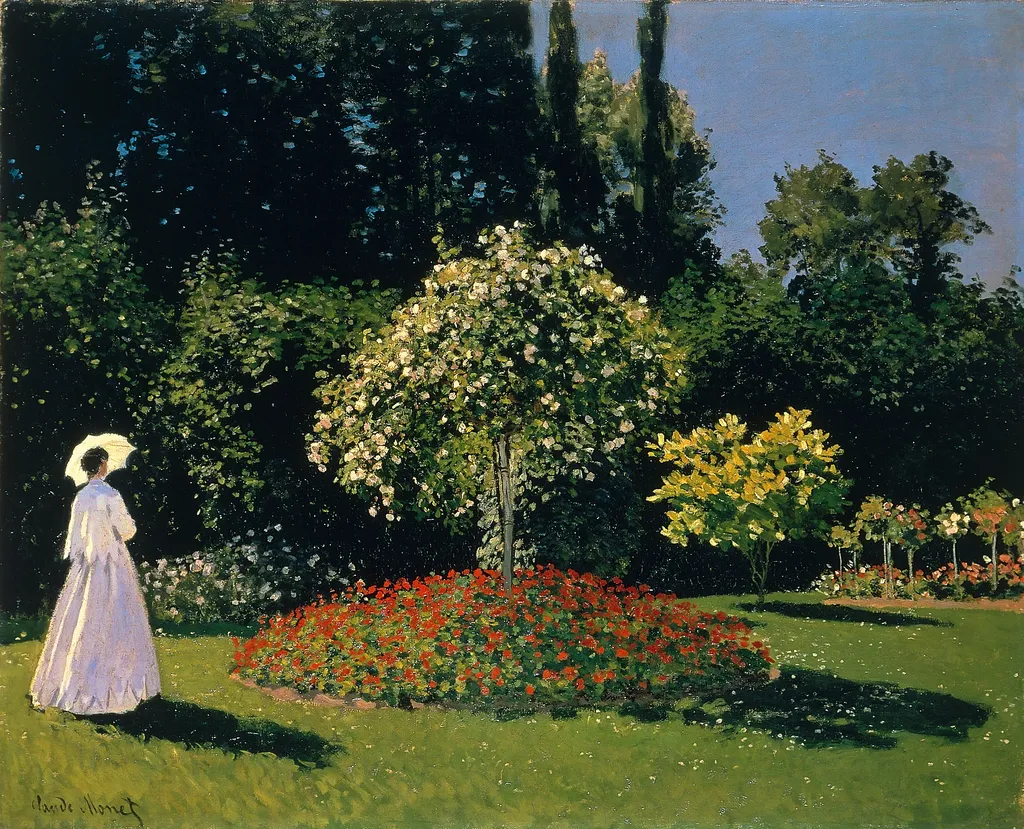
Woman in the Garden is an oil painting by the Impressionist artist Claude Monet. It dates from 1867 and is held in the collection of the Hermitage Museum.
About this work
Subject & Meaning
X‑ray study reveals the work was painted over an earlier image, and the subject anticipates Monet’s lifelong interest in gardens and floral motifs.
Monet’s Woman in the Garden portrays Jeanne‑Marguerite Lecadre, the young wife of his cousin, standing in the family garden at Sainte‑Adresse. She is shown in a white dress with an umbrella, positioned before a bright red flower bed and a white rose bush, with light falling from the left. The composition treats the figure mainly as a colour accent that balances the surrounding greens and reds, emphasizing the effects of light rather than personal characterization.
X‑ray study reveals the work was painted over an earlier image, and the subject anticipates Monet’s lifelong interest in gardens and floral motifs. The painting, created en plein air in 1867, is now housed in the Hermitage Museum.
Technique & Style
Executed en plein air in 1867, this work is an oil painting on canvas measuring approximately 82 by 101 cm. X-ray analysis reveals the composition was painted over a previous picture; specifically, a male figure originally positioned to the right of the central subject was later obscured. The style is notably composed and detailed, diverging from the loose brushwork characteristic of Monet's later Impressionist periods.
The composition relies on an ordered structure defined by three principal elements: the female figure, a central flowering rose bush, and a secondary bush on the right. Strong color contrasts are achieved through the subject's bright white dress set against red, pink, and green foliage. The figure is depicted from behind, functioning primarily as a color accent that balances the surrounding tones rather than as a psychological portrait, emphasizing the interplay of light and shadow in an outdoor setting.
History & Provenance
The painting was begun in 1866 and completed in 1867 by Monet at Sainte-Adresse, where he stayed in the summer of 1867. The scene was painted en plein air in the garden of his cousin Paul-Eugène Lecadre, depicting his cousin’s wife Jeanne-Marguerite Lecadre.
It was first shown at the fourth Impressionist exhibition in 1879. By that time it belonged to the Lecadre family. In 1899 Durand-Ruel sold the work to Russian collector Sergei Shchukin. After the Russian Revolution, the painting entered the collection of the Hermitage Museum, where it has remained since 1930.
The painting is held in the collection of the State Hermitage Museum in Saint Petersburg, Russia, and measures 82 × 101 cm. It was also shown at the Hermitage Amsterdam for the 2012–2013 exhibition “Impressionisme: Sensatie en inspiratie. Favorieten uit de Hermitage.”
Context
Painted in 1867, Woman in the Garden represents a transitional moment in Claude Monet's career, bridging his early academic training with his emerging Impressionist style. Although executed en plein air, the work retains a composed, detailed structure that contrasts with the looser brushwork of his later masterpieces. X-ray analysis reveals the painting was created over a previous composition that originally included a male figure, indicating a shift in focus from narrative storytelling to the study of light and color relationships.
The subject, Jeanne-Marguerite Lecadre, serves primarily as a chromatic element rather than a psychological portrait, allowing Monet to explore the interaction of the white dress against the red flowers and green foliage.
The work was exhibited at the fourth Impressionist exhibition in 1879, where critics praised its unpretentious quality and refined texture. Its influence extended beyond France, inspiring Adolph Menzel's Walk in the Garden upon its return to Paris. The painting's trajectory from private family ownership to the collection of Russian industrialist Sergei Shchukin, and subsequently to the Hermitage Museum following the Russian Revolution, underscores its enduring significance within the Impressionist canon.
Legacy
Woman in the Garden has been credited with anticipating Monet's lifelong devotion to painting gardens and flowers in natural light, a subject he pursued throughout his later career. The work was shown at the 4th Impressionist Exhibition in 1879, where the periodical La petite République Française praised it as a "masterpiece of unaffected simplicity" possessing an unusually rounded texture. It also inspired Adolph Menzel's Promenade im Park after Monet brought the canvas back to Paris at the end of 1867.
After passing through several French collections, the painting was acquired in 1899 by the dealer Durand-Ruel for the Russian textile baron Sergei Shchukin; following the Russian Revolution it became state property and entered the Hermitage, where it has been held since 1930.
Overview
Claude Monet commenced Woman in the Garden (also known as Femme au jardin) in 1866, at the age of 26. This oil on canvas painting, measuring 82 by 101 centimeters, depicts a figure within a lush outdoor setting. It was created en plein air and is now part of the collection at the Hermitage Museum in St. Petersburg, Russia, representing an early work in the artist's developing career.
Own this work as a print
Artist & collection
Artist
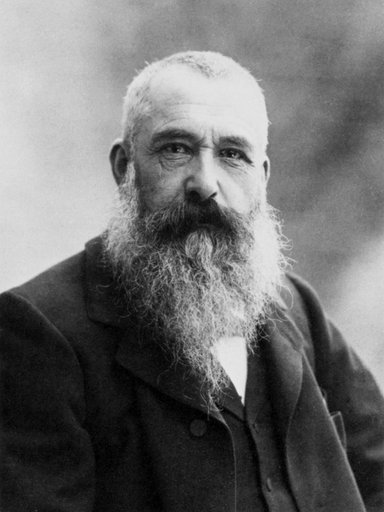
Oscar-Claude Monet was a French painter and founder of Impressionism who is seen as a key precursor to modernism, especially in his attempts to paint nature as he perceived it.


 The Little Gardener
 Springtime
 A Garden Nook at Bellevue
 In the Woods at Giverny: Blanche Hoschedé at Her Easel with Suzanne Hoschedé Reading
 Monet's Garden at Giverny
 The Kitchen Garden
 Rounded Flower Bed (Corbeille de fleurs)
 Peasant Woman Resting at the Foot of a Tree, Effect of Sunshine, Éragny
 The Monet Family in Their Garden at Argenteuil