Artwork
The Artist's Garden at Vétheuil
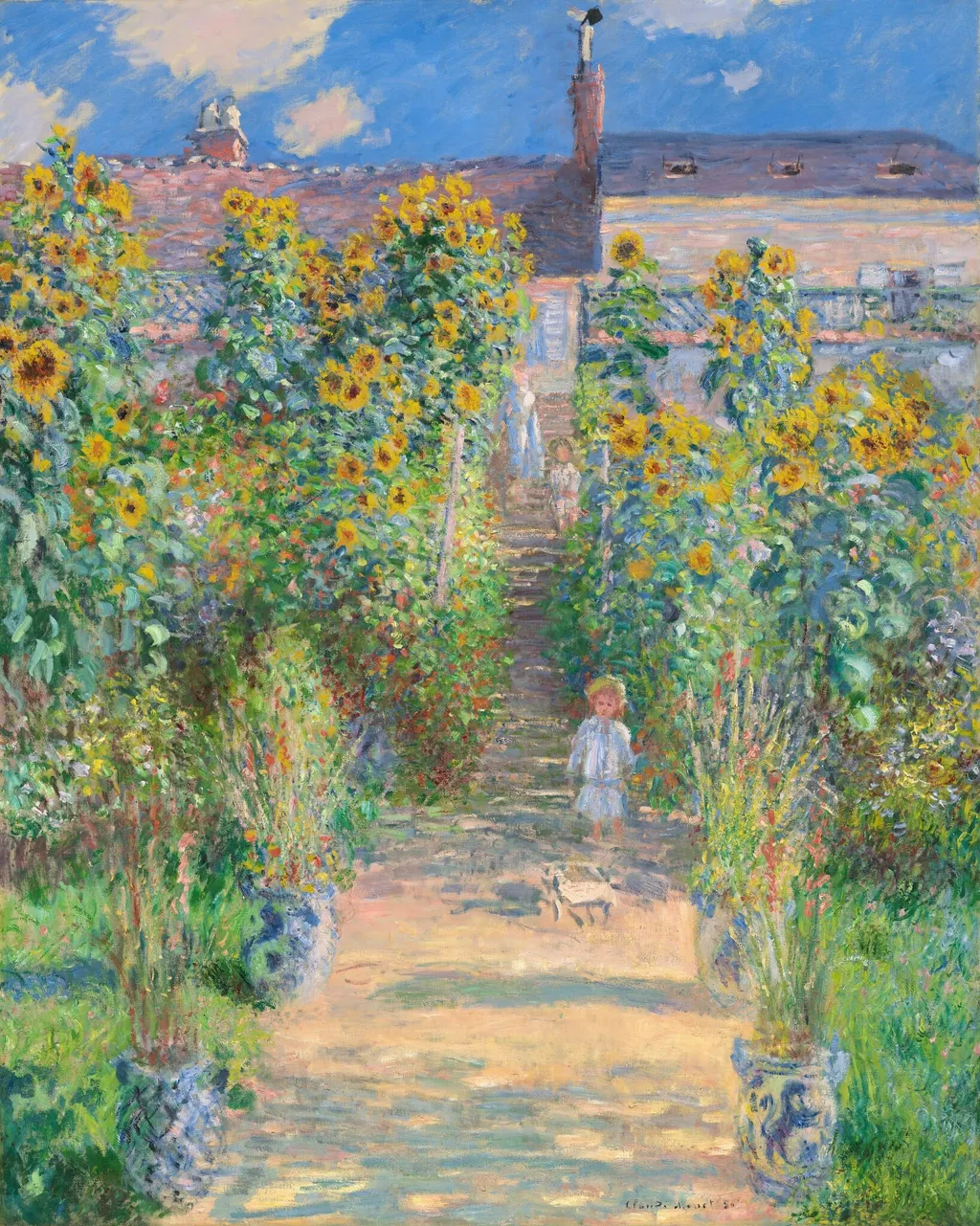
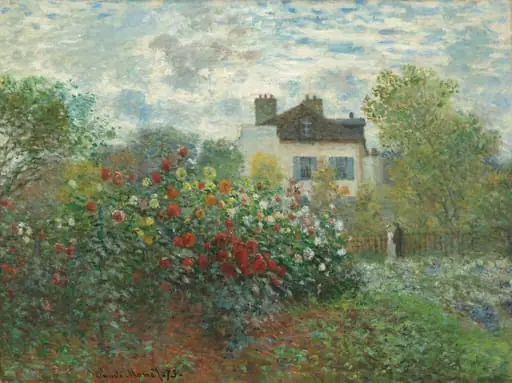
The Artist's Garden at Vétheuil is an oil painting by the Impressionist artist Claude Monet. It dates from 1881 and is held in the collection of the National Gallery of Art.
- Inscription
- Inscribed:lower right, dated incorrectly: Claude Monet 80 [1]
About this work
Find another Monet painting at the National Gallery of Art, Washington.
Monet painted his garden in Vétheuil with quick brushstrokes. Pink flowers pop against green grass. A tree’s shadow falls across the path.
He painted this in 1881 when he lived there with his family. The garden felt like a safe place while his wife was sick. Light bounces off the petals in soft patches.
Look for the way light changes in his work. See how he piles paint thickly on the canvas.
Find another Monet painting at the National Gallery of Art, Washington.
Subject & Meaning
The painting depicts Monet's garden in Vétheuil, dominated by tall sunflowers that create a dense, fog-like atmosphere. Within this lush vegetation, the artist's two sons and possibly their nurse are subtly embedded, their forms camouflaged by the swaying flowers and the work's loose brushwork. The restricted color palette of blue, white, and yellow enhances this sense of immersion, suggesting the family exists within a protective cocoon crafted by the father.
Iconographically, the scene represents a peaceful rural existence where the children could explore freely while Monet pursued his growing passion for gardening. This domestic tranquility contrasts with the household's underlying financial struggles and impending move to Poissy. The garden serves as a sanctuary, capturing a fleeting moment of familial harmony amidst personal loss and economic uncertainty.
Technique & Style
Executed in 1881, this work is an oil painting on canvas measuring 151.5 by 121 centimeters. Monet employed a restricted palette dominated by blue, white, and yellow to unify the composition. The artist applied the paint with a free, loose handling that allows the figures of his sons and their nurse to become partially camouflaged within the dense foliage of sunflowers.
This stylistic approach creates an atmospheric effect, suggesting the family is enveloped in a protective cocoon amidst the garden setting. The technique emphasizes the rhythmic movement of the plants rather than sharp delineation of forms.
History & Provenance
The painting was created by Monet in 1881 while he lived at Vétheuil, where he cultivated the depicted garden with sunflowers and reused blue drawing pots from his earlier stay in the Netherlands. Monet retained the work for nearly three decades before selling it in 1910 to Georges Bernheim in Paris.
The ownership chain continued through intermediary dealers: René Gimpel (Paris), Guez (Paris), and Gimpel Fils (London) by 1946. By 1950 it had passed to Wildenstein & Co. (London, New York, Paris), which sold the work on 15 March 1961 to Ailsa Mellon Bruce. She bequeathed it in 1970 to the National Gallery of Art, Washington, D.C., where it remains.
The Artist's Garden at Vétheuil is held by the National Gallery of Art in Washington, D.C., where it was accessioned in 1970 as a bequest from Ailsa Mellon Bruce. Prior to entering the museum's collection, the painting was sold to Bruce on March 15, 1961, by Wildenstein & Co. Its ownership history traces back to 1910, when the artist sold the work to Georges Bernheim in Paris.
The canvas subsequently passed through the hands of René Gimpel, the Guez gallery, and Gimpel Fils in London by 1946. According to available records, the work has participated in nearly twenty exhibitions across the United States, Europe, and Japan.
Context
Painted in 1881, this work emerges from a pivotal domestic chapter where Monet resided in Vétheuil with the Hoschedé family following the death of his wife, Camille. The composition reflects the artist's deepening engagement with gardening, utilizing sunflowers and blue pots previously acquired in the Netherlands to create a secluded environment for his children. Art historically, the piece is one of four known versions Monet produced of this specific garden view during this period, illustrating his method of exploring a single motif through varied perspectives.
The painting remained in the artist's possession for nearly three decades before entering the market in 1910, eventually becoming part of the Ailsa Mellon Bruce bequest to the National Gallery of Art. Its inclusion in approximately twenty exhibitions across the United States, Europe, and Japan underscores its recognized status within the Impressionist canon.
Legacy
The Artist's Garden at Vétheuil entered the National Gallery of Art in 1970 through the bequest of Ailsa Mellon Bruce, having previously been sold by Monet in 1910 to Bernheim and later acquired by Wildenstein before its 1961 sale to Bruce [1]. The work, recorded in the National Gallery of Art's collection with dimensions 151.5 cm × 121 cm [2], has been featured in roughly twenty exhibitions across the United States, Europe, and Japan, underscoring its continued presence in major museum programs [1][3]. Its inclusion in the inaugural show of Gimpel Fils in London (1946) and subsequent loan histories illustrate its role in shaping scholarly discourse on Monet’s garden series [1][3].
Overview
Claude Monet's The Artist's Garden at Vétheuil, executed in 1881, captures the domestic landscape of the home he shared with his family in the village of Vétheuil. Painted in oil on canvas, the work exemplifies the artist's mature Impressionist technique, utilizing rapid, distinct brushstrokes to render the interplay of light and shadow across the garden path. The composition features a vibrant array of pink flowers contrasting against lush green grass, with the dappled shadow of a tree stretching across the foreground.
This period marked a significant phase in Monet's career where he turned his focus from the broader French countryside to the intimate, cultivated spaces surrounding his residence. The painting reflects the artist's dedication to observing natural light and color variations in a specific locale. Created during a time of personal hardship as his wife, Camille, suffered from terminal illness, the garden served as a subject of solace and continuity.
The work stands as a testament to Monet's ability to transform a private, domestic scene into a universal study of atmospheric conditions and botanical vitality, solidifying his reputation for capturing the fleeting effects of the natural world.
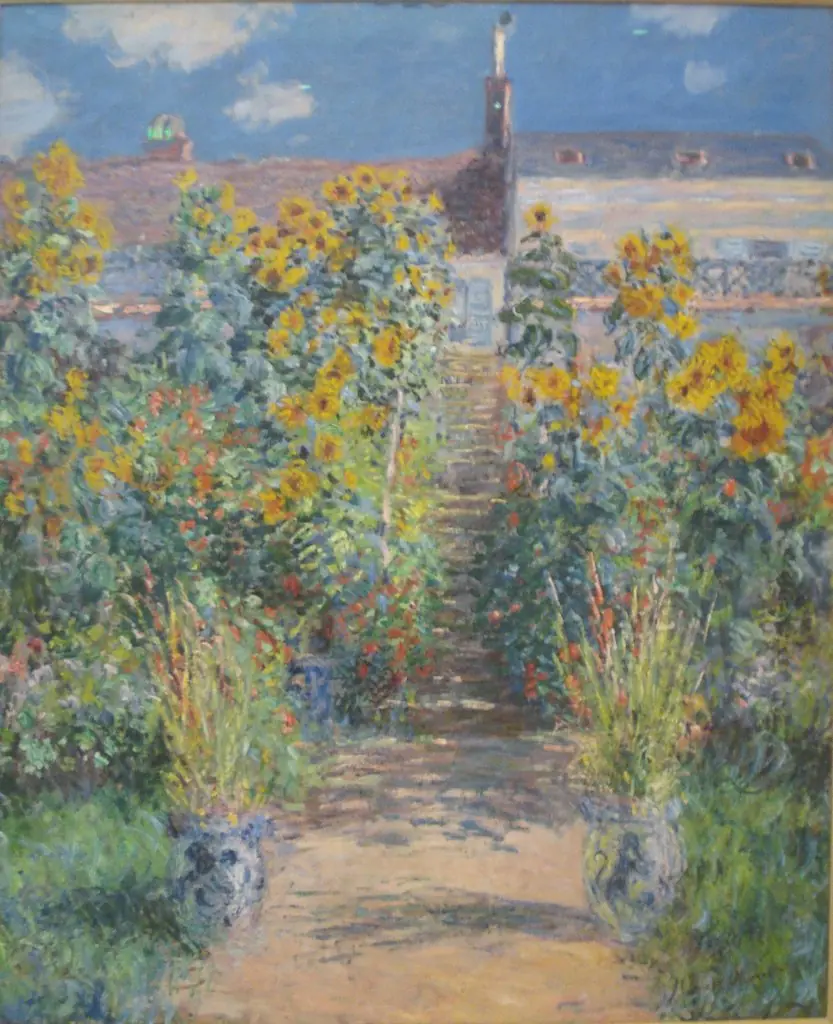
Own this work as a print
Artist & collection
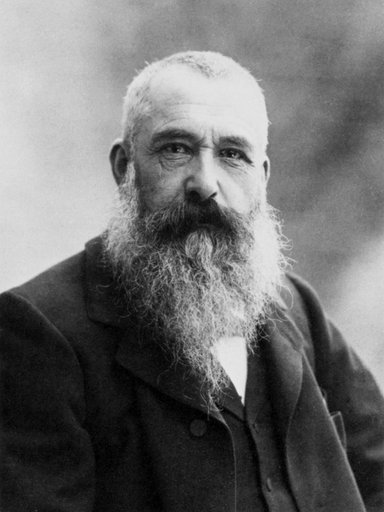
Artist
Oscar-Claude Monet was a French painter and founder of Impressionism who is seen as a key precursor to modernism, especially in his attempts to paint nature as he perceived it.