Artwork
The Descent from the Cross
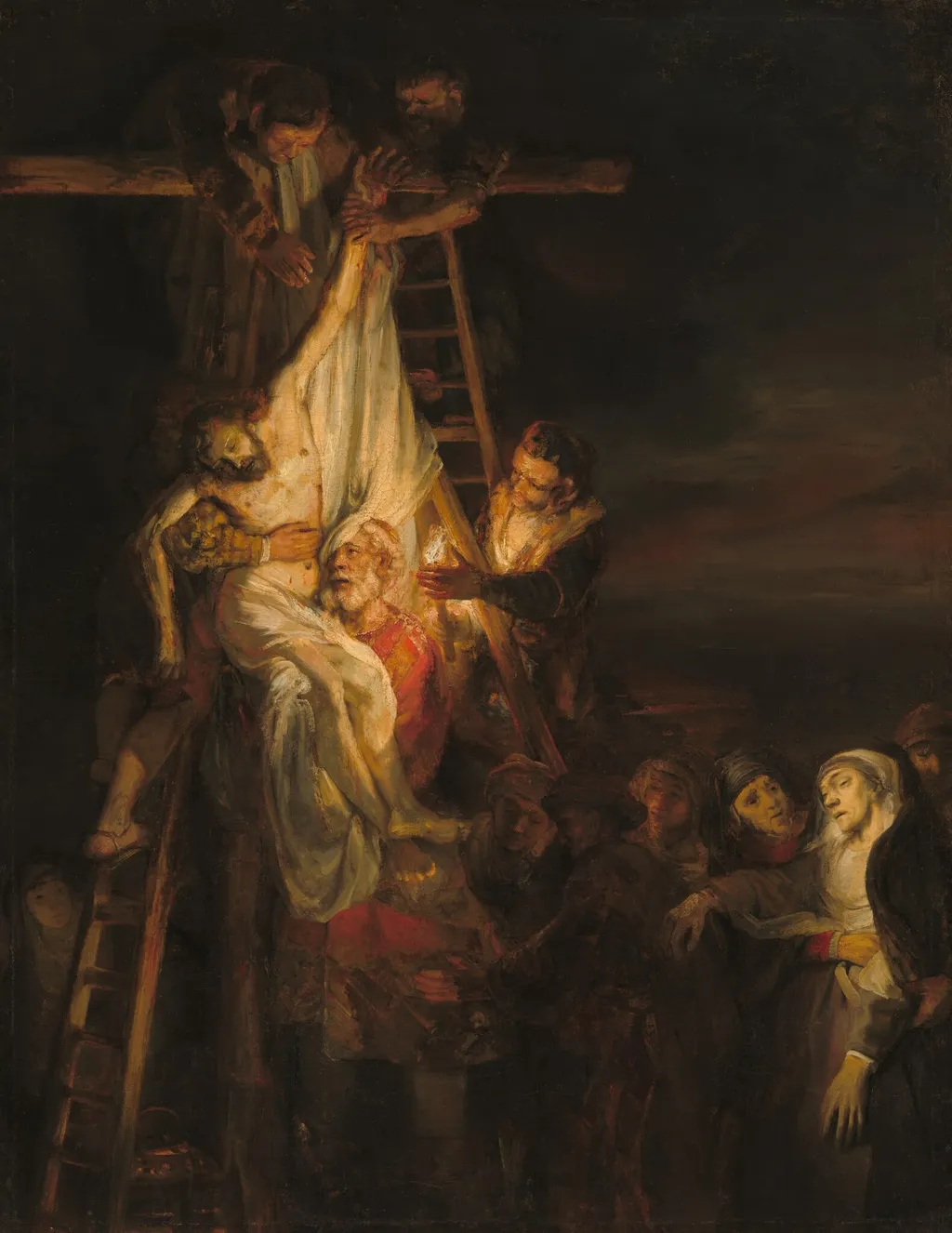
The Descent from the Cross is an oil painting. It dates from 1651 and is held in the collection of the National Gallery of Art.
- Inscription
- Inscribed:falsely signed and dated, lower center: Rembrandt f. 1651 (this inscription removed during conservation treatment in 1991-1992)
About this work
Subject & Meaning
Symbolically, the work conveys themes of sacrifice, redemption, and human sorrow, emphasizing the physical and emotional weight of Christ’s death.
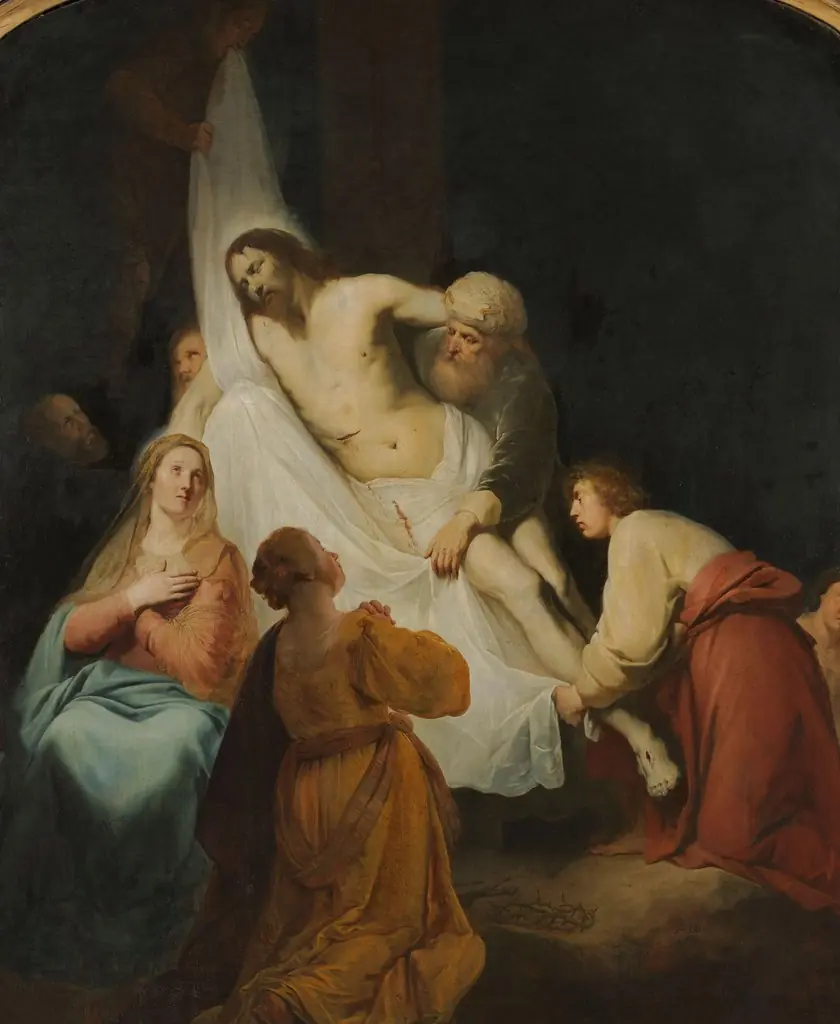
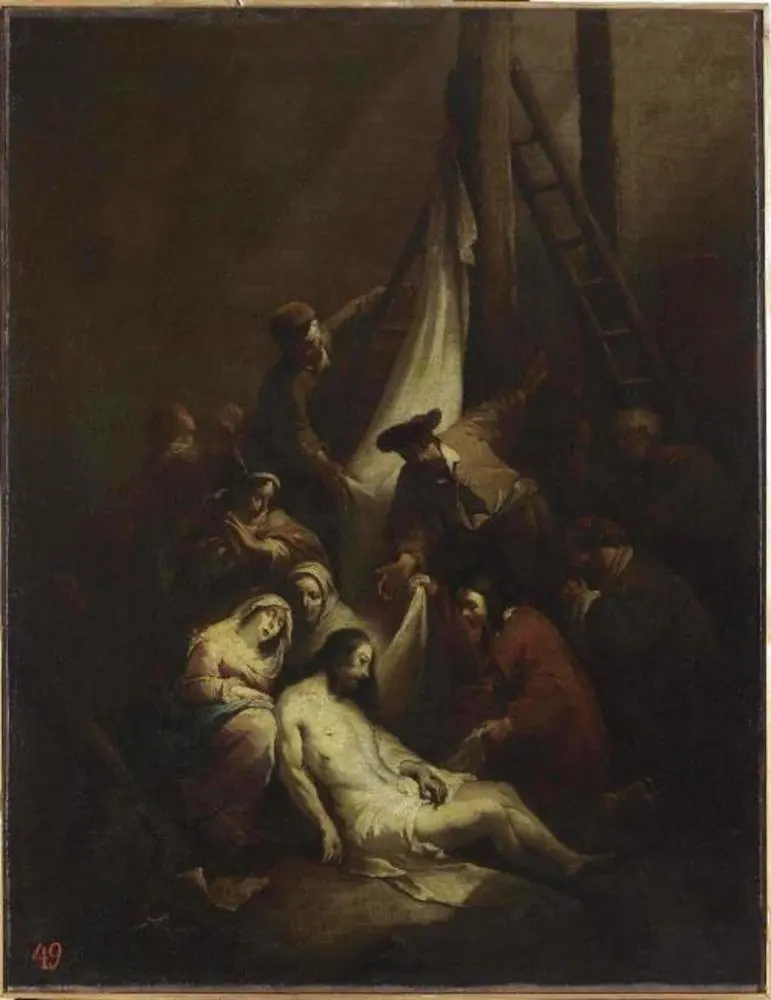
The painting depicts the Descent from the Cross, a pivotal New Testament scene in which the body of Jesus Christ is lowered from the cross following his crucifixion. The composition centers on the lifeless figure of Christ, surrounded by a group of mourners, including Joseph of Arimathea and the Virgin Mary, whose grief-stricken expression is illuminated by torchlight. Symbolically, the work conveys themes of sacrifice, redemption, and human sorrow, emphasizing the physical and emotional weight of Christ’s death.
The torch’s dramatic lighting highlights the pallor of Christ’s body and Mary’s face, underscoring the sacred transition from death to burial and foreshadowing the Resurrection. The scene’s intimate, human-scale treatment reflects the Dutch Golden Age’s focus on emotional realism within religious narratives.
Technique & Style
The Descent from the Cross is an oil painting executed on a canvas support, created between 1650 and 1652 within the workshop of Rembrandt. The work measures 142 cm in height and 110.9 cm in width. Stylistically, the composition features a complex arrangement where five figures form a chain to support the body of Christ, while a sixth figure prepares to receive him.
The handling of light is dramatic, utilizing a torch held by a figure on a ladder to illuminate two primary faces: the pale visage of the Virgin Mary and the lifeless countenance of her son. Although the composition is attributed to Rembrandt's design, possibly sketched directly onto the canvas, the actual execution lacks the master's characteristic brushwork. Instead, the painting demonstrates the hand of a talented pupil, identified by some scholars as Constantijn van Renesse, who worked under the master's supervision during this period.
History & Provenance
The Descent from the Cross, an oil on canvas painted circa 1650–1652, depicts the biblical scene of the lowering of Christ from the cross. It was created in Rembrandt’s workshop, likely under the direction of his pupil Constantijn van Renesse, with the composition probably drawn by Rembrandt himself. The work entered the collection of Harriet, viscountess Hampden, and was sold at Christie & Manson in London on 19 April 1834; subsequently it passed through the ownership of John A. Beaver, William Parker, and later Fritz von Gans before being acquired by the estate of Peter A.B. Widener, which gifted it to the National Gallery of Art in 1942.
The Descent from the Cross (1650) is held in the National Gallery of Art in Washington, D.C., where it is part of the permanent collection under accession number 1942.9.28. The painting entered the museum’s holdings in 1942 as a gift from the Estate of Peter A.B. Widener via Joseph E. Widener. Prior to its acquisition, it was exhibited in London during the 1909 Christie’s sale (no. 99) before passing through dealers F. Kleinberger & Co. and Bachstitz. Its exhibition history includes its inclusion in the National Gallery of Art’s displays since its accession.
Context
The Descent from the Cross (c. 1650–1652) occupies a distinct position within Rembrandt's late workshop output, representing the Dutch Golden Age rather than a masterpiece by the master himself. Scholarly consensus attributes the execution to a talented student, most likely Constantijn van Renesse, who studied under Rembrandt between 1649 and 1652. While Rembrandt is credited with conceiving the composition and potentially drawing the initial design, the finished canvas lacks his characteristic hand, suggesting the master supervised but did not paint the work.
This piece is part of a broader thematic exploration of the Deposition by Rembrandt, who treated the subject in earlier works such as the 1634 painting. The artwork is currently held in the National Gallery of Art in Washington, D.C., where it serves as a key example of the collaborative nature of 17th-century Dutch studio production.
Overview
This oil on canvas painting, titled The Descent from the Cross, dates from 1650–1652 and depicts the solemn moment Christ's body is removed from the cross. While its composition is attributed to Rembrandt, the execution was carried out by an unidentified artist within his workshop, with Constantijn van Renesse often suggested as the painter. The work is now housed in the National Gallery of Art in Washington.
Artist & collection