Artwork
Descent from the Cross
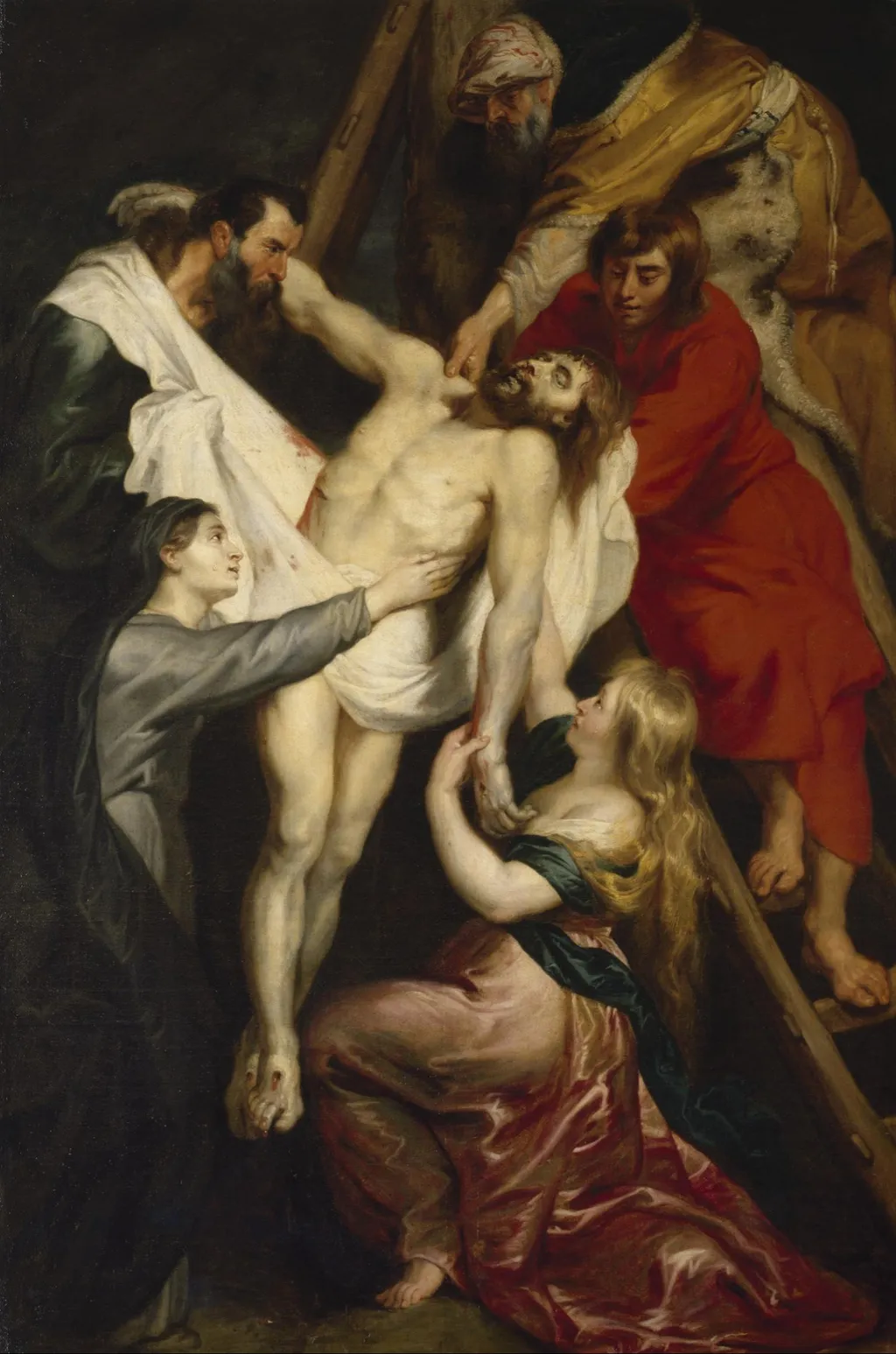
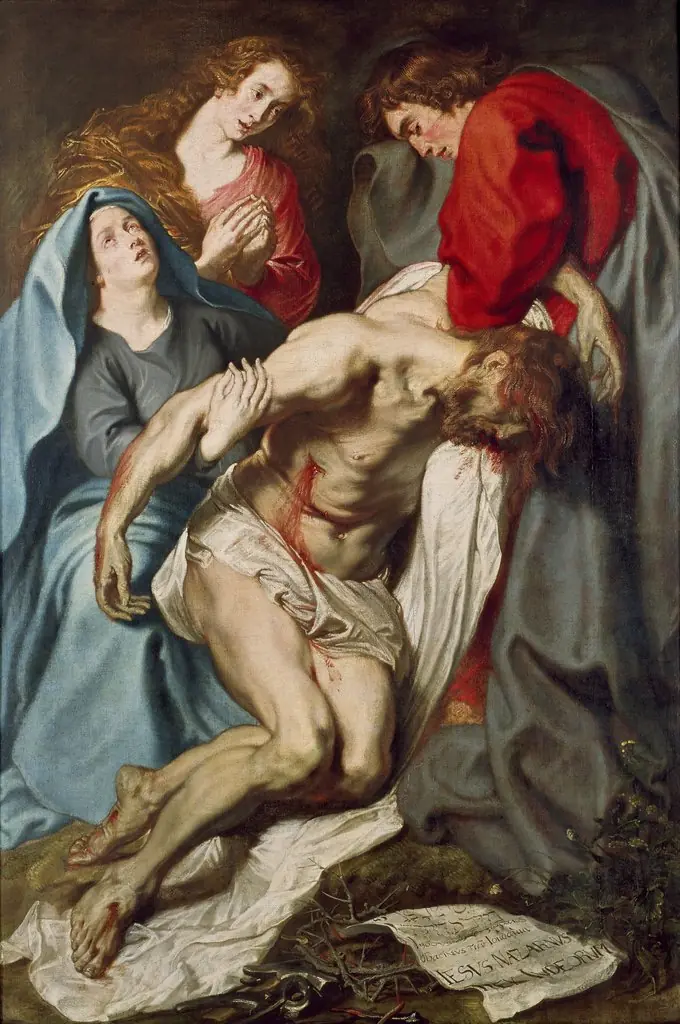
Descent from the Cross is an oil painting by the Flemish Baroque painting artist Peter Paul Rubens. It dates from 1617 and is held in the collection of the Hermitage Museum.
About this work
Overview
The Descent from the Cross is an oil on canvas painting by Peter Paul Rubens, dated 1617, now held in the Hermitage Museum in Saint Petersburg.
The Descent from the Cross is an oil on canvas painting by Peter Paul Rubens, dated 1617, now held in the Hermitage Museum in Saint Petersburg. Measuring 297 by 200 centimetres, this religious work depicts the lowering of Christ's body from the cross, a subject Rubens returned to repeatedly throughout his career. While Rubens painted several celebrated versions of this theme, including the famous triptych for Antwerp Cathedral, this 1617 canvas stands as a significant independent iteration, distinguished by its intimate scale and concentrated emotional focus. The painting entered the Hermitage collection in 1814 through the acquisition of Empress Josephine's collection at Malmaison, and it remains one of the key examples of Rubens's sustained engagement with one of Christian art's most poignant subjects.
Subject & Meaning
The painting depicts the biblical episode of the Deposition, drawn from the Gospel accounts in which Joseph of Arimathea, Nicodemus, and other followers remove Jesus's body from the cross after the Crucifixion. The composition centres on five figures lowering the pale, dead Christ, whose head tilts back with eyes rolled upward, blood visible at his hands, feet, and forehead. Four figures support or receive him: a bearded man in dark green and white holds the torso from the left; a kneeling woman in grey reaches toward the body; a kneeling blonde woman in pink and dark green clasps Christ's right hand; and a young man in vivid red stands to the right, assisting. Above them, an older bearded man in a turban and golden-brown robes leans down from a ladder, his hand on the cross. The dark, undefined background throws focus entirely onto the figures, emphasising the devotional intimacy of the scene. The subject carried particular resonance in Counter-Reformation Flanders, where images of Christ's bodily suffering were intended to stir empathy and reinforce belief in the physical reality of the Passion.
Technique & Style
Rubens executed the work in oil on canvas, a medium he increasingly favoured for its flexibility and scale. The palette is dominated by deep reds, creamy whites, dark greens, and golden browns against near-black shadows. Light falls strongly from the upper left, illuminating the pale body of Christ and the blonde woman's hair, creating a dramatic chiaroscuro effect that isolates the sacred action from its surroundings. The brushwork is smooth and blended on flesh, with more visible texture in drapery and background, demonstrating Rubens's characteristic ability to modulate paint handling according to subject matter. The composition forms a diagonal cascade from upper right to lower left, a structural device Rubens employed across his Deposition scenes to convey movement and emotional urgency. The broad free brushstrokes visible in certain passages, particularly in the older man's body and robes, have prompted scholarly suggestion of studio participation, with Rubens's pupil Anthony van Dyck possibly contributing to the execution.
History & Provenance
The painting was commissioned for the high altar of the Capuchin church in Lier, near Antwerp, and was based on Rubens's earlier successful treatment of the subject for Antwerp Cathedral. Two preparatory drawings for the work survive: one in the EV Thaw collection in New York, previously in the Wrangham collection in the United Kingdom, and another in the Museum of Fine Arts, Boston. The painting remained in the chapel until 1794, when it was hidden from French invaders by the monks. It subsequently entered the collection of Josephine Beauharnais at the Chateau de Malmaison. In 1814, the painting was acquired for the Hermitage Museum in Saint Petersburg, where it remains today under inventory number GE-471. The work has not been subject to the same convoluted wartime displacements as the Antwerp Cathedral triptych, which was removed by French forces in 1794 and later seized by German troops in 1914 before its eventual return.
Context
The 1617 canvas belongs to a period of intense productivity for Rubens, following his return from Italy in 1608 and his establishment as the preeminent painter of the Spanish Netherlands. By this date he had already completed the great triptych for the Cathedral of Our Lady in Antwerp, commissioned by the Guild of the Arquebusiers in 1611 and finished in 1614, a work that transformed his reputation across Europe. The Lier commission represents Rubens's practice of revisiting successful compositions for new patrons, adapting his ideas to different settings and scales. The subject held deep personal significance for the artist, who engaged with it from his earliest major commission, the 1600-1602 panel for Eleonora de' Medici Gonzaga in Mantua, through to late variants. Rubens's repeated treatments of the Descent reflect both the devotional demands of his Catholic patrons and his own sustained artistic fascination with the physical and emotional possibilities of the theme. The Hermitage canvas emerges from this context as a work that condenses the monumental achievement of the Antwerp triptych into a more concentrated format, demonstrating how Rubens's ideas continued to evolve through reiteration.
Legacy
While the 1617 canvas has remained somewhat overshadowed by the fame of the Antwerp Cathedral triptych, it nevertheless represents a crucial document in the broader understanding of Rubens's working methods and the dissemination of his compositions. The existence of preparatory drawings in major collections attests to scholarly and collector interest in tracing the genesis of Rubens's ideas. The painting's presence in the Hermitage, one of the world's most significant repositories of European art, ensures its continued visibility to scholars and the public. Its acquisition through Josephine Beauharnais's collection places it within a significant chapter of Napoleonic-era art transfer, when works from across Europe were consolidated in imperial collections. For art historians, the canvas offers essential comparative material for understanding how Rubens adapted his most powerful compositions across different scales and contexts, and the possible involvement of Anthony van Dyck provides material for ongoing debates about workshop practice in the Rubens atelier. The painting thus maintains its place as a significant, if less celebrated, member of Rubens's extended series of Deposition scenes, contributing to the comprehensive picture of how one of Baroque art's most influential artists continually reimagined one of Christian art's most emotionally charged subjects.
Own this work as a print
Artist & collection
Artist
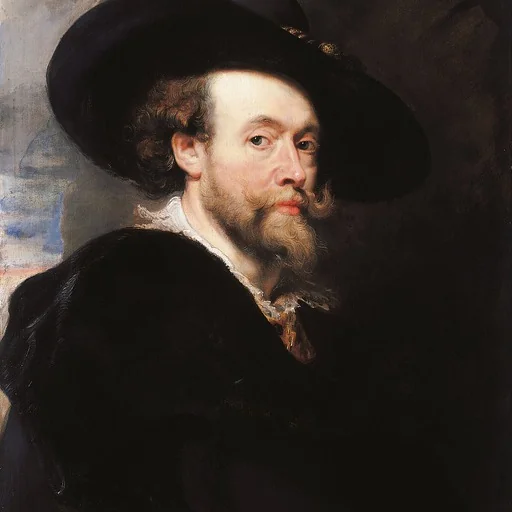
Sir Peter Paul Rubens ( ROO-bənz; Dutch:; 28 June 1577 – 30 May 1640) was a Flemish artist and diplomat.