Artwork
Raising of the Cross
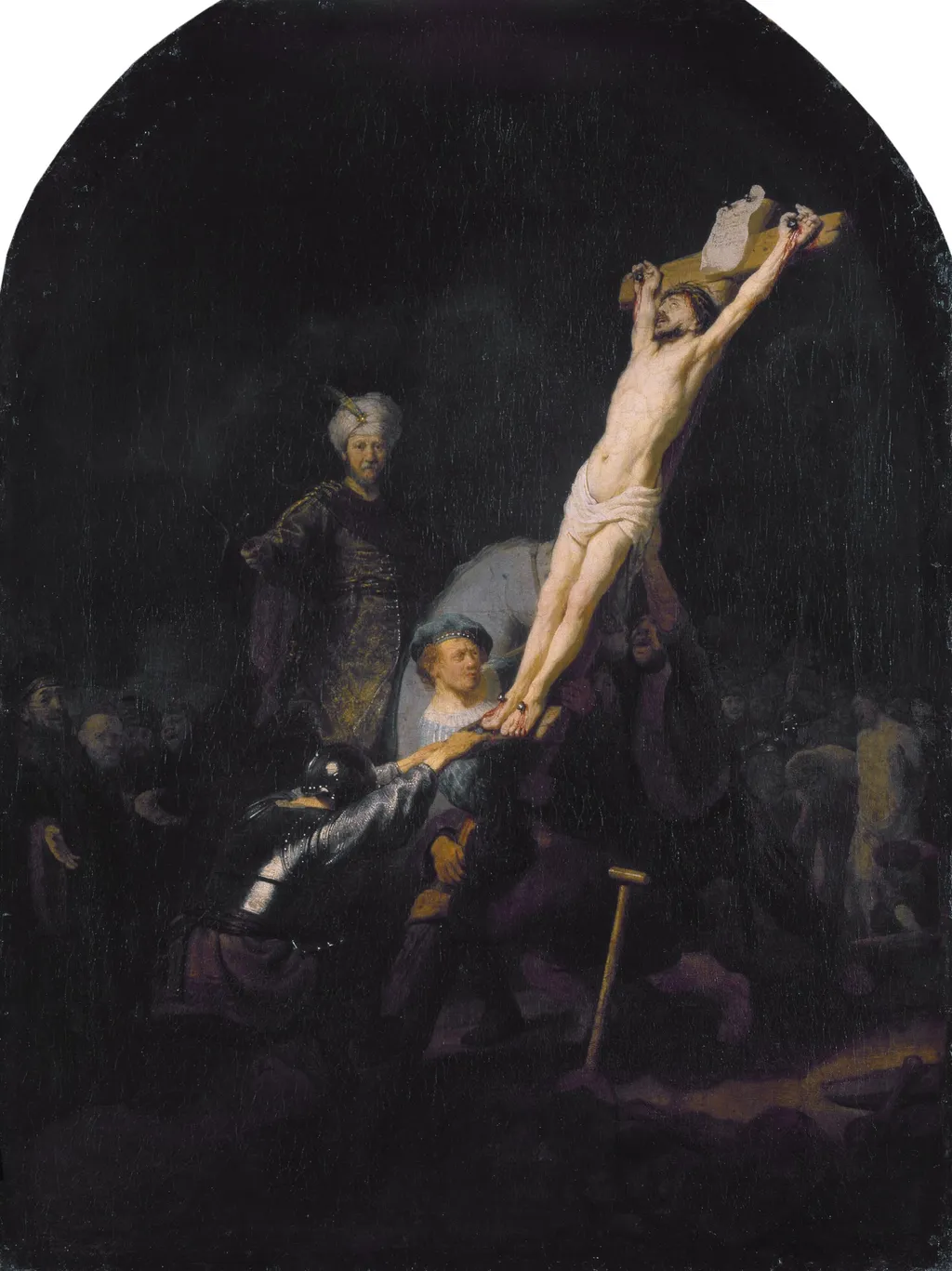
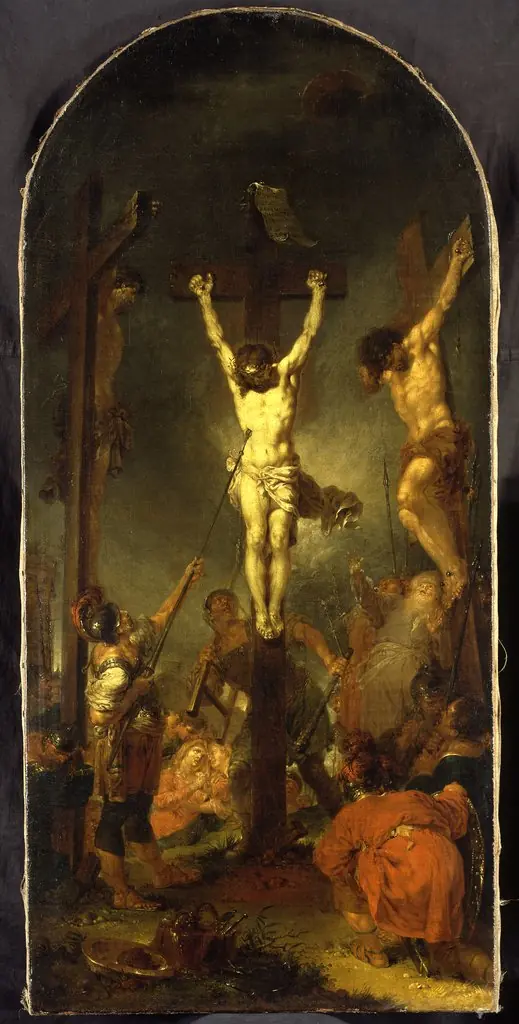
Raising of the Cross is an oil painting by the Dutch Golden Age artist Rembrandt van Rijn. It dates from 1633 and is held in the collection of the Alte Pinakothek. Created in 1633, this oil painting by Rembrandt depicts the moment a group of figures hoists the wooden cross bearing Christ.
About this work
Subject & Meaning
Painted in 1633 as part of a Passion series, this work depicts the biblical moment where executioners raise the cross bearing Jesus Christ.
Painted in 1633 as part of a Passion series, this work depicts the biblical moment where executioners raise the cross bearing Jesus Christ. The composition centers on the physical effort of four men lifting the structure, while a Roman centurion on horseback oversees the event in rich Eastern attire. In the background, soldiers bring forward the two thieves destined for crucifixion, and a group of Pharisees observes from the shadows.
The scene is defined by dramatic chiaroscuro, with full light falling exclusively on Christ's body and one specific executioner. Rembrandt inserted his own likeness into this illuminated figure, wearing a blue cap and coat. This self-portrait within the narrative is interpreted as a Protestant theological statement suggesting that all humanity, represented by the artist himself, shares responsibility for Christ's death.
Technique & Style
The painting is executed in oil on canvas, measuring 96.2 × 72.2 cm, with an original height closer to 98.2 cm before the arched top was wrapped around its present stretcher. Rembrandt employs a dramatic chiaroscuro typical of his early maturity: Christ's body is bathed in full light from the left, standing out against a deeply shadowed background of surcharged dark clouds, while the surrounding figures remain largely submerged in gloom. The composition is crowded with small full-length figures arranged around the central cross, which is being raised from the right by executioners and soldiers.
The artist inserts himself into the scene as the central executioner wearing a light blue coat and blue cap, an in assistenza self-portrait that integrates the painter into the narrative. The handling of paint creates a solemn, nocturnal atmosphere, with rich coloristic details such as the Roman centurion's gold brocade coat and deep purple cloak emerging from the darkness.
History & Provenance
Painted in 1633, Raising of the Cross was commissioned by Frederick Henry, Prince of Orange, as part of a four-panel "Passion" series. The work remained in the Prince's collection at Honselaarsdijk until his death in 1647, after which it passed to his widow, Amalia of Solms-Braunfels, appearing in her 1667 inventory at The Hague. Following her death, the painting likely entered the collection of her grandson, William III of Orange and England, where it remained until 1702.
It subsequently joined the holdings of Johann Wilhelm, Elector Palatine, in Düsseldorf, where it was recorded in 1716. The artwork was transferred to Munich in 1806 to join the Wittelsbach collection, eventually becoming part of the Bavarian State Painting Collections and entering the Alte Pinakothek in 1836.
Painted in 1633 for Frederick Henry, Prince of Orange, this work has remained in continuous provenance to the present day. Following the Prince's death, it passed to his widow, Amalia of Solms-Braunfels, and later to their grandson, William III of England, by 1702. The painting subsequently entered the collection of Johann Wilhelm, Elector Palatine, in Düsseldorf before transferring to Munich in 1806.
Since 1836, the canvas has been held by the Alte Pinakothek in Munich as part of the Bavarian State Painting Collections. Historical records list the work as number 327 in the museum's 1911 catalogue. An earlier inventory from 1667 recorded the piece as number 69 in Amalia's collection at the Oude Hof in The Hague.
Context
Critical reception of Raising of the Cross has long emphasized its dramatic intensity and technical innovation within Rembrandt's oeuvre. Early scholarship, such as Smith's 1836 description, highlighted the dynamic composition and chiaroscuro effects, noting the painting's 2 ft. 10 in. by 2 ft. 1 in. dimensions and arched format now housed in Munich's Alte Pinakothek. Contemporary analysis underscores its role in the Dutch Golden Age 'passion' series commissioned by Frederick Henry, Prince of Orange, and its remarkable uninterrupted provenance from 1633 to the present.
The work's significance is further contextualized by its rare continuous documentation from creation through successive owners including Amalia of Solms-Braunfels and William III, establishing it as a cornerstone for understanding Rembrandt's narrative strategies and engagement with religious themes.
Overview
Created in 1633, this oil painting by Rembrandt depicts the moment a group of figures hoists the wooden cross bearing Christ. The central figure is illuminated, his outstretched arms contrasting with a deep, shadowed backdrop, while surrounding characters in armor and robes either support the cross or observe the scene.
Own this work as a print
Artist & collection

Artist
Rembrandt Harmenszoon van Rijn, known mononymously as Rembrandt, was a Dutch Golden Age painter, printmaker, and draughtsman.