Artwork
Copy after Rubens's "Wolf and Fox Hunt"
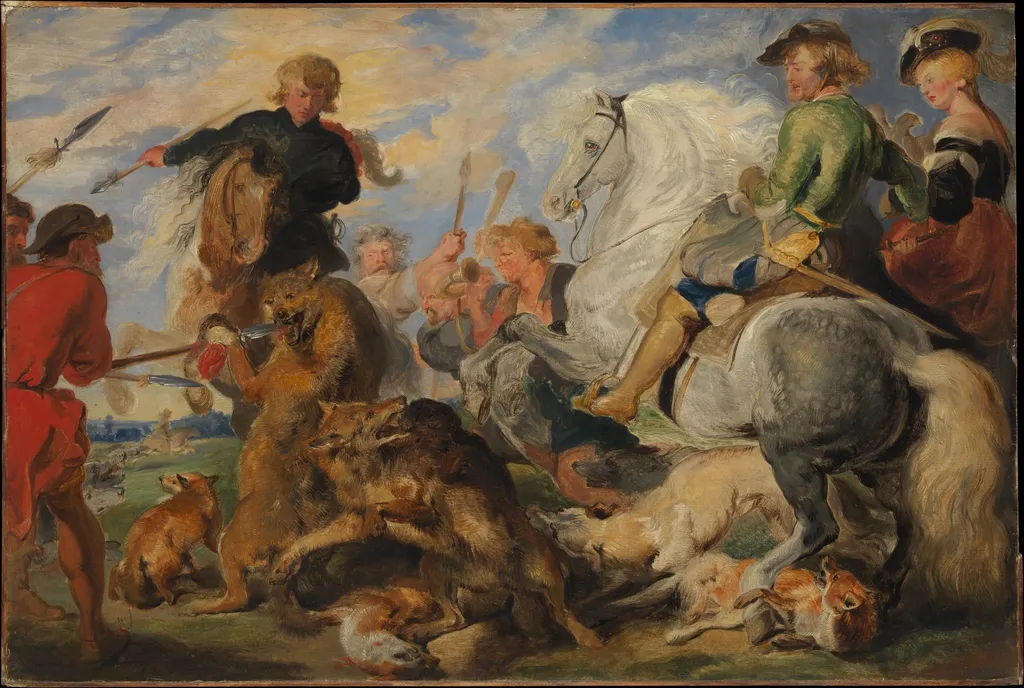
Copy after Rubens's "Wolf and Fox Hunt" is an oil painting by Edwin Landseer. It dates from 1824 and is held in the collection of the Metropolitan Museum of Art.
About this work
Subject & Meaning
Wolves and foxes, captured mid-flight or in desperate struggle, populate the scene, embodying the raw violence of the hunt.
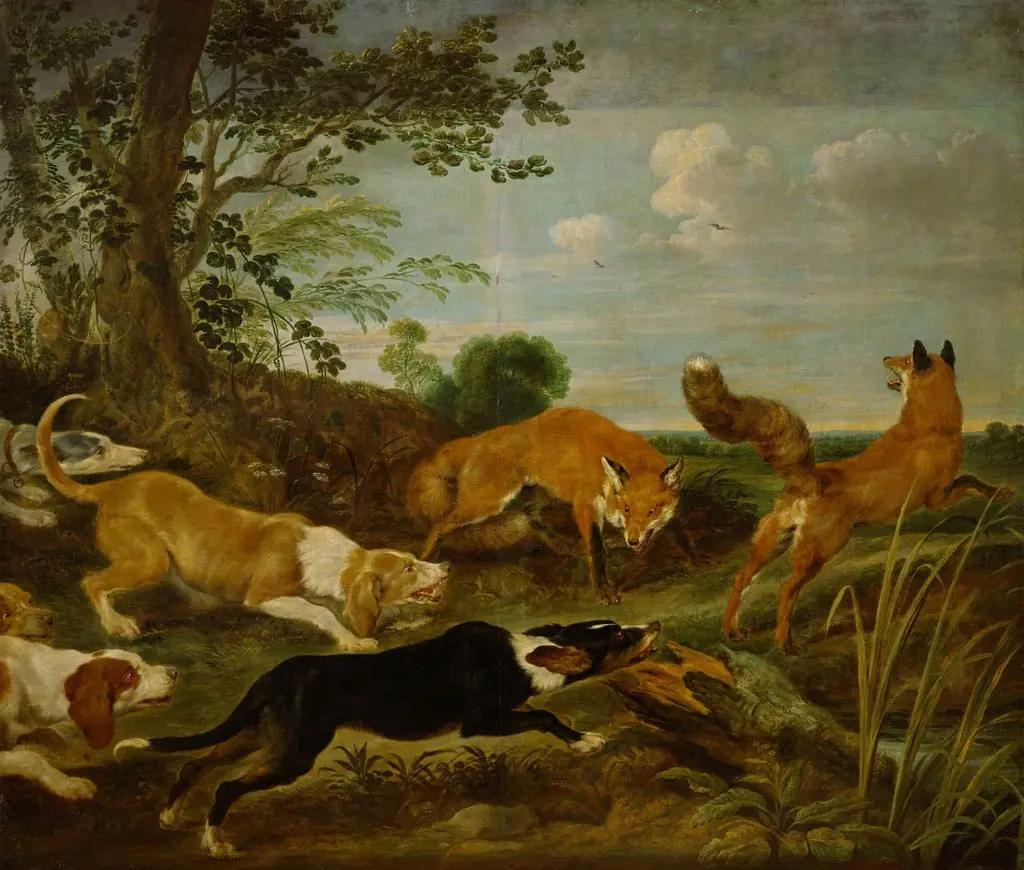
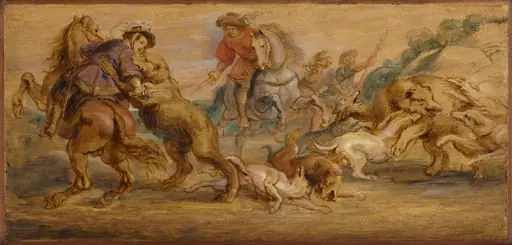
The subject depicted in Edwin Landseer’s 1824 painting Copy after Rubens’s "Wolf and Fox Hunt" directly reproduces the iconography of Peter Paul Rubens’s 1616 hunt scene, centering on a dramatic pursuit of wolves and foxes by mounted hunters and their dogs. The composition foregrounds a pack of hounds in varied postures, some lunging, others barking, while a rider on a rearing horse dominates the left side, wielding a spear. Wolves and foxes, captured mid-flight or in desperate struggle, populate the scene, embodying the raw violence of the hunt.
This subject, drawn from Rubens’s original, symbolizes the aristocratic sport of hunting as both a display of prowess and a confrontation with untamed nature, reinforcing themes of dominance and the sublime in early modern European art.
Technique & Style
Executed in oil paint on panel, the work measures 40.6 by 60.6 centimeters, a relatively modest horizontal format suited to its hunting subject. Landseer's handling translates Rubens's dynamic Baroque composition into the smoother, more linear idiom characteristic of early nineteenth-century British painting, with crisply delineated figures of hunters, horses, wolves, and foxes rendered in the tight, descriptive manner associated with his early career. The panel support, rather than canvas, lends a fine, smooth surface that encourages precise draftsmanship and polished finish over the broader, more gestural brushwork typical of Rubens's originals.
The compact scale and detailed execution reflect Landseer's practice in 1824 of working closely after Old Master models to study anatomy, movement, and dramatic narrative.
History & Provenance
The copy after Rubens’s Wolf and Fox Hunt by Edwin Landseer is dated to 1824, aligning with Landseer’s early career when he frequently engaged with Old Master compositions. The work entered the Metropolitan Museum of Art collection, where it has remained, documented by the museum’s records and wikidata as accessioned oil on panel measuring 40.6 × 60.6 cm. No record of a direct commission survives, suggesting Landseer likely produced the copy independently, possibly as a study or marketable replica of Rubens’s hunting scene. The painting’s provenance within the Met’s holdings indicates continuous institutional custody since acquisition, without intervening private owners.
The painting is held in the collection of the Metropolitan Museum of Art, New York, where it is inventoried as 1975.1.107. It was painted in 1824 and was later exhibited at the Royal Academy in 1824 as no. 110 under the title A Scene from Rubens’s “Wolf and Fox Hunt”.
Context
The 1824 oil painting by Edwin Landseer replicates Rubens’s Wolf and Fox Hunt, measuring 40.6 × 60.6 cm and housed in the Metropolitan Museum of Art. Executed in oil on panel, the work portrays a horse, a wolf, a fox and a hunter, reflecting the 19th‑century British fascination with sporting and animal subjects. As a replica of a Baroque masterpiece, it illustrates Landseer’s engagement with European artistic heritage while showcasing his specialization in animal anatomy and narrative.
Its inclusion in a major museum collection underscores the continued appreciation of such subjects in contemporary art discourse.
Legacy
Edwin Landseer's 1824 oil painting Copy after Rubens's Wolf and Fox Hunt entered the Metropolitan Museum of Art's collection, a placement that signals its acknowledged importance within the artist's body of work. As a precise after‑image of Rubens's composition, the piece exemplifies Landseer's mastery of animal subject matter and his ability to adapt Baroque dynamism to a Romantic sensibility. Its presence in a leading museum has contributed to sustained scholarly attention on Landseer's role in 19th‑century sporting and wildlife painting, influencing later artists who pursued similar themes of hunting and equine drama.
Overview
Edwin Landseer's 1824 oil painting, a copy after Peter Paul Rubens's 'Wolf and Fox Hunt,' captures a dynamic and chaotic hunting scene. The composition centers on a frenzied pursuit where riders on horseback, armed with sticks and spears, chase wolves and foxes through a rugged landscape. A rearing horse dominates the foreground, its rider gripping the reins tightly, while another figure in a green coat leans forward to engage the prey.
Below, dogs bark and snap at the fleeing animals, adding to the sense of immediate action. Landseer, then only twenty-two, executed this work early in his career, demonstrating his precocious mastery of animal anatomy and movement. By emulating Rubens's Baroque energy, the young English painter engaged with the Old Master tradition while establishing his own reputation for depicting animals with vitality and realism.
The cloudy background enhances the dramatic atmosphere, focusing attention on the violent interplay between the hunters and their quarry. This piece reflects Landseer's lifelong fascination with animal subjects and his ability to translate the vigor of Rubens's style into a distinctly 19th-century context.
Own this work as a print
Artist & collection

Artist
Sir Edwin Henry Landseer was an English painter and sculptor, well known for his paintings of animals – particularly horses, dogs, and stags. His best-known work is the lion sculptures at the base of Nelson's Column in Trafalgar Square.