Artwork
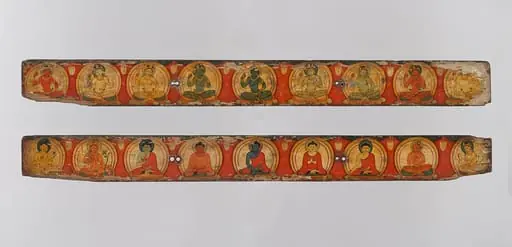
Four bodhisattvas and two attendants flanking Vajrasattva, bottom cover, from a Manuscript of the Perfection of Wisdom in Eight Thousand Lines (Ashtasahasrika Prajnaparamita-sutra)

Four bodhisattvas and two attendants flanking Vajrasattva, bottom cover, from a Manuscript of the Perfection of Wisdom in Eight Thousand Lines (Ashtasahasrika Prajnaparamita-sutra) is an unspecified painting by Unknown. It dates from 14 and is held in the collection of the Cleveland Museum of Art.
- Accession no.
- 1938.301.189.a
- Credit line
- Purchase from the J. H. Wade Fund
About this work
Overview
This painted wooden panel once served as the bottom cover of a manuscript containing the Ashtasahasrika Prajnaparamita-sutra, a key Mahayana Buddhist text.
This painted wooden panel once served as the bottom cover of a manuscript containing the Ashtasahasrika Prajnaparamita-sutra, a key Mahayana Buddhist text. It depicts six figures arranged in a single row, all seated on lotus thrones. The composition is symmetrical, with Vajrasattva at the center, flanked by four bodhisattvas and two attendants.
The original vibrant pigments, gold, red, and blue, have faded over time, yet their presence remains evident in the surviving layers of paint and gilding.
Subject & Meaning
The central figure is Vajrasattva, a tantric deity symbolizing purity and the essence of enlightenment. Surrounding him are bodhisattvas, enlightened beings who delay nirvana to aid others, and attendants who likely represent guardians or ritual assistants. Each holds symbolic attributes, a vase, wheel, or lotus, signifying spiritual qualities such as wisdom, dharma, and compassion. The arrangement reflects a devotional hierarchy, reinforcing the text’s themes of wisdom and protective power.
Technique & Style
The figures are rendered in a stylized, frontal manner typical of early Nepalese and Tibetan manuscript art. Gold leaf outlines define forms, while rich red backgrounds contrast with blue and white accents in garments and halos. Facial features are simplified, with almond-shaped eyes and serene expressions.
The flat perspective and lack of spatial depth emphasize spiritual presence over naturalism. Pigments were applied with fine brushes, likely using mineral-based paints bound with animal glue.
History & Provenance
The panel originates from a 12th-century manuscript produced in the Kathmandu Valley, a center of Buddhist manuscript production. Such covers protected the sacred text during handling and storage. The work was likely commissioned by a monastic community or wealthy patron for ritual use.
It entered the Cleveland Museum of Art’s collection through documented acquisitions in the 20th century, preserving its connection to a specific religious and artistic tradition.
Context
This artwork belongs to a broader tradition of illustrated Buddhist manuscripts from medieval Nepal and Tibet, where texts were not only read but also venerated as sacred objects. The inclusion of protective figures on covers was common, intended to shield the scripture from harm and invoke spiritual presence during recitation. Such manuscripts were often stored in monastic libraries and used in liturgical settings, blending textual study with visual devotion.
Legacy
Though the manuscript’s text is now separated, the cover remains a rare surviving example of early Himalayan manuscript illumination. It provides insight into the visual language of Buddhist devotion in the 12th century and the integration of iconography with textual practice. Contemporary scholars study such panels to trace stylistic influences across South and Central Asia, preserving the material culture of a once-widespread religious tradition.

Artist & collection









 Untitled
 Perfection of Wisdom in Eight Thousand Lines: Ashtasahasrika Prajnaparamita: Back Cover
 Ratnasambhava, Akshobhya, Vairochana with attendants, Amitabha, and Amoghasiddhi, Top cover, from a Manuscript of the Perfection of Wisdom in Eight Thousand Lines (Ashtasahasrika Prajnaparamita-sutra)
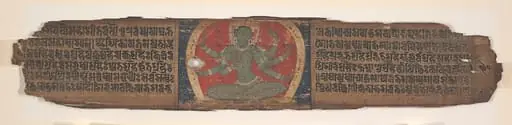
 Bodhisattva Manjushri with two forms of Avalokiteshvara, folio 348 (recto) from a Gandavyuha-sutra (Scripture of the Supreme Array)
 Bodhisattva Manjushri with two forms of Avalokiteshvara, folio 348 (recto) from a Gandavyuha-sutra (Scripture of the Supreme Array)
 Folio 348 from a Gandavyuha-sutra (Scripture of the Supreme Array): Bodhisattva Manjushri with two forms of Avalokiteshvara (recto); Bodhisattva Samantabhadra purifies the path to enlightenment, with Manjushri (verso)
 Folio 73 from a Gandavyuha-sutra (Scripture of the Supreme Array): Sudhana and an antelope (recto); text (verso)
 Untitled
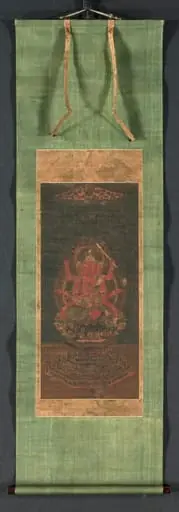 Wisdom King of Passion (Aizen Myōō)