Artwork
The Count of Habsburg
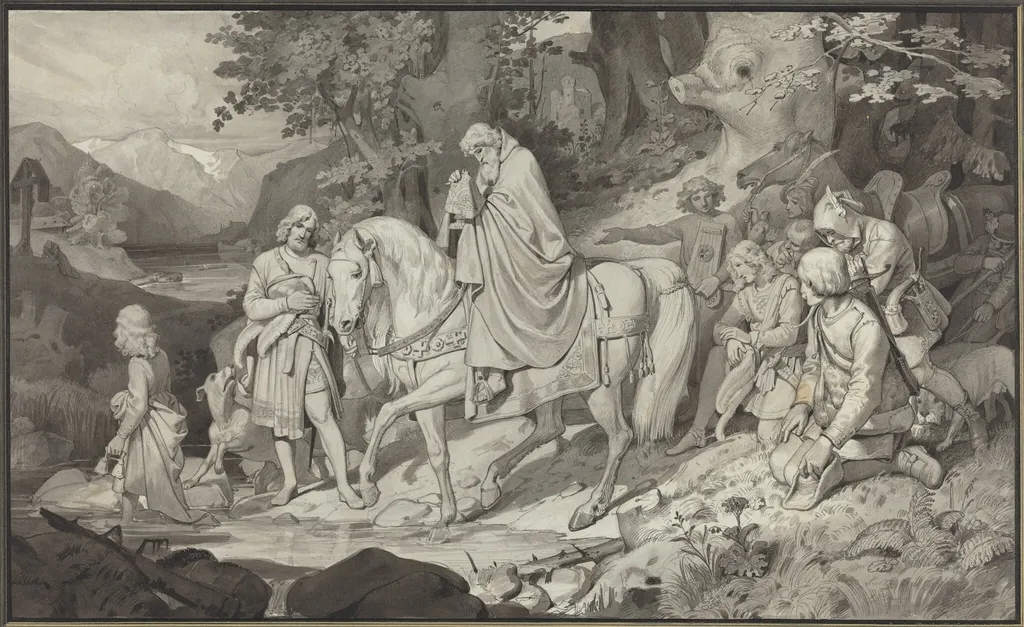
The Count of Habsburg is a graphite drawing by the Romanticist artist Philipp von Foltz. It dates from 1837 and is held in the collection of the National Gallery of Art.
- Inscription
- Inscribed:by the artist, lower right in ink: Foltz / 1837; by later hand, lower left verso of mount in graphite: Rodolfo d'Absburg Fil Foltz; by later hand, lower right verso of mount in graphite: FILIPP VON FOLTZ / BINGEN 1805 - MUNICH 1877
About this work
Overview
Executed in brown-gray ink and gray wash over graphite on chronicle wove paper, mounted on an old support, the work measures 27.
The Count of Habsburg is a drawing of 1837 by the German history painter Philipp von Foltz (1805-1877). Executed in brown-gray ink and gray wash over graphite on chronicle wove paper, mounted on an old support, the work measures 27.5 by 45 cm. It is held in the collection of the National Gallery of Art in Washington, D.C., under accession number 2001.107.2. The drawing exemplifies Foltz's practice as a history painter during a pivotal period in his career, shortly before his appointment as professor at the Munich Academy, and demonstrates the precise linear technique and historical subject matter that characterized his output. As a monochrome work in ink and wash, it also reveals the draftsmanship skills that underpinned his larger painted compositions.
Subject & Meaning
The drawing depicts the legendary Count of Habsburg, the progenitor of the Habsburg dynasty, in a narrative scene rather than a conventional portrait. The central figure appears mounted on a white horse, crossing a shallow stream, wearing a heavy cloak and holding an object in his right hand. A standing man grasps the horse's bridle to his left, while a small child stands at the water's edge nearby. To the right, several attendant figures gather: one kneels to wash or fill a vessel, another points outward, and others stand or sit among rocks and vegetation. The background includes dense forest, distant mountains, a body of water, and architectural ruins. This iconography suggests a moment of transit or pilgrimage, possibly alluding to the legendary founding narrative of the Habsburg family, which emphasized humble origins and divine favor. The inclusion of the child and the act of water-giving may reference the famous story of the Habsburg ancestor who was helped across a river, a tale that served to legitimize dynastic power through folkloric origins. The pointing figure and the gathered group create a sense of witness and narrative progression, while the ruins in the background evoke the passage of time and the ancient roots of the dynasty.
Technique & Style
The work is executed entirely in monochrome, using brown-gray ink and gray wash over graphite on wove paper, mounted on an old support. The technique relies on precise linear drawing combined with wash shading to create tonal depth and volume throughout the composition. Light falls from the upper left, illuminating the central horse and figures while casting shadows beneath them, demonstrating Foltz's careful attention to naturalistic lighting effects. The palette is restricted to black, white, and gray tones, with no color present. Fine detail appears throughout the costumes, horse trappings, foliage, and rocky terrain, revealing the artist's meticulous hand. The composition spreads horizontally across the scene, a format suited to narrative history painting that allows for the inclusion of multiple figures and landscape elements. The handling of the wash creates atmospheric depth in the background mountains and forest, while the foreground figures are rendered with sharper definition. This combination of precise draftsmanship and tonal wash technique reflects the academic training Foltz received under Peter von Cornelius and aligns with the conventions of German history painting in the early nineteenth century.
History & Provenance
The drawing is signed and dated by the artist in the lower right in ink: "Foltz / 1837." Two later inscriptions appear on the verso of the mount: one in graphite at lower left reading "Rodolfo d'Absburg Fil Foltz," and another at lower right stating "FILIPP VON FOLTZ / BINGEN 1805 - MUNICH 1877." The work was sold at Galerie Gerda Bassenge on November 25, 2000, as lot 5738, and subsequently passed through the Hamburg dealers Moeller and Rotermund. The National Gallery of Art purchased the drawing in 2001, and it entered the collection under accession number 2001.107.2. The date of 1837 places the work shortly after Foltz's return from his study advertise study trip to Rome in 1835, and before his appointment as professor at the Munich Academy by King Maximilian II of Bavaria. No extensive exhibition history is recorded in the available sources.
Context
Philipp von Foltz was born in Bingen am Rhein in 1805, the son of the painter Ludwig Foltz, who provided his earliest instruction. In 1825 he entered the Academy of Fine Arts in Munich, where he studied with Peter von Cornelius, the leading German history painter of the generation. He assisted Cornelius with frescoes at the Glyptothek and the Hofgarten, and later worked with Wilhelm Lindenschmit the Elder at the new Royal Palace on murals based on Friedrich Schiller's ballads. The Count of Habsburg belongs to the period when Foltz was establishing himself through historical subjects, following his study trip to Rome in 1835 and the creation there of his monumental painting Des Sängers Fluch after Ludwig Uhland's poem. His paintings are characterized by historical precision, though they are now considered conservative and academic in approach. The choice of Habsburg subject matter reflects the widespread interest in dynastic and national history among German artists during the period, as well as the patronage culture that celebrated legitimizing narratives of noble families. Critical reception of Foltz's work has emphasized its technical accomplishment while noting its conventional character; his later career as Director of the Royal Gallery from 1865 to 1875 was marked by controversy over restoration methods using chemical processes developed by Max von Pettenkofer and the overpainting of canvases, though he was elevated to the nobility in 1869.
Legacy
The Count of Habsburg remains a significant example of Foltz's draftsmanship and his engagement with historical narrative subjects. As a work now in the National Gallery of Art, it contributes to the representation of nineteenth-century German drawing in a major American collection. Foltz's broader reputation rests on his history paintings and mural commissions, particularly those for the Maximilianeum, rather than on drawings per se, making this sheet a valuable document of his working method. The work's acquisition by the National Gallery in 2001 reflects continued institutional interest in German academic art of the nineteenth century. Foltz died in Munich in 1877, and while his paintings are now considered rather conservative, they retain importance for understanding the visual culture of Bavarian court patronage and the academic tradition of history painting in Germany. The drawing serves as a testament to the enduring appeal of Habsburg legend in European art and to the technical skills that underpinned the larger decorative programs of the era.
Own this work as a print
Artist & collection


- The Flight with the Holy Family at the Right
 The Knight and Death
 Preaching of John the Baptist in the Wilderness
 Flight into Egypt: The Holy Family Leaving the Shore
 An Angel Foretells the Birth of Abraham's Son
 Flight into Egypt: The Holy Family and the Flock of Sheep
 The Episode of the Falling Idol
 Beheading of a Martyr
 Die Karawane
 Hunting to Hounds
 Ruth and Boas
 Italienische Landschaft mit Vieh