Artwork
The judgement of Paris
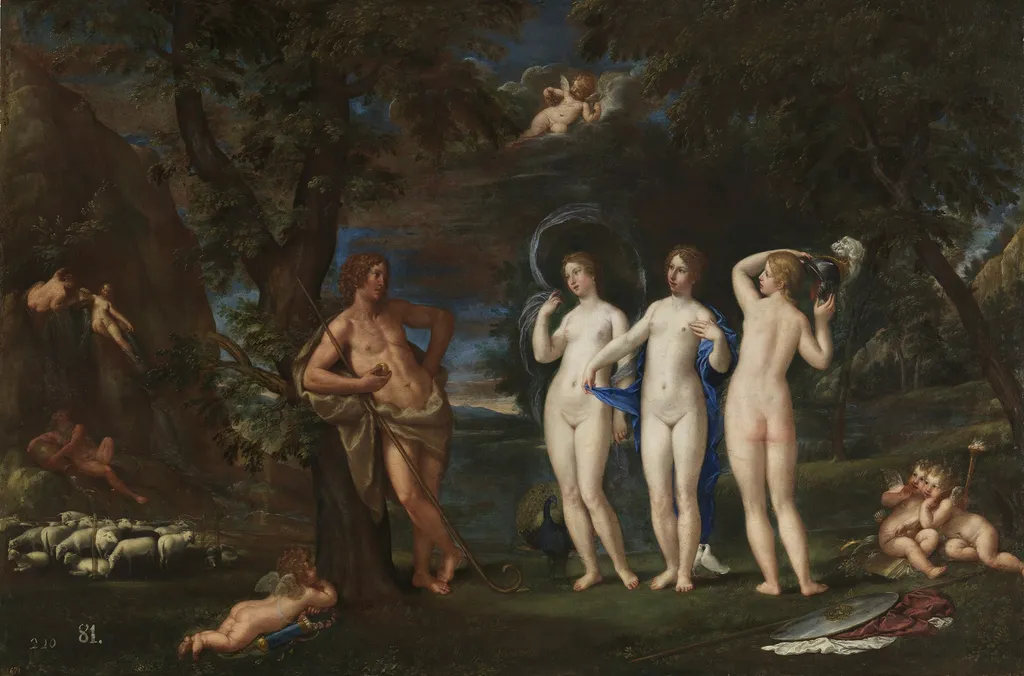
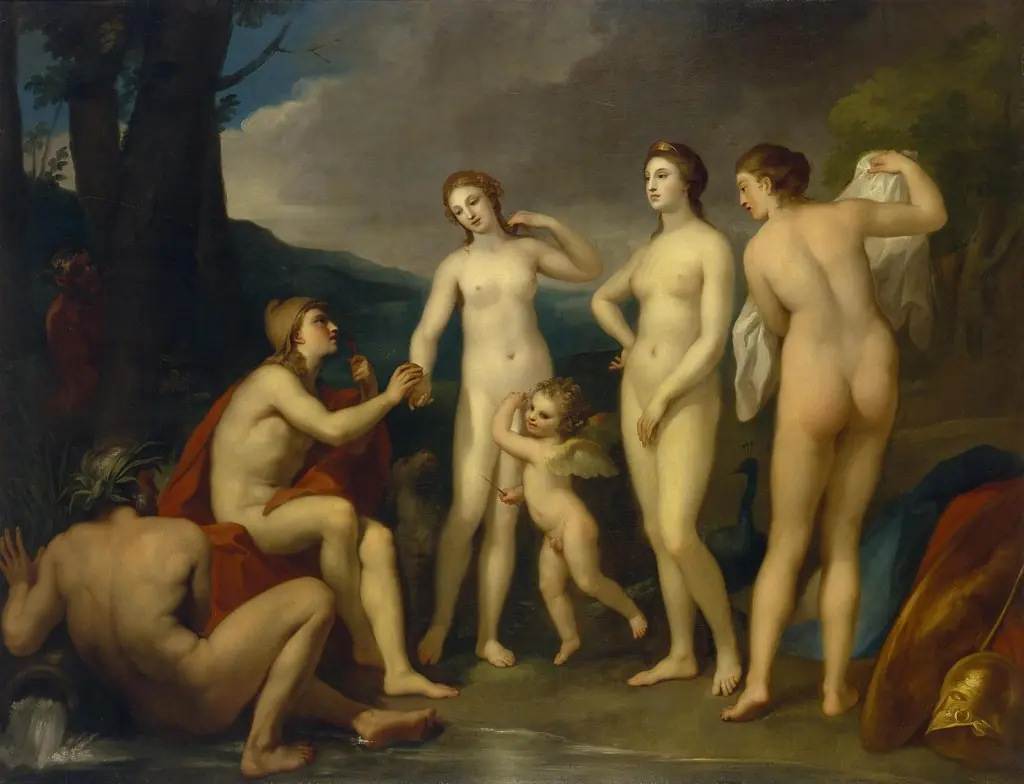
The judgement of Paris is an oil painting by the Early Baroque Italian artist Francesco Albani. It dates from 1650 and is held in the collection of the Museo del Prado.
About this work
Subject & Meaning
The work illustrates the myth of the Judgement of Paris, the Trojan prince shown with attributes that signal his martial and regal status, namely a spear, combat helmet, shield, money, book and crown, while the central figure bears a crown, emphasizing his role as arbiter of beauty. These iconographic elements locate the scene within the mythological tradition in which Paris evaluates the three goddesses, a theme that conveys ideas of choice, vanity and fate. The painting is classified as a mythological work and is housed in the Museo del Prado, reflecting its status as a canonical example of 17th‑century mythological painting.
Technique & Style
The composition balances three principal figures, Pallas, Juno, and Venus, around a compact landscape backdrop that recedes through atmospheric recession.
The work is executed in oil paint on canvas, a standard medium for mid-seventeenth-century Italian cabinet pictures. The handling favors smooth, blended modeling of flesh and drapery, aligning with Albani’s late classicizing manner. The composition balances three principal figures, Pallas, Juno, and Venus, around a compact landscape backdrop that recedes through atmospheric recession.
Color is restrained, with silvery greys and muted blues dominating the upper zone and warmer earth tones anchoring the foreground. The surface shows no overt abrasions in standard imaging reports, suggesting stable condition without major losses or pentimenti.
History & Provenance
Francesco Albani executed The Judgement of Paris in 1650. Created as an oil painting on canvas, the work measures 113 cm in height and 171 cm in width. The composition depicts the mythological scene involving Paris, along with symbolic elements such as a spear, combat helmet, shield, money, book, and crown.
The painting is currently held in the collection of the Museo del Prado, where it remains on display.
The painting is held in the Museo del Prado, Madrid, where it is inventoried as oil on canvas, measuring 113 × 171 cm.
It has been exhibited by the museum as part of its permanent display of Italian Baroque paintings. In 2002 it appeared in the Prado’s reinstallation of its Italian galleries, and it remained on view in the same suite of rooms during the reinstallation completed in 2021.
Overview
Francesco Albani's oil painting, The Judgement of Paris, dates to approximately 1650. This mythological work depicts the pivotal moment from Greek legend when Paris must choose the most beautiful goddess. The painting is currently housed in the collection of the Museo del Prado, where it represents a characteristic example of Albani's classical style.

Own this work as a print
Artist & collection

Artist
Francesco Albani or Albano was an Italian Baroque painter of Albanian descent who was active in Bologna, Rome, Viterbo (1609–1610), Mantua (1621–1622) and Florence (1633).