Artwork
Madrid fair
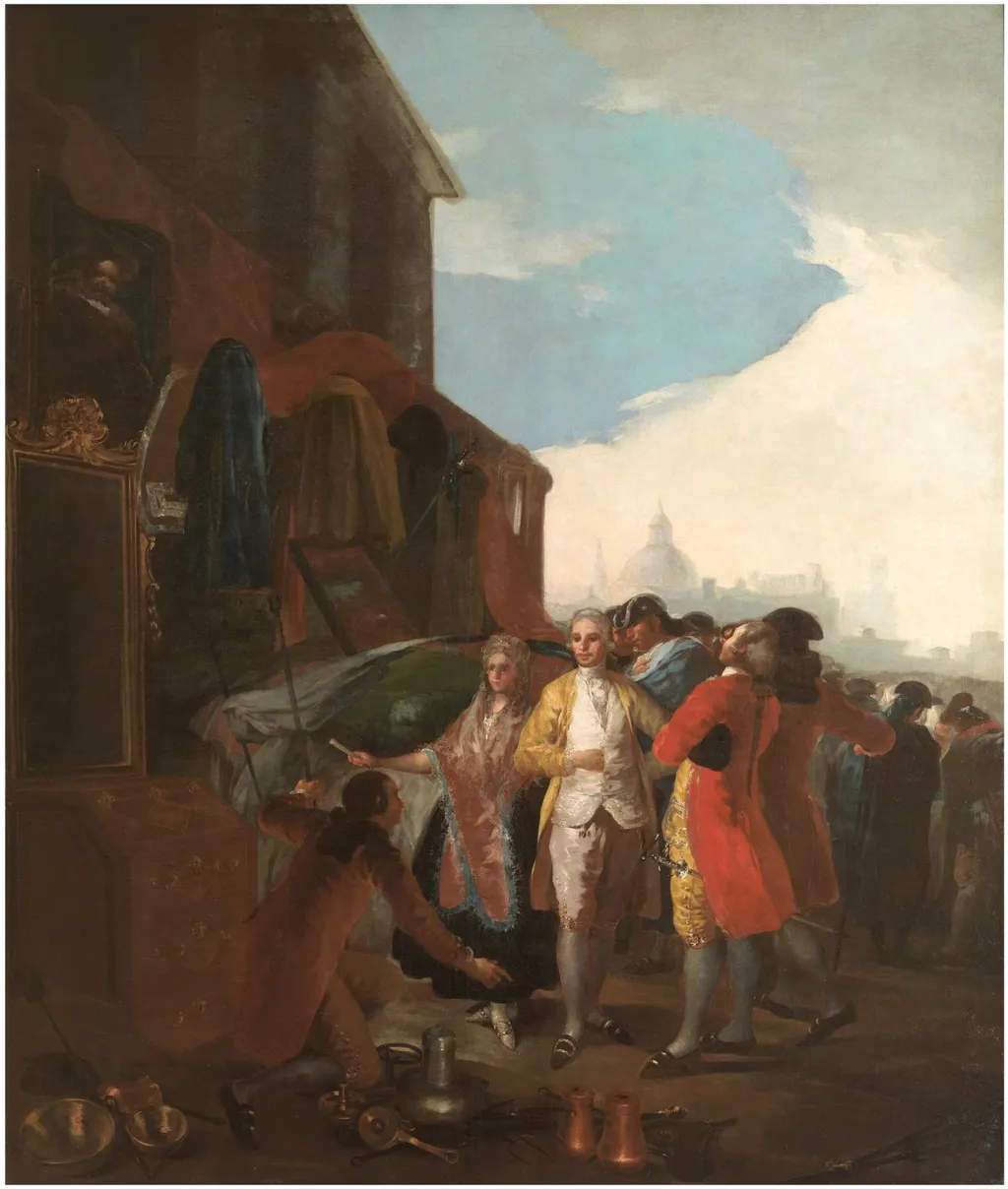
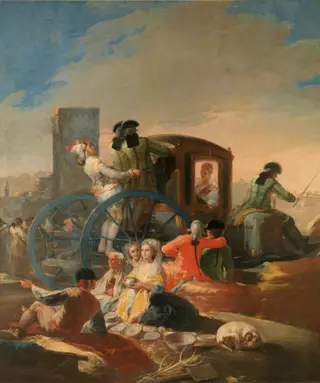
Madrid fair is an oil painting by the Rococo painting artist Francisco de Goya. It dates from 1790 and is held in the collection of the Museo del Prado.
About this work
Subject & Meaning
A woman gestures with her fan toward an item while a man with monocles inspects objects, capturing refined madrilenian social customs.
The painting depicts a bustling flea market scene in Madrid, likely set in the plaza de la Cebada with the Royal Basilica of Saint Francis the Great visible in the background. At center, well-dressed figures examine wares, pottery, furniture, and other goods, offered by a merchant whose stock has passed out of fashion, discarded by households redecorating in the Gallic style. A woman gestures with her fan toward an item while a man with monocles inspects objects, capturing refined madrilenian social customs.
The composition incorporates a still life of chocolate wares in the foreground, demonstrating Goya's mastery of genre and perspective. Among the market goods appears a portrait reminiscent of Diego Velázquez's style. The two majos receive dramatic illumination through rapid brushwork, with metallic reflections rendered in silvery gray tones.
As a tapestry cartoon, the work served royal decorative purposes, feeding the late-eighteenth-century aristocratic appetite for castizo (Spanish popular) subjects.
Technique & Style
The work is an oil paint on canvas painting created between 1778 and 1779. It measures 258 cm in height and 218 cm in width. The composition depicts a bustling market scene in Madrid, showing various individuals examining pottery, furniture, and other merchandise from a vendor, while other stalls display items such as paintings.
In the background, the Royal Basilica of Saint Francis the Great is visible. Goya incorporates castilian themes and demonstrates mastery of perspective and genre, including a still life of a chocolate cup in the foreground. The painting features quick brushstrokes highlighting the metallic reflections of two majos in a silver-gray tone.
The work was produced as a cartoon for tapestry intended for the bedroom of the Princes of Asturias at the Palace of El Pardo and is currently housed in the Museo del Prado.
History & Provenance
Madrid fair was produced by Francisco de Goya between 1778 and 1779 as part of the third series of tapestry cartoons intended for the antechamber of the Prince of Asturias at the Royal Palace of El Pardo. The painting was delivered to the Royal Tapestry Factory on 5 January 1779.
The work was subsequently considered lost until 1869, when Gregorio Cruzada Villaamil located the canvas in the basement of the Royal Palace of Madrid. It was transferred to the Museo del Prado in 1870 by royal orders dated 19 January and 9 February of that year, and first appeared in the museum's catalogue in 1876. It has since remained in the Prado's collection, where it is displayed in room 92.
The painting has been held by the Museo del Prado since 1870, when it was transferred there by royal ordinances dated 19 January and 9 February of that year. It had been rediscovered in 1869 in the basement of the Royal Palace of Madrid by Gregorio Cruzada Villaamil, and was first listed in the museum's catalogue in 1876. It is currently displayed in Room 92 of the Prado.
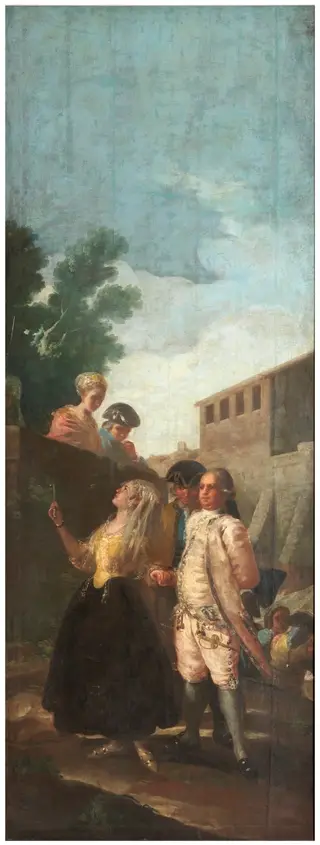
Originally delivered to the Royal Tapestry Factory on 5 January 1779, the work was part of the third series of tapestry cartoons made for the antechamber of the Prince of Asturias at the Royal Palace of El Pardo. The series also included El Cacharrero, El Militar y la señora, La Acerolera, Muchachos jugando a soldados, Niños del carretón, and El Juego de pelota a pala.
Context
Painted in 1778–1779, Madrid Fair belongs to the third series of tapestry cartoons Goya produced for the antechamber of the Prince and Princess of Asturias at the Palacio del Pardo. The work exemplifies Goya's engagement with costumbrismo and Castilian themes that appealed to late-eighteenth-century Spanish aristocracy.
The painting was presumed lost until its rediscovery in 1869 by Gregorio Cruzada Villaamil in the basement of the Royal Palace of Madrid; it entered the Museo del Prado in 1870 and was first catalogued in 1876. Scholarly attention has focused on Goya's technical mastery of perspective and genre, particularly his rapid brushwork and silver-grey tonalities in depicting the two majos. The inclusion of a still life within the chocolate tray demonstrates his compositional sophistication.
The setting, likely Madrid's flea market near the Plaza de la Cebada, with the Royal Basilica of Saint Francis the Great in the background, anchors the scene in identifiable urban space, while a portrait visible among the goods evokes Diego Velázquez, signalling Goya's dialogue with Spanish pictorial tradition.
Overview
Madrid Fair, created by Francisco Goya in 1790, is an oil painting capturing a vibrant scene of everyday life at the Royal Basilica of Saint Francis the Great in Madrid. The work is housed in the Museo del Prado.
Legacy
As a work by Goya, Madrid Fair contributes to his legacy as a pivotal figure in the transition from Old Masters to modern art, influencing subsequent artists with its innovative use of light, color, and depiction of everyday life.
Own this work as a print
Artist & collection
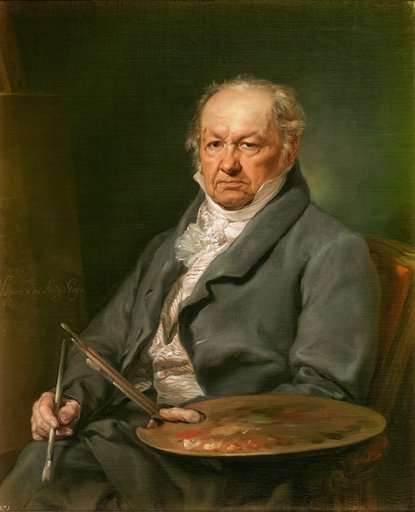
Artist
Francisco José de Goya y Lucientes was a Spanish romantic painter and printmaker.