Artwork
The Crockery Vendor
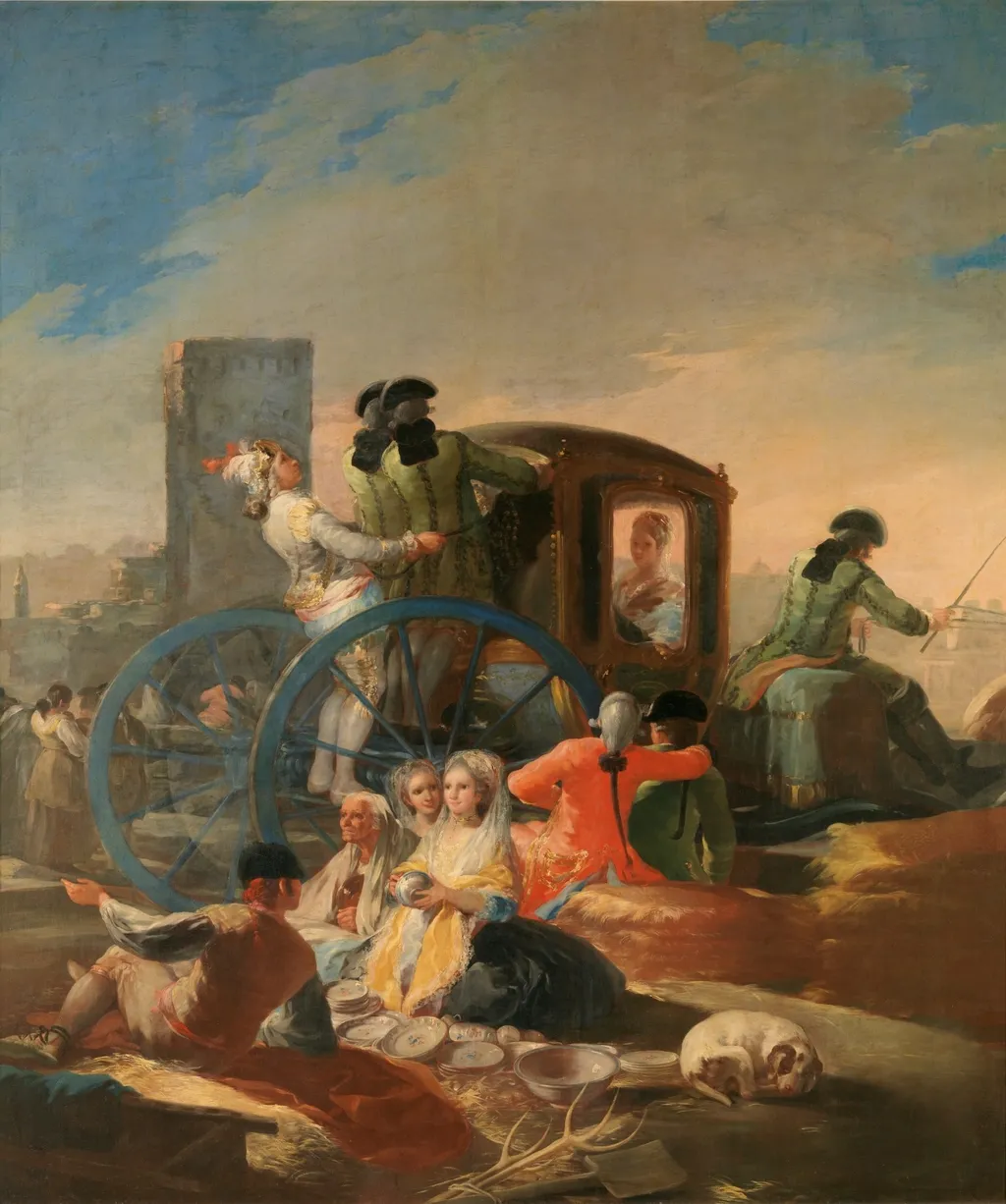
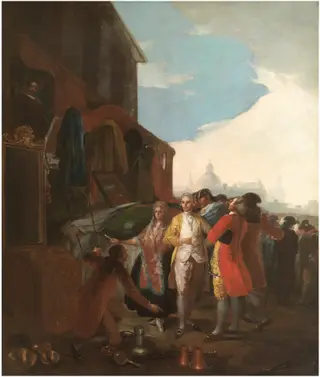
The Crockery Vendor is an oil painting by the Rococo painting artist Francisco de Goya. It dates from 1790 and is held in the collection of the Museo del Prado.
About this work
Subject & Meaning
The scene depicts a Valencian crockery vendor offering pottery at a street stall, surrounded by two women and an elderly figure who examine the wares.
The scene depicts a Valencian crockery vendor offering pottery at a street stall, surrounded by two women and an elderly figure who examine the wares. The arrangement isolates the vendor in half-light while the women are brightly lit, aligning the composition with Goya’s admiration for Velázquez’s Christ in the House of Martha and Mary and Old Woman Frying Eggs, echoed in the elderly woman’s pose and the still-life character of the ceramics.
Goya’s use of loose brushwork and light applied with a palette knife, along with the impressionistic soft focus of the noblewoman seen through the carriage window, conveys a costumbrista snapshot of Madrid’s social strata. The juxtaposition of the humble vendor with the aristocratic carriage underscores the disparities of urban life under Charles IV’s reign.
Technique & Style
Executed in oil on canvas, this tapestry cartoon measures 259 by 220 centimeters. The work demonstrates an evolution in Goya's technique, characterized by loose brushwork and the application of bright highlights using a palette knife. The composition employs a costumbrista scene bathed in sunset light, creating a harmony of coppery golds, grays, and blue sky tones.
Tactile qualities of faience, porcelain, metal, and fabric are rendered with exquisite skill in the foreground still life. A notable formal feature is the impressionistic blur used to depict a lady inside a carriage, alongside a visible pentimento where the artist corrected the position of the carriage's rear left wheel. The lighting scheme illuminates three female figures while leaving the vendor in semi-darkness, emphasizing social contrasts.
History & Provenance
Created as a tapestry cartoon for the Royal Tapestry Factory of Santa Bárbara, this work was delivered on January 6, 1779. It belonged to the third series intended for the bedroom of the Prince of Asturias, the future Charles IV, and his wife Marie Louise of Parma at the Palace of El Pardo. The painting was valued at six thousand reales upon completion.
Considered lost for nearly a century, the canvas was rediscovered in 1869 by Gregorio Cruzada Villaamil in the basement of the Royal Palace of Madrid. Following royal ordinances issued in January and February 1870, it was transferred to the Museo del Prado, where it first appeared in the museum's catalogue in 1876. Two tapestries based on this design were subsequently woven for the Palace of El Pardo and the Monastery of El Escorial.
The painting is held in the collection of the Museo del Prado in Madrid, where it is displayed in room 92. Although delivered to the Royal Tapestry Factory in January 1779, the work was considered lost until its discovery in the basement of the Royal Palace of Madrid in 1869 by Gregorio Cruzada Villaamil. It was officially transferred to the museum in 1870 following royal ordinances issued in January and February of that year. The piece first appeared in the museum's printed catalogue in 1876.
The work has been included in several exhibitions, notably appearing in the 2002 show Goya: Images of Women at the National Gallery of Art in Washington. It was also featured in the 2005 exhibition Goya: Prophet of Modernity, which was presented at the Alte Nationalgalerie in Berlin and the Kunsthistorisches Museum in Vienna.
Context
Created as a tapestry cartoon for the Royal Tapestry Factory, this work was intended to decorate the dining room of the Prince of Asturias, the future Charles IV. Alongside The Parasol, it is considered a masterpiece of Goya's early Madrid period. The painting demonstrates the artist's admiration for Diego Velázquez, specifically echoing compositions like Christ in the House of Martha and Mary through its depiction of an elderly woman holding a frying pan.
Scholars identify emerging constants in Goya's style within this piece, particularly the juxtaposition of high and low social classes within a single costumbrista scene. The work exhibits technical evolution through loose brushwork and the use of a palette knife to apply bright highlights. Art historians have also noted the impressionistic handling of the figure inside the carriage and the dynamic capture of the vehicle's movement, marking a significant development in the artist's approach to light and motion.
Legacy
The Crockery Vendor is esteemed as a masterpiece of Goya's initial period in Madrid, often cited alongside The Parasol as the pinnacle of his early tapestry cartoon work. The painting's legacy is deeply tied to the rediscovery of the canvas, which was considered lost until 1869 when Gregorio Cruzada Villaamil found it in the basement of the Royal Palace of Madrid. Following its recovery, the work was formally transferred to the Museo del Prado in 1870 and first appeared in the museum's official catalogue in 1876.
The original tapestry design inspired two physical tapestries, one created for the Palace of El Pardo and another for El Escorial. Art historical analysis highlights the work's enduring significance for its early demonstration of Goya's mature style, particularly his loose brushwork, use of the palette knife for light effects, and the innovative depiction of social contrast between high-status figures in a carriage and humble street vendors.
Overview
Francisco Goya painted The Crockery Vendor in 1790, employing oil on canvas. The work belongs to the Rococo period and is currently part of the Museo del Prado’s collection. It presents an animated street scene populated by figures in period dress, a carriage, and an assortment of pottery and tableware, all set against a clear sky and a stone edifice in the distance.
Own this work as a print
Artist & collection
Artist
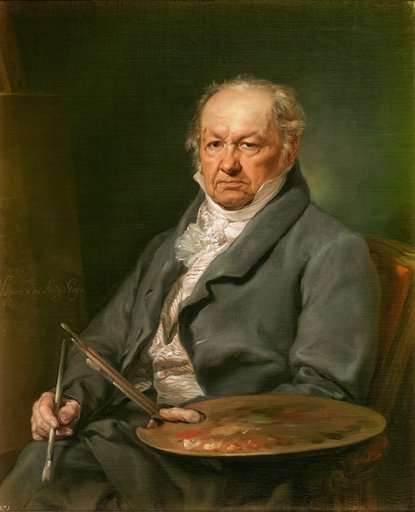
Francisco José de Goya y Lucientes was a Spanish romantic painter and printmaker.