Artwork
Fur Traders Descending the Missouri
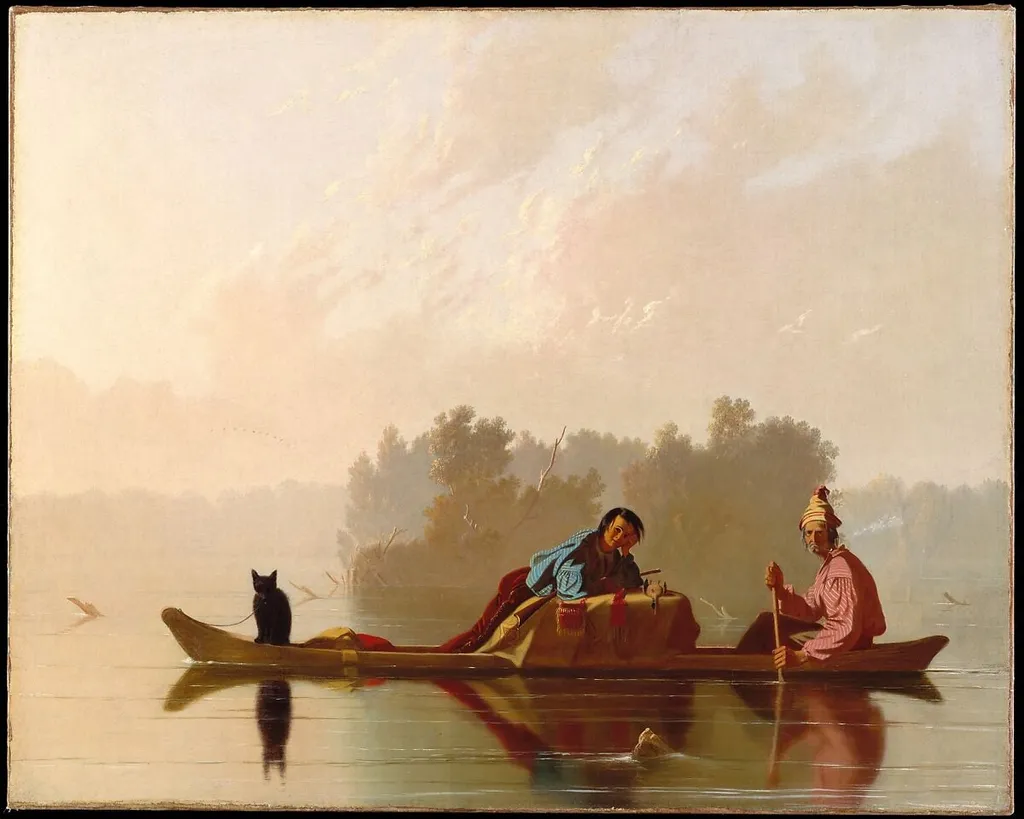
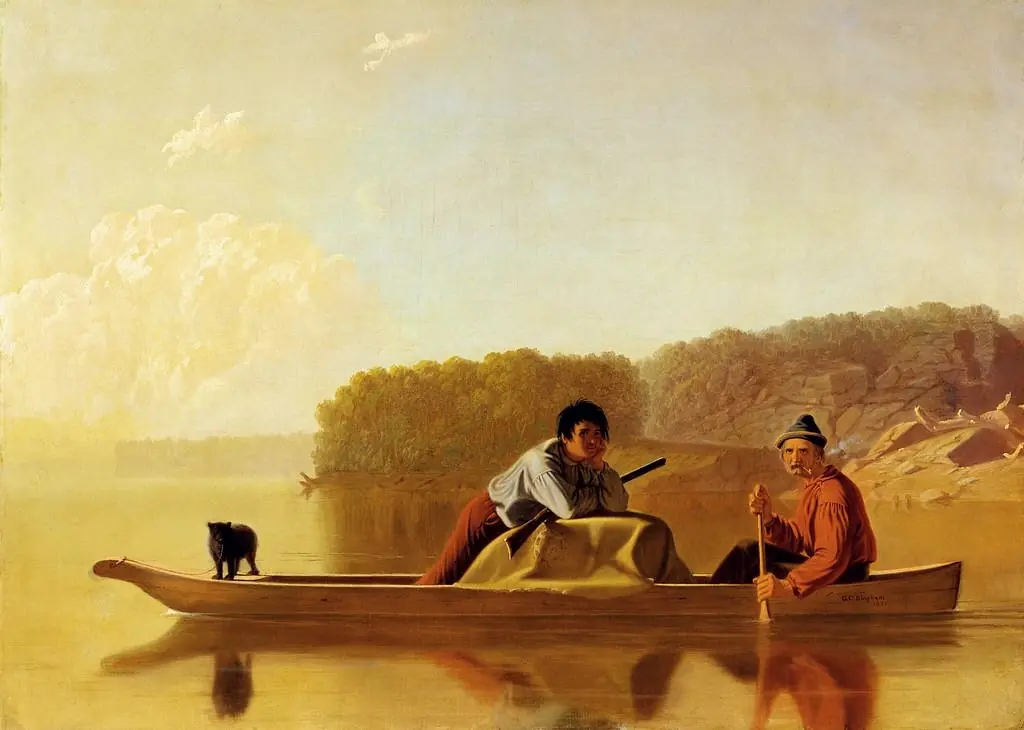
Fur Traders Descending the Missouri is an oil painting by the Realist artist George Caleb Bingham. It dates from 1845 and is held in the collection of the Metropolitan Museum of Art.
About this work
A dead duck rests atop a pile of furs in a dugout canoe gliding down the Missouri River, where a French trader steers while his half-Native American son lounges with a rifle. George Caleb Bingham brought this canvas back to St. Louis in the summer of 1845 after a winter in central Missouri, then sent it to New York's American Art-Union, which renamed it from "French Trader & Half breed Son" to the more neutral title it carries today at the Metropolitan Museum of Art.
Subject & Meaning
Fur Traders Descending the Missouri depicts a tranquil scene on the Missouri River, showing a small boat carrying a fur trader, a man, and a cat, with the river and its banks forming the setting [,]. Painted by George Caleb Bingham in 1845, it is a genre painting that chronicles America's westward expansion and frontier river life before the steamboat era []. Bingham's work is distinguished among the first generation of painters of the early American West for classic narrative scenes drawn from observation and experience, and this painting is described as containing a colorful cast of characters imbued with layers of symbolism and socio-political commentary [].
While the sources confirm the presence of the fur trader, the boat, the cat, and the river as the depicted elements, the specific symbolic meanings attached to each figure and object are not detailed in the provided material beyond the general characterization of the work as layered with symbolism and commentary on the commerce and social relations of the American frontier [].
Technique & Style
The work is also linked stylistically to luminism, the Hudson River School, and French Realism, movements that shaped his approach to landscape and narrative.
Fur Traders Descending the Missouri is executed in oil paint on canvas, a standard support for mid-19th-century American easel painting. The canvas measures approximately 73.7 cm in height by 92.7 cm in width, a horizontal format suited to the riverine subject. Bingham's handling is associated with the style of genre painting, in which he rendered scenes of life along the Mississippi and Missouri rivers drawn from direct observation and experience.
The work is also linked stylistically to luminism, the Hudson River School, and French Realism, movements that shaped his approach to landscape and narrative. Bingham's technique is noted for strong draftsmanship and a native ability to capture likeness, qualities that carried over from his portrait practice into this genre composition. The painting is held in the collection of the Metropolitan Museum of Art, classified within The American Wing.
History & Provenance
Fur Traders Descending the Missouri (1845) is held by the Metropolitan Museum of Art in New York, classified within The American Wing. The painting is catalogued in the George Caleb Bingham Catalogue Raisonné, a public-access electronic resource launched in 2018 that builds on the scholarship of E. Maurice Bloch, whose 1986 printed catalogue raisonné, The Paintings of George Caleb Bingham, first compiled Bingham's known works. While Bingham's oeuvre is distributed across numerous major American collections, including the National Gallery of Art, the Amon Carter Museum of American Art, and the Saint Louis Art Museum, this particular canvas remains in the Metropolitan's holdings.
The sources provided do not specify a discrete accession number or a detailed chronology of exhibitions for the work.
Context
George Caleb Bingham (1811–1879), known in his lifetime as "the Missouri artist," is recognized as one of the most important American painters of the 19th century and is distinguished among the first generation of artists of the early American West. His genre paintings chronicle America's westward expansion and depict life along the Mississippi and Missouri rivers, capturing frontier commerce, leisure, and river life before the steamboat era. Fur Traders Descending the Missouri (1845) is among his most renowned works, imbued with symbolism and socio-political commentary, and is associated with the movements of luminism, the Hudson River School, and French Realism.
Bingham's oeuvre is held by major institutions including the National Gallery of Art, the Metropolitan Museum of Art, the Saint Louis Art Museum, and the White House. Scholarly study of his work was advanced by 20th-century art historian E. Maurice Bloch, whose 1986 catalogue raisonné was expanded into a public-access electronic catalogue launched in 2018.
Legacy
Fur Traders Descending the Missouri stands as the most renowned work by George Caleb Bingham and a defining image of nineteenth-century American frontier art. Bingham is recognized as one of the most important American artists of that era and is distinguished among the first generation of painters of the early American West for classic narrative scenes drawn from observation and experience. The painting is held today in the Metropolitan Museum of Art and is cited as a celebrated example of his genre painting, imbued with layers of symbolism and socio-political commentary.
Bingham's broader body of work, of which this canvas is the touchstone, is regarded as comprising national treasures and is valued as vivid historical records of the politics, commerce, and social relations of the American frontier. His paintings are preserved in major public collections including the National Gallery of Art, the White House, and other prominent institutions across the United States.
Overview
George Caleb Bingham's Fur Traders Descending the Missouri is a significant work from the mid-19th century, capturing a moment of frontier life. Bingham, known as "the Missouri artist," was a prominent figure among the early painters depicting the American West. This oil on canvas exemplifies his approach to narrative scenes, drawing from his direct observations and experiences along the Missouri River. The painting offers a glimpse into the interactions and activities that characterized the region during this period.
Artist & collection

Artist
George Caleb Bingham (March 20, 1811 – July 7, 1879) is recognized as one of the most important American artists of the 19th century.

 The Trappers' Return
 Duck Shooters
 A Halt on the Prairie for a Smoke
 Midday Rest
 Indians Playing Cards
 Indian Surveying a Landscape
 Encampment of Pawnee Indians at Sunset
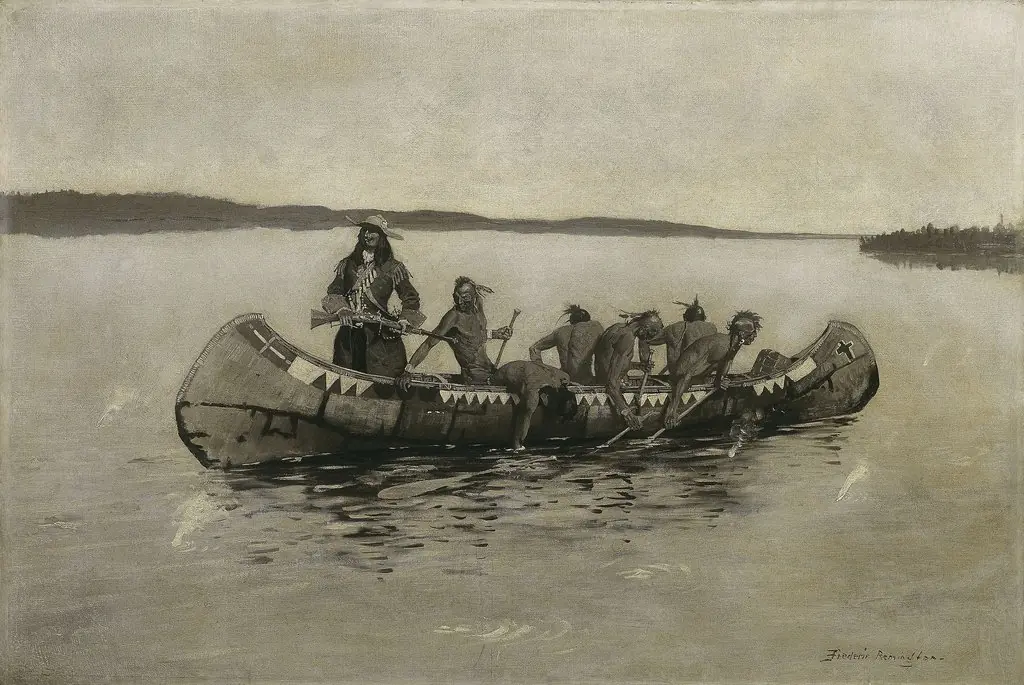 This Was a Fatal Embarkation
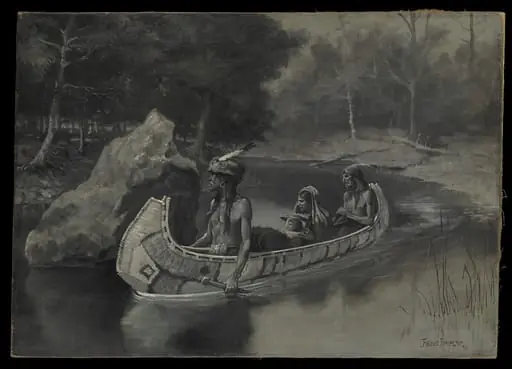 Pitched It Sheer into the River . . . Where It Still Is Seen in the Summer
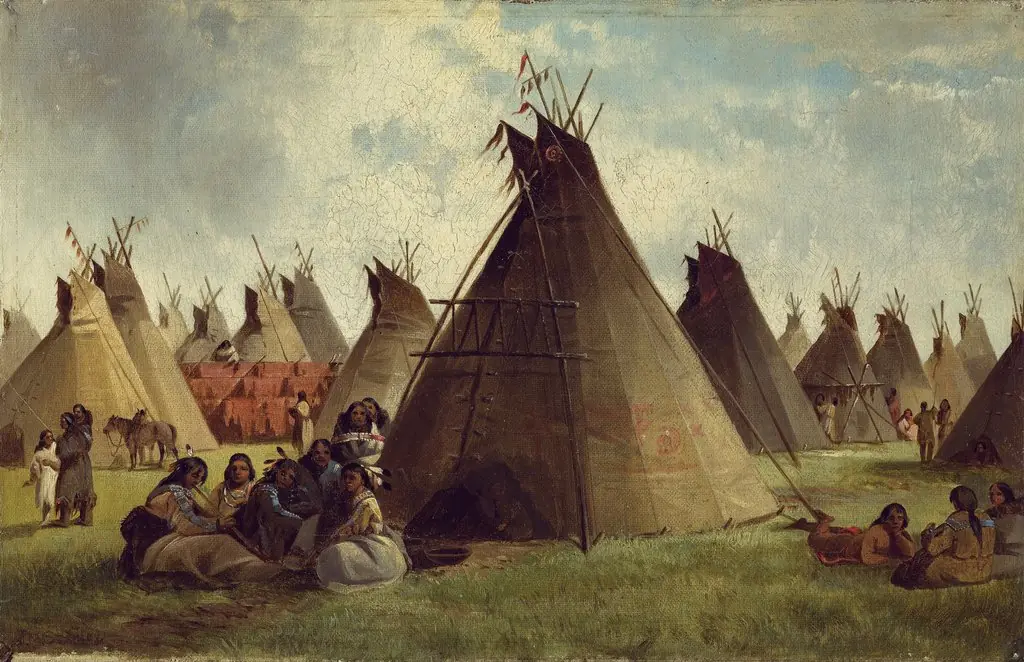 Prairie Indian Encampment
- Assiniboin Encampment on the Upper Missouri