Artwork
The Jolly Flatboatmen
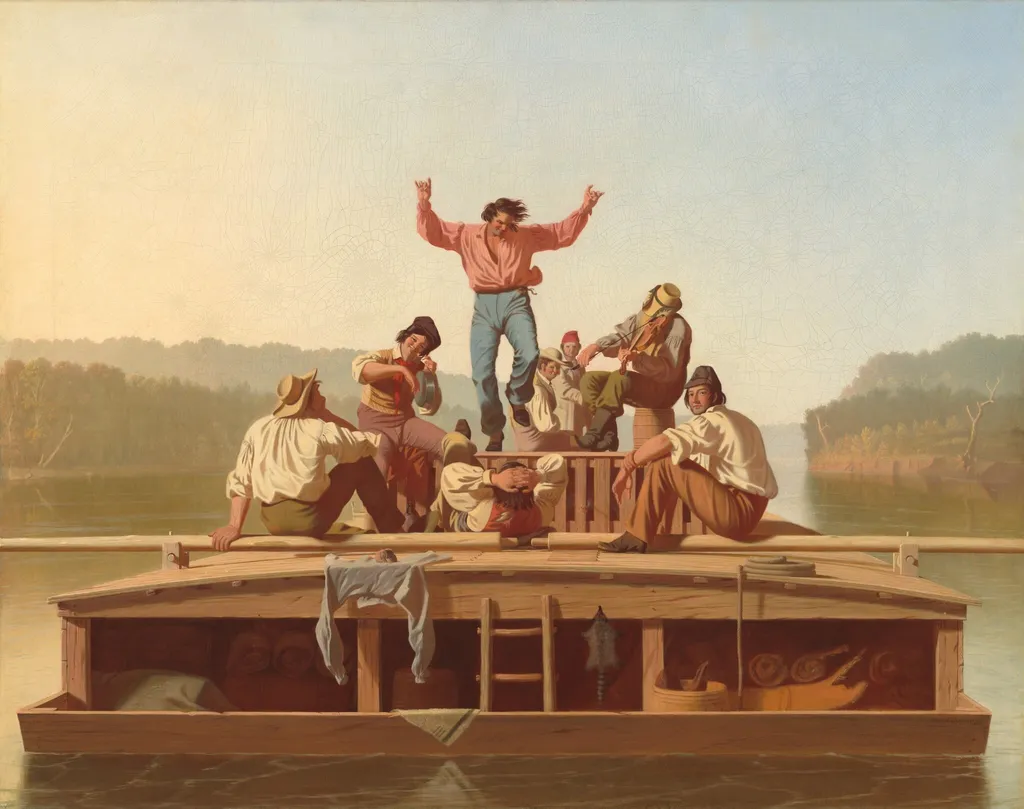
The Jolly Flatboatmen is an oil painting by the Hudson River School artist George Caleb Bingham. It dates from 1846 and is held in the collection of the National Gallery of Art.
- Inscription
- Inscribed:lower right on boat: G. C. Bingham
About this work
Technique & Style
The Jolly Flatboatmen is an oil on canvas painting, executed in 1846 by George Caleb Bingham.
The Jolly Flatboatmen is an oil on canvas painting, executed in 1846 by George Caleb Bingham. The work measures 96.8 by 123.2 centimeters and is classified as a genre painting. Its early history indicates it was submitted by the artist for sale to the American Art-Union in New York, recommended for purchase in October 1846 under the title Dance on the Flat boat, and selected to be reproduced as a mezzotint engraving, a process that required the canvas to be transferred to an engraver in December 1846 and likely returned in spring 1848.
The painting is now held in the collection of the National Gallery of Art in Washington, D.C. The sources do not provide further detail on Bingham's specific brushwork, palette, handling, surface condition, or stylistic qualities beyond the medium, dimensions, and genre classification.
History & Provenance
George Caleb Bingham created the oil-on-canvas painting in 1846. He submitted the work to the American Art-Union in New York, where the executive committee initially recommended its purchase on October 9, 1846, under the title Dance on the Flat boat. The committee officially renamed the piece The Jolly Flatboatman on December 6, 1846, and turned it over to an engraver on December 7 for a mezzotint reproduction.
Following approved payment on February 1, 1847, the painting was awarded at the Union's annual meeting on December 24, 1847, to Benjamin van Schaick, a New York grocer.
The work later entered the collection of Herbert Claiborne Pell, Jr., and subsequently passed to his son, Claiborne Pell, before being held by the Pell Family Trust. Richard A. Manoogian of Detroit purchased the painting in 1986, after which it was held by the Richard and Jane Manoogian Foundation in Taylor, Michigan. The National Gallery of Art in Washington, D.C., acquired the painting on April 8, 2015.
Context
The Jolly Flatboatmen entered public view in late 1846 through the American Art-Union, where its favorable reception led to an engraving that amplified Bingham’s reputation. Contemporary commentary highlighted the painting’s lively depiction of river workers, reinforcing the artist’s role in popularizing genre scenes of American frontier and river life. Scholars have linked the work to Bingham’s broader exploration of American life and commerce, noting its technical vigor and narrative clarity as exemplars of mid-nineteenth-century genre painting.
After passing through several private collections, the canvas entered the National Gallery of Art in 2015, where it is studied as a key example of early American genre painting.
Legacy
The Jolly Flatboatmen gained lasting influence through its widely circulated mezzotint engraving, which helped disseminate Bingham’s river-scene imagery throughout the mid-nineteenth-century art market. John Francis McDermott’s 1958 article notes that the work inspired a number of imitators, underscoring its role in shaping American genre painting. After changing hands through several private collections, the painting entered the National Gallery of Art in 2015, securing its place in a major public institution and affirming its reputation as a quintessential example of Bingham’s frontier narratives.
Overview
George Caleb Bingham's 1846 oil on canvas, "The Jolly Flatboatmen," depicts a scene of daily life on an American river. It captures a group of men aboard a flatboat, engaged in various activities, under a clear sky. This work exemplifies the artist's focus on the American frontier and its inhabitants, offering a glimpse into the informal culture of river travel during the period.
Subject & Meaning
The painting portrays several men aboard a flatboat navigating a river. One figure stands prominently with arms raised, while others relax, some playing a fiddle, suggesting leisure amidst their journey. Dressed in informal attire, they occupy a vessel featuring a covered storage area.
The background shows a tranquil landscape of trees beneath an open sky, emphasizing the natural environment and the freedom of river life.
Own this work as a print
Artist & collection

Artist
George Caleb Bingham (March 20, 1811 – July 7, 1879) is recognized as one of the most important American artists of the 19th century.